





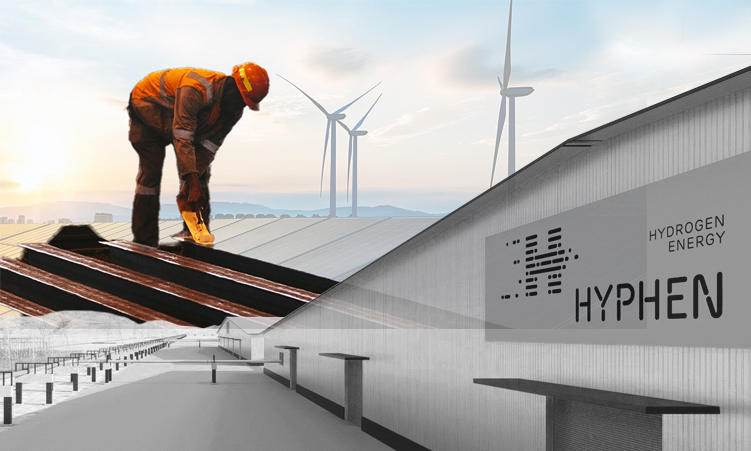
The government’s 24% stake in Hyphen Hydrogen Energy’s N$180-billion hydrogen project has raised concerns over financial risk, transparency, and long-term economic impact.
Hyphen recently awarded China National Chemical Engineering & Construction Corporation Seven (CC7) a contract to construct it flagship green ammonia plant in Namibia.
Concerns have, however, been raised since the project has not passed several research tests.
The Namibian understands that Hyphen has not yet completed its environmental and social impact assessment study, which was set to commence at the start of the year.
DEBT WORRIES
Swanu of Namibia president Evilastus Kaaronda has expressed concern over Namibia’s 24% stake, saying should Hyphen source the N$180-billion loan and fail to repay it, it could have ripple effect on Namibia’s economy – especially given government debt-to-GDP of 64%.
“This would increase the debt per gross domestic product (GDP) ratio, and that already is a problem in itself. That would also mean money that would otherwise be allocated to social services or sectors would be redirected to finance the debts,” he says.
Kaaronda says this does not only include the provision of medicine, which has been reported to be out of stock countrywide, but also job recruitment and social grants, which the government is already struggling to address.
The lawmaker says the Euro bond, which is expected to reach maturity
(at N$9.5 billion) in October, as announced by the Ministry of Finance, will also be affected.
The Eurobond was issued in 2015.
The government has since built a US$463 million (almost N$7 billion) sinking fund and plans to add N$3 billion (about US$160 million) this year.
However, a funding gap of US$125 to US$150 million (about N$2.2 to N$2.6 billion) remains.
“Already as it is, we are in that financial squeeze which will heavily impact the economy,” Kaaronda says.
In 2024/25, borrowing needs increased to N$15.3 billion, with N$12.8 billion, nearly 84%, raised on the domestic market, a Simonis Storm report indicates.
For 2025/26, domestic borrowing is expected to reach N$21.2 billion, the highest on record.
Kaaronda says there is, however, no reason to assume the 24% stake will not materialise, but questions how the 24% was arrived at and why a better deal was not done.
WARNING
Last year, economist Rowland Brown warned against the public borrowing or the use of taxpayer subsidies to fund green hydrogen initiatives.
“We further note that Namibians should hope that the hydrogen hype delivers. However, using Namibian public funds for this is nothing short of reckless, especially given the ample other, very real, demands on the public purse.
“Using Namibian taxpayer funds, whether from the revenue of today or through borrowing from the future, should be an absolute red line,” Brown said at the time.
The Namibia Green Hydrogen (GH2) programme maintains that the government is shielded from liability for any future loans the investor may take, however, its investment could be exposed.
GH2 spokesperson Jona Musheko says the government will make no further investment in the project.
“That will be on their bank balance sheet. There is no contractual linkage. That is in their private capacity as investors. Remember, this thing is like a bid or a tender. When you get a tender, you must get money to finance that job,” he says.
Musheko says the government was, however, compelled to make the investment to avoid missing out on natural resources should the project prove to be a success.
“The only difference is that because this is a big national project that we wanted to participate in, we also then bought shares, so that if it succeeds, we don’t just then see people harvesting and we are not anywhere,” he says.
“We already paid for our shares, our 24%. We already brought our shares to the table. Whatever they need to do would be their input.”
Musheko says the government would not be exposed to financial risk through its 24% stake in Hyphen “in terms of loans and facilities”.
RED FLAGS
Civil society has over the years raised red flags about the green hydrogen project, which has been steamrolled by the Presidency.
Critics have accused Hyphen of refusing to provide information to the public, including the blunt refusal to make public all information – also to lawmakers.
Swapo secretary general Sophia Shaningwa has in the past told then-Swapo parliamentarian Tjekero Tweya to “shut up” as he has allegedly been “talking too much”.
Tweya, as the chair of the parliamentary standing committee on natural resources, made his and other lawmakers’ displeasure known after James Mnyupe, former president Hage Geingob’s hydrogen team leader, avoided appearing in person to explain the green hydrogen scheme to parliamentarians.
Mnyupe and his team are accused of “strategically” releasing bits of information about the ambitious project touted at more than N$200 billion.
National Development Party president Martin Lukato says with the struggling economy, the impact will be felt by many Namibians, meaning the government would have to not only find ways to pay off existing debts, but also try to provide social services to vulnerable people.
‘NEOCOLONIALISM’
Economist Omu Kakujaha-Matundu has in the past raised strong reservations about the project’s arrangement, arguing that the current arrangement perpetuates a neocolonial dynamic, where developing countries’ governments are reduced to beggars in their own resource-rich nations.
“Resources should belong to the state and the investors should be the ones negotiating the shares with the government, but in this neocolonial setting developing countries’ governments become the beggars,” he says.
He says desperation to attract foreign direct investment leads African leaders to open themselves up to potential abuse.