



The Ministry of Education, Arts and Culture provides N$15 per girl per year for sanitary pads.
This was revealed in defence of deputy education minister Faustina Caley’s objection last week to a bill proposing free access to sanitary products for schoolgirls in Namibia.
The ministry said the current Basic Education Act already provides for these products.
In a statement issued on Friday, the ministry said the school grant policy has increased funding for health and hygiene needs, including sanitary products and toiletries, to N$15 per learner.
This is in addition to the education grant for the 2024/25 financial year.
“The total allocation towards health and hygiene will thus increase to N$12 261 420 annually for the 817 428 pupils enrolled in schools currently,” the statement reads.
On average, a pack of eight sanitary pads costs N$25.
A 2021 report, titled ‘Comprehensive Assessment of Menstrual Health and Hygiene Management Knowledge, Attitudes, Practices on Adolescent Girls in Namibia’, has revealed that most girls prefer and use disposable pads, but one in four girls cannot afford these items.
The report states that only one in 10 girls use reusable pads, and that 4,2% of girls do not attend school while menstruating.
The report also revealed that only half of schools in Namibia have access to toilet paper, and that soap is in short supply.
The ministry says schools are directed to allocate N$5 per child for a dignity project, which involves catering for items such as sanitary pads.
“The guidelines also provide for the sustainability of the provision of health and hygiene products, in the sense that the school will provide a maximum start-up amount of N$2 000 and N$3 000 for primary and secondary schools, respectively, for starting an income-generating project to buy sanitary pads and other essential toiletries for pupils in need,” the statement reads.
Caley received much backlash for objecting to the private member’s bill.
Official opposition leader McHenry Venaani recently tabled the bill in the National Assembly to “regulate the provision of free sanitary materials to schoolgirls in need in Namibia”.
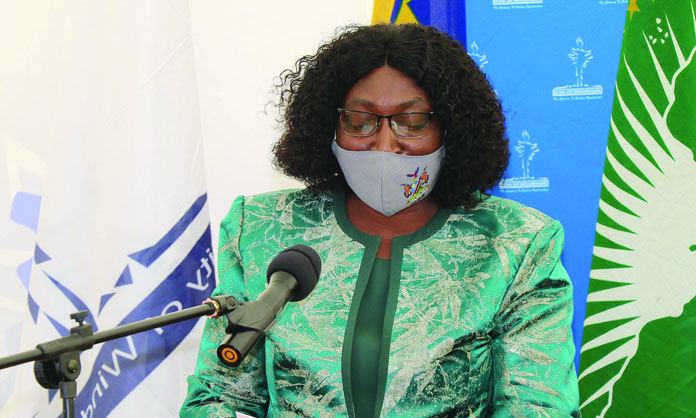
Caley last week in statement motivated her objection, saying the integrated school health policy already outlines the distribution of sanitary pads.
“We have appointed life skills teachers at all schools to identify pupils who are vulnerable, and in need of sanitary materials.
“The grant policy, which allows for equitable allocation of grants to schools on the basis of their socio-economic status, also addresses the allocation of sanitary pads and other materials to our pupils,” she said.
Venaani said: “It is a shame what Swapo did today.”
He insisted that an act that forces the government to implement it should be granted through the parliament.
“When the act is not explicit, you create a law specifically that warrants government action. They are not acting, that power is left with the ministers relocating,” he said.
Venaani said having such a law in place would leave the government no choice but to implement it.
“Because for the last 10 years they have not been doing it,” he said.
Last year, executive director of education, arts and culture Sanet Steenkamp said dispensers are not a straightforward matter, neither is issuing directives.
She said it’s about what is feasible.
“Of course, we do take the issue of sanitary pads/towels provision to schools very seriously. Years ago we looked into all the possibilities,” Steenkamp said.
“At this stage, we would rather concentrate on the accessibility of good quality sanitary products,” she said.
In an age of information overload, Sunrise is The Namibian’s morning briefing, delivered at 6h00 from Monday to Friday. It offers a curated rundown of the most important stories from the past 24 hours – occasionally with a light, witty touch. It’s an essential way to stay informed. Subscribe and join our newsletter community.

The Namibian uses AI tools to assist with improved quality, accuracy and efficiency, while maintaining editorial oversight and journalistic integrity.
Stay informed with The Namibian – your source for credible journalism. Get in-depth reporting and opinions for
only N$85 a month. Invest in journalism, invest in democracy –
Subscribe Now!