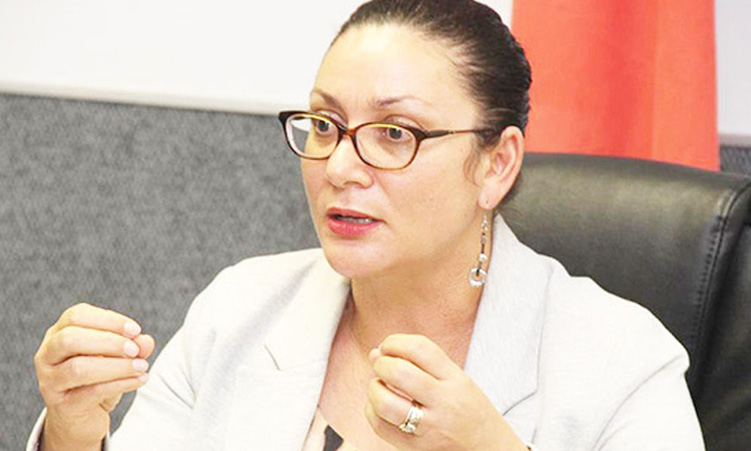
CHARLOTTE Nangolo (CN) is a mining and engineering professional who is calling on the youth not to wait for investments, but to get involved.
Shante Mahalie (SM) recently chatted to the Australia-based Nangolo, who is currently the chief executive officer (CEO) of Thorium Network, about her career.
Nangolo’s main message is the following: “We can say we do not have money, but until we take the initiative and show our commitment to the things we want to achieve, no one is going to rescue us.”
SM: Who is Charlotte Nangolo?
CN: I’m from northern Namibia, and was born at a village 30 km from the Angolan border. I attended Oshigambo High School, a private missionary school, where my interest in science was born.
SM: Tell us how your career started.
CN: Leaving high school, I did two years at the University of Namibia (Unam), majoring in geology and physics, before I got the opportunity to go and study mining engineering at the University of the Witwatersrand (Wits) in South Africa.
Upon graduating, I started off as a graduate mining engineer at Navachab Gold Mine at Karibib under AngloGold Ashanti.
There I spent three years learning the basics of the mining engineering trade before a job opportunity at Rio Tinto in Australia became available.
SM: Tell us about your past experiences, and how they link to your current job and CEO position?
CN: After two years, I left Australia to pursue a master’s degree in mineral economics at Wits.
My career plan has been to be able to combine the technical and financial aspects of mining. I have always believed the combination of these two would take me far, and I genuinely had a passion for both.
Prior to heading back to university to do my master’s, I had a break of six months during which I got an opportunity to serve as a mining research analyst with the IJG Group (a stockbroking firm) in Windhoek, covering uranium as a commodity, and exploration companies in the uranium space. This was prior to the Fukushima fiasco.
This role, albeit short, gave me insight into the world of the financial markets, and how to use my technical mining skills in that space.
While studying, I was privileged enough to lecture undergraduate financial modelling for mining projects, as well as a postgraduate course in mineral resource management with Wits’ School of Mining.
Upon completing my postgraduate studies, I got a job in Perth, in Australia – this time in a mining consulting space.
This was my introduction to the world of mining consulting.
SM: Tell us more about your role at CSA Global and the Swiss Thorium Network.
CN: CSA Global is a global firm focusing on geology, mining, and management consulting. We provide strategic mining services and advice to mining companies and mining investors. At Thorium Network I am the CEO of the Liechtenstein Fund.
The Liechtenstein Fund is a fund of one billion euros, which is regulated by the jurisdiction of Liechtenstein, and is open to accredited investors in Europe only.
As CEO I am supported by an advisory board, consisting of six members, and a technical executive team of experts in geology, nuclear energy, and digital assets within the Thorium Network family.
SM: How would you encourage young people in Namibia who are currently in this career field or aspire to study mining engineering?
CN: Be hungry and be available. Be intentional about what you want to achieve, and make sure to plan and follow through.
Sometimes things may be delayed or change, but you need to be flexible as well.
I was fortunate enough to study mining and engineering in South Africa, and most of the South African mining engineering programmes are internationally accredited.
That’s why I was able to get a job in Australia, but unfortunately the mining and engineering programmes at Namibian institutions are not internationally accredited.
The accreditation of these mining programmes is key to enabling students and graduates to go out into the world.
But until that is done, the geographical locations where they can work are really limited.
The world is hungry out there. For example, in Australia there is a shortage of mining engineers, and they need people from South Africa, India, and China, for example.
In an age of information overload, Sunrise is The Namibian’s morning briefing, delivered at 6h00 from Monday to Friday. It offers a curated rundown of the most important stories from the past 24 hours – occasionally with a light, witty touch. It’s an essential way to stay informed. Subscribe and join our newsletter community.

The Namibian uses AI tools to assist with improved quality, accuracy and efficiency, while maintaining editorial oversight and journalistic integrity.
Stay informed with The Namibian – your source for credible journalism. Get in-depth reporting and opinions for
only N$85 a month. Invest in journalism, invest in democracy –
Subscribe Now!