



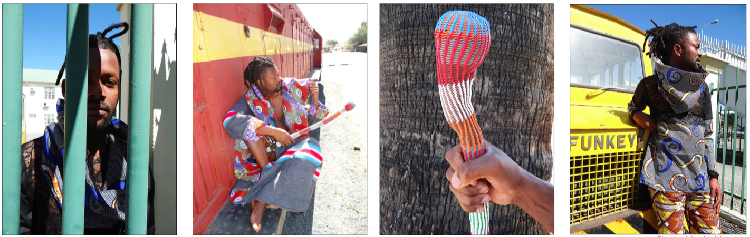
To begin, there is the burning of the elephant dung.
A ritual to invite the invisible world in. To honour the ancestors who Nashilongweshipwe Mushaandja credits with the coming of the music. The sweet ongovela (melody) that recurs in the performance artist, academic and curator’s head along with the yearning to be close to the fire.
Mushaandja calls the 10 tracks that his ancestors have musically inspired ‘Trance !Namib Freedom Station’. An album by the Tschuku Tschukus (an inclusive name for Mushaandja and his collaborators) that begins with the sound of a train and surges on as a medley of chants, melody and Spoken Word in a rousing ode to migrants. Those who have seen the world out of necessity or yearning and those who travel as bodies or simply as souls.
Featuring a luminous Sam Batola, Nesindano Namises, Kgafela oa Magogodi, Sebastian Vries, Chris Eiseb, Tendai Dandera, Nayasha Kirsten, Ponti Dikuua, Shali Malua, Imms Nicolau, Jean Pierre Ntsika, Sithulele Shabangu, Ngwenya Bhekizizwe, Bafana Ndhlovu and cover art by Nambowa Malua with each under the direction of Mushaandja, the album is an archive and a display of activism drawing its influences from resistance jazz, folk, shambo and urban jive.
“’Tschuku’, the first track, says let the child go and see the world and come back home,” says Mushaandja who was born at Oshigambo in the Oshikoto region in 1987, a year he believes is momentous as artists such as Muafangejo, Dambudzo Marechera, Thomas Sankara and James Baldwin died.
Singing of Independence Avenue, fallen heroes Nanghili Nashima and Chiwoniso, progress, defeating the odds as well as the disruption of patriarchy by the youth in songs like ‘Rebel Chile’, Mushaandja’s album, sang largely in Oshiwambo with a traditional Rukwangali song enhanced by a land and love prayer in Oshindonga and Shona, is one in which music transcends language.
“Music is a language everyone can understand. It is beyond the spoken/verbal word. Think about how the music makes you feel and that is all that matters,” says Mushaandja.
“Writing and performing music in Oshiwambo is how I keep in touch with my heritage. It is how I learn about the ever changing culture. More so, writing songs in my mother tongue and other African language comes easier than writing in English.”
Presenting ‘Namib Sunset’, a queer love song; ‘Uyelele’, a record about light and why we need more of it in the world and “we will be free” as a reminder to those who have always been displaced, erased and misrepresented that they will be free someday, Mushaandja’s album is at once introspective, joyful and inciting while what’s in the name is an amalgamation of feeling, place, history and theme.
“This is music that transports one through a meditative vibe. It is largely inspired by the land of wide open spaces and its infinite knowledge. It is also a story of liberation. A cry for emancipation of the body fighting a struggle at an intersection,” says Mushaandja, whose theme of migration is inspired by his forefathers.
“I am a migrant. I have always been one. Always packing and unpacking. Most importantly, I come from a lineage of migrants. Parents and grandparents who were migrant contract labourers, family members who went into exile.”
Inspired by the common threads and sounds of southern African songs of migration, Mushaandja presents ‘Trance !Namib Freedom Station’, live recorded at the Warehouse Theatre in September 2016 with additional tracks by album producer Dikuua, as an intimate and autobiographic exploration of memory and voice four years in the making.
One that helped him across many borders.
“I have a passion for cultural imaginations and I’m committed to mapping my progressive ancestral archives and footsteps. My people have suffered erasure for many centuries,” says Mushaandja who sings of what his body remembers and the things he wants to keep close while inspiring new imaginations and serving as a piece of memory of our collective journey.
Keenly in touch with language, culture and aware of the totems, the snake on his mother’s side and the hyena from his father, that allow him to access his power, Mushaandja believes it is not enough to simply be aware of one’s roots.
“There are people who know language and culture but they are violent, patriarchal and sexist,” he says.
“Language and culture are always changing because of place, body and time. As long as we are dedicated to tracing ancient knowledge and reflecting on how it is applicable today, we will keep moving to a place of love and revolution. The revolution is urgent and it is unapologetic. It’s not just about knowing language and culture; it is also what we do with them.”
Currently attending Chale Wote, a street art festival in Ghana, and eager to introduce ‘Trance !Namib Freedom Station’ to listening souls in Switzerland for three months and Germany for two months as part of a series of residencies, research and performances in 2018, Mushaandja continues to shed his particular hue of light on the live and the lingering.
Launched at the Franco-Namibian Cultural Centre on 4 August following his ‘Black Bantu Child’ EP published in 2012, the soulful, riveting tunes of ‘Trance !Namib Freedom Station’, like Mushaandja’s forebearers, currently beckons, crests and calls.
“The music comes from them,” he says.
“I hear it in my body before I even pen it. If I remember a song from my kindergarten days under a huge tree in the North, then I know that it is them.”
In an age of information overload, Sunrise is The Namibian’s morning briefing, delivered at 6h00 from Monday to Friday. It offers a curated rundown of the most important stories from the past 24 hours – occasionally with a light, witty touch. It’s an essential way to stay informed. Subscribe and join our newsletter community.

The Namibian uses AI tools to assist with improved quality, accuracy and efficiency, while maintaining editorial oversight and journalistic integrity.
Stay informed with The Namibian – your source for credible journalism. Get in-depth reporting and opinions for
only N$85 a month. Invest in journalism, invest in democracy –
Subscribe Now!