



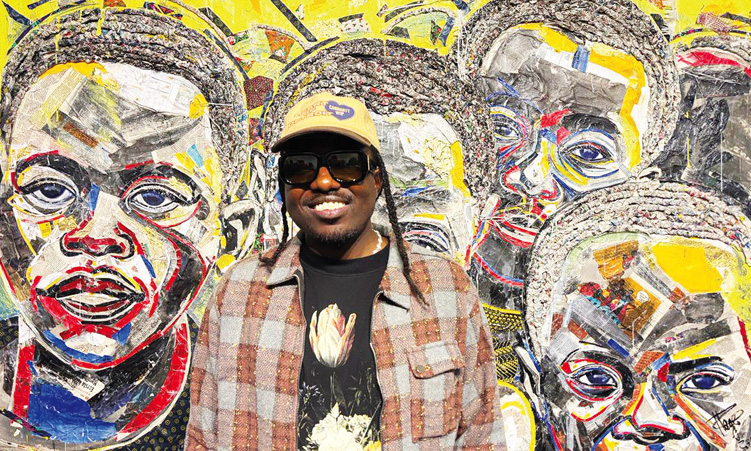
Hage Mukwendje is the kind of visual artist whose art opening feels like a celebrity meet-and-greet.
It’s the beginning of October and ‘Faces that Refuse to Fade’, Mukwendje’s first solo exhibition at the National Art Gallery of Namibia (NAGN), adorns the walls and the place is full to bursting.
People dress up. They embrace Mukwendje excitedly.
They sip wine, socialise loudly and pose in front of his expressive, mixed-media faces before uploading the experience to social media, making sure to tag him.
Days later, the imagery and opening are still trending.
Such sustained excitement makes for a refreshing change in Namibia’s often sedate visual art scene.
And Mukwendje is thrilled by the response.
“I’m the biggest fan of my supporters because they support me.
They made me who I am and without that love, I wouldn’t be where I am today,” says Mukwendje.
“When I get such a reaction, it motivates me to push harder and stay consistent,” he adds.
“This art is not just my art. I’m inspired by people, so it’s not just about me. It’s about everyone.”
That belief – that his art is for the people – is seen throughout Mukwendje’s canvases.
For local audiences, the work carries a sense of familiarity.
The children peering out or playing spark nostalgia.
Mukwendje’s powerful, traditionally dressed women, a boy with a goat slung over his shoulders and smiling elders are all recognisable figures.
“The faces that refuse to fade are a meditation on presence. They’re an act of remembrance – of collective memories, of our ancestors, the past and the present,” says Mukwendje.
“If you look at the wall, there’s a young boy carrying a goat. That’s one of my moments.
Every boy from the village will see the joy of looking after animals and how we used to play around,” he says.
In ‘This Face Holds Generations’, depicting a smiling girl surrounded by butterflies, Mukwendje speaks to legacy, family, motherhood and continuity.
The insects – bees, dragonflies and butterflies – recall his childhood at Okalongo in northern Namibia.
“For us, growing up, these were like live flowers. We played with dragonflies a lot. We wanted to catch them.
We wanted to be one, you know?” he says. “For me, these insects are moving flowers.”
While his images captivate with their soulful eyes and layered textures, they’re also remarkable in scale.
A mural stretches across the gallery wall, while colourful canvases made of discarded plastic bottles, newspapers and found electrical fans tower over viewers who marvel at their construction.
At the centre is Mukwendje’s pièce de résistance – a fragmented portrait of president Netumbo Nandi-Ndaitwah.
The artwork shifts as the viewer moves, delighting patrons who try to capture the illusion on their phones.
“My grandmother was my mother and father at the same time.
Many of us come from this background. Through the women in my artworks, I wanted to show how powerful a woman figure can be,” says Mukwendje.
“Having been raised by a grandmother, having a female president has always been a dream.
I wanted to make the president’s portrait the centre of attraction – it’s special to have a female president.”
While he admires Nandi-Ndaitwah, Mukwendje is also celebrated by his growing legion of youthful fans.
“I get a lot of messages from young artists asking about prices and how many pieces I sold,” he says.
“First of all, it’s not about selling. Of course, I want to live.
But when you do art only for money, you won’t go anywhere,” he says.
“Being dependent on others or galleries can be challenging.
Sometimes, you need to go out there and do things your own way to be recognised.”
Mukwendje says he never imagined selling a painting for N$2 000 when he started.
Today, the College of the Arts alumnus sustainably sources much of his material from local dump sites, turning “trash into treasure”.
He has since sold artworks for 10 times as much and exhibited around the world.
“I even invited the security guards at the Eros dump yard to the exhibition.
Unfortunately, I didn’t see them,” he says. “I wanted them to see what I do with all the trash because when they look at me, they think I’m mad!”
Looking ahead, Mukwendje mentions upcoming shows in Finland and Italy next year – and an unexpected venture into fashion.
“Since I was young, I either wanted to be an architect or a fashion designer.
I’m crazy about fashion,” he says. “I have a brand that I’ve been working on for a long time and it’s coming soon.”
Meanwhile, Mukwendje remains humble.
“Everywhere in the world, it’s not easy to live as an artist. When my art started being recognised, I didn’t know how long it would last, but now I live for it,” he says.
“With art, it’s a story after a story. It’s like a Netflix series. There’s a lot of exploration still to do, but I’ll continue representing my people.
“I don’t know what the future holds, but I’ll keep it going.”
‘Faces that Refuse to Fade’ is on display at the NAGN until 1 November.
– martha@namibian.com.na; Martha Mukaiwa on Twitter and Instagram; marthamukaiwa.com
In an age of information overload, Sunrise is The Namibian’s morning briefing, delivered at 6h00 from Monday to Friday. It offers a curated rundown of the most important stories from the past 24 hours – occasionally with a light, witty touch. It’s an essential way to stay informed. Subscribe and join our newsletter community.

The Namibian uses AI tools to assist with improved quality, accuracy and efficiency, while maintaining editorial oversight and journalistic integrity.
Stay informed with The Namibian – your source for credible journalism. Get in-depth reporting and opinions for
only N$85 a month. Invest in journalism, invest in democracy –
Subscribe Now!