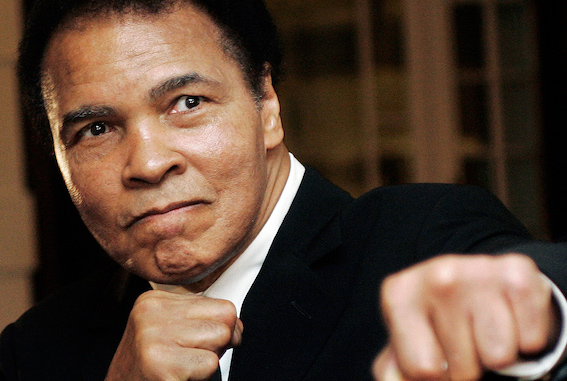
PARIS — One of Muhammad Ali’s greatest battles was not in the ring but against Parkinson’s disease, which severely hampered his speech and motor skills in the last three decades of his life.
For many specialists, the crippling neurological disorder was no accident, but the tragic result of Ali’s years as a boxer.
Ali was diagnosed with Parkinson’s in 1984 at the age of 42, three years after he retired with 61 professional bouts under his belt.
At the time, experts spoke of ‘dementia pugilistica’ or ‘punchdrunk syndrome’ to describe brain damage seen in sports people who sustain multiple concussions over the course of their careers.
“We cannot say anything decisively, but there are strong suspicions,” Andre Monroche, head of the medical commission of the French contact sports federation, told AFP.
“We know now that repeated blows alter the nerve cells, especially in a brain that has not been rested,” he said.
JeanFrancois Chermann, a neurologist at Leopold Bellan Hospital in Paris, is categorical.
In a 2010 book on the impact of knockouts, Chermann wrote that Ali, “at the end of his training sessions, let down his guard and asked his sparring partner to give him blows to the head to show he was the strongest.”
“There is a link between his current illness and that kind of practice,” Chermann wrote.
Medical studies have long warned about the consequences from boxing and other sports where the head receives frequent impacts.
A 2008 study by the University of Heidelberg in Germany scanned the brains of 42 boxers and 37 nonboxers.
In three of the boxers, they found ‘microhaemorrhages’ in the brain – the likely result of the sharp impact of blows in the ring that damage soft, swirling cerebral tissue.
“These changes are most likely precursors for later severe brain damage such as Parkinson’s disease or dementia,” the authors said.
In 2013, a probe published in the journal Scientific Reports found ‘profound abnormalities’ in the brain activity of retired American football players.
Unusual activity in the frontal lobe, observed in former National Football League (NFL) players as they carried out a cognitive test, matched records for heavy blows they had received to the head while on the field.
Around 30% of boxers develop neurological difficulties after their career, according to Chermann. “The more knockouts you suffer, the greater the risks.”
Amateur boxers are even more at risk, he said. “They have more fights, are monitored less and spend less time working on their defence, compared to the pros,” Chermann said.
Knockouts are only the tip of the iceberg when it comes to head injuries sustained in a range of sports, from rugby and ice hockey, to skiing, judo and horseriding, to name but a few.