



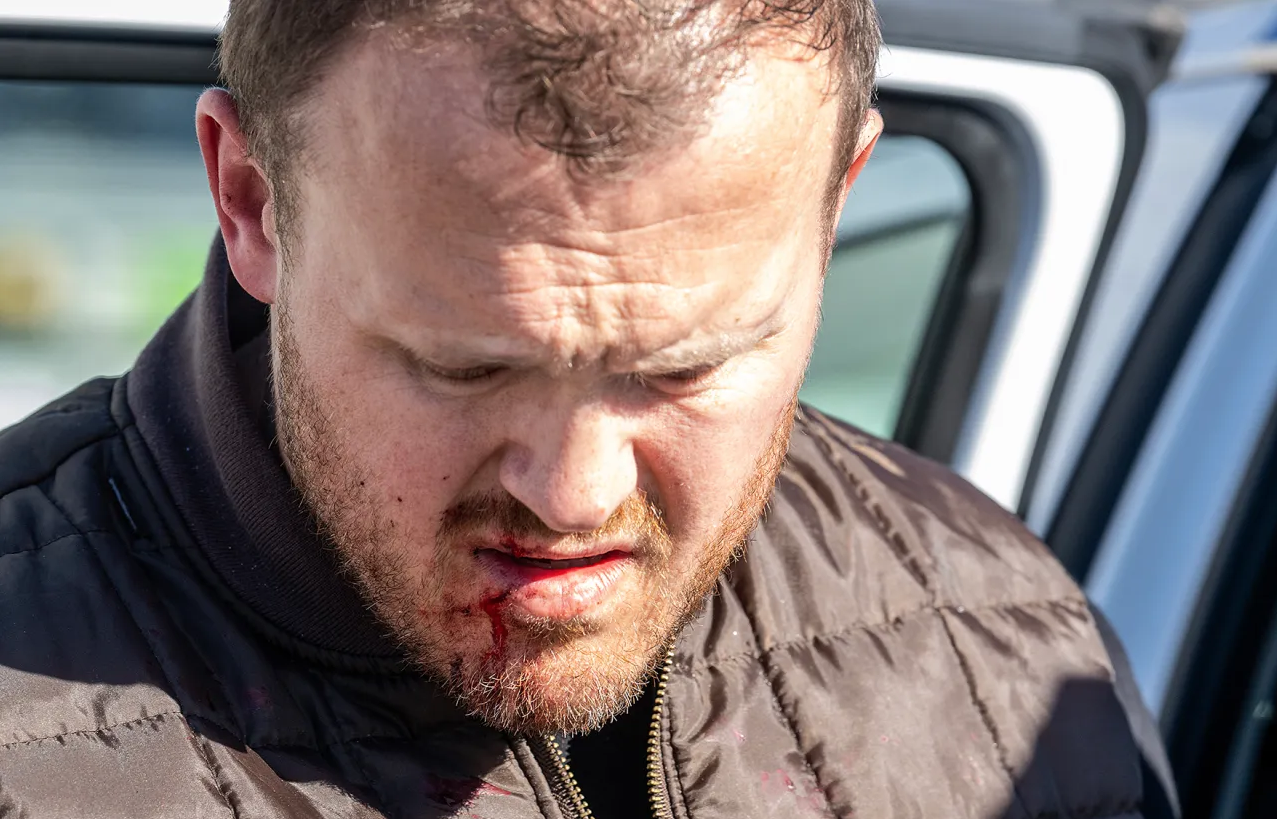
The smash-and-grab attack on parliamentary police committee chairperson Ian Cameron’s vehicle, resulting in him shooting one of his assailants, prompts serious inquiries into the appropriate application of force and the approach MPs adopt when operating in high-risk zones.
The parliamentary police committee chairperson, DA MP Ian Cameron, says he acted in self-defence when he shot one of the assailants who attacked his vehicle in Philippi, Cape Town, last week, but there are ongoing questions over whether the force was reasonable and whether he should have been carrying a firearm at all.
While bricks were hurled at his vehicle, an act that could reasonably be seen as life-threatening and prompting the use of a firearm in self-defence, the assailants themselves were apparently not armed, and their exact intent remains unclear. Only a police probe, followed by referral to a senior prosecutor, will determine whether there might be a prima facie case against Cameron.
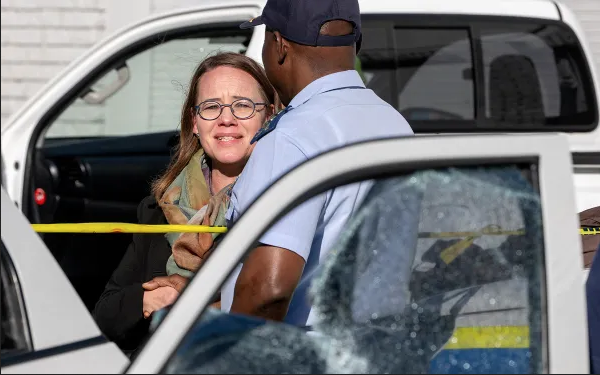
In the aftermath of the incident on Tuesday, 19 August, experts told Daily Maverick it was imperative that the SAPS gather statements on the shooting, conduct ballistics tests and potentially refer the docket to a senior prosecutor, who would decide whether the evidence warranted prosecution.
Cameron and two fellow DA MPs, Nicholas Gotsell and Lisa-Maré Schickerling, were on their way to the airport from an oversight visit at the Philippi SAPS training academy when three suspects smashed their windows using bricks. The attack is a stark reminder of how perilous such areas, as well as the roads around Cape Town International Airport, remain.
Two teenagers, aged 16 and 18, were arrested in connection with the incident, while a third suspect remains at large.
On Tuesday, 26 August, Cameron confirmed to Daily Maverick that his firearm has been sent for a ballistic test, adding, “I’ve not been charged and there is nothing to prosecute at the moment. There is no inquest because no one is dead.”
Questions to the SAPS about whether Cameron had been charged, and whether his firearm had been sent for ballistic testing, drew only a one-line response from police spokesperson Lieutenant-Colonel Malcolm Pojie: “Detectives are busy tracking the third suspect who is still at large. The investigation continues.”
At the heart of Cameron firing a shot is Section 49 of the Firearms Control Act 60 of 2000, which allows for the use of force that is reasonable and proportionate in the circumstances for self-protection, or in the prevention of crime. In practice, this means that the use of a firearm may be justified if an armed intruder poses a serious threat of death or severe injury.
‘I thought he would die’
Recounting the ordeal, Cameron said he was recovering well. He suffered broken teeth and required stitches, which he said were healing, though he still had pain in his mouth from a brick that hit his face.
Commenting on firing his weapon, Cameron said he acted in self-defence and believed he saved the lives of his two companions, Gotsell and Schickerling.
“Absolutely I thought my colleague, Gotsell, was potentially dead. He literally drops down with blood covering his head and face. And he just lost consciousness. They continued to attack.
“They literally beat me in the face with a sharpened brick. They beat him; they were halfway inside the vehicle in the back. They didn’t throw the bricks and run away. They continued to attack, so anyone who wants to argue [that I shouldn’t have fired my weapon] is more than welcome, come be in my circumstances and in my position and then we will talk again,” he said.
Cameron stressed that the law very clearly says the threat must be imminent and you must use proportionate force.
“If you are busy hitting my colleague with a brick over his head and I shoot in self-defence, then it is definitely proportionate. Especially when three people, maybe four even, according to the police, were attacking, what I was meant to do … ask them to wait a little longer for me to call the police first before they continue beating us up?” he said.
Responding to those who say he should face the full might of the law for the shooting, Cameron emphasised that such voices were few, and the large majority had been very supportive.
The question of immediate danger
The Institute for Security Studies’ Willem Els told Daily Maverick that what needed to happen now was that the investigating officer had to take statements from everyone.
Els said it had to be verified whether Cameron acted in accordance with the law, after which the case docket would be sent to the senior state prosecutor, who would then determine whether a prima facie case existed.
“In terms of the law, your life must be in immediate danger. You must be threatened and have reasonable grounds to believe that your life is in imminent danger, that you could be killed or seriously injured,” he said.
Another crime expert, who requested to remain anonymous, used the example of a house robbery. He said the Firearm Act suggests that if someone breaks in armed with a weapon and fires at you, but misses, and you return fire, hitting the assailant, that would generally be considered a clear case of self-defence.
In the Cameron case, he said, there weren’t sufficient details to evaluate the situation and that there appeared to be conflicting versions of what happened.
“Bricks were thrown at the vehicle, but the intent behind the attack remains unclear – whether it was to scare them, get them to leave, rob them, steal the vehicle, or was murder the intent?”
The expert also noted that an initial media report shortly after the incident quoted Cameron saying he fired his weapon, but wasn’t sure if he hit anyone as they ran away.
“These kinds of cases need to be investigated, because it is unclear whether the group or person he shot was actually threatening his life. Because there were clearly some people who were throwing bricks at the vehicle, which could be interpreted as potentially threatening your life, and you could use your firearm. The point is they were not armed, and whether it was their intent,” he said.
The expert further explained that, in typical self-defence cases, a person had to show that they acted in a manner intended to prevent injury.
“So in many cases, you are supposed to fire a warning shot. Cameron did not indicate in any of his commentary that he did fire a warning shot and shot one of the attackers.
“Police should investigate this, do ballistic tests, but they should investigate the circumstances under which he used his firearm,” he said.
Should public officials be armed?
Activist and Good Party councillor in the City of Cape Town, Axolile Notywala, says this is a pressing question he is still grappling with.
“When I listened to the interviews with Cameron and the other MP, Gontsell, the way they were talking about how Cameron was able to defend themselves, it sounded very suspicious, it wasn’t the full story, they were narrating,” he said in an interview with Daily Maverick.
Notywala said he believed many questions needed answers.
“It is only the police or the courts that can be able to tell us whether it was appropriate for him to respond to a 18-year-old and 16-year-old carrying bricks to respond with shooting at them.”
Another question that concerned Notywala was why an MP, on official duty performing an oversight visit, was carrying a firearm, and whether this was something the public should expect from their elected representatives.
“Understanding the different contexts, whether dangerous or not, is this something that must be allowed for MPs? If so, what about MPLs at provincial level, or councillors at local level? Are we now creating an environment where public officials carry firearms? What message does that send to the public?”
Notywala indicated that, to his knowledge as a City of Cape Town councillor, “If I’m doing oversight work and at any point I enter a dangerous community, or feel unsafe, I have the right to alert the speaker. The speaker can then make the necessary arrangements for my safety – that is what I know at the local level.”
For two days, Daily Maverick has unsuccessfully tried to reach parliamentary spokesperson Moloto Mothapo, receiving no response to messages regarding Parliament’s protocol on MPs carrying firearms, including during oversight visits.
Cameron and his colleagues conducted an unannounced oversight visit at the Philippi SAPS training academy. According to a Parliamentary legal adviser, there appeared to be no rules or protocol in place on unannounced oversight visits, with calls from some MPs to put guidelines in place.
While MPs are not permitted to carry firearms in the parliamentary precinct, this 2015 statement by Parliament, in response to former EFF MP Floyd Shivambu’s claim that he would bring a weapon to the precinct, suggests they are allowed to carry firearms: “Those who are armed when they arrive on the precinct are required to book in their arms in safes at the entrances to the Parliamentary buildings.”
It is unclear, however, if they are permitted to bring weapons to oversight visits.
‘No capacity’ for SAPS escort
Responding to Daily Maverick’s questions on whether he should have arranged a police escort, Cameron said, “This was an unannounced oversight visit, which means you do not arrive with escorts and advance warning. Unannounced oversight is often the most effective, especially where material irregularities are apparent.
“I have worked in the Cape Flats for years without escorts. Two threat assessments have already confirmed I should have some protection, but SAPS told Parliament they do not have the capacity.”
He said he didn’t want to take scarce resources away from local police stations and communities in need, and said there would be further backlash if MPs diverted SAPS vehicles and staff while residents continued to wait for help.
“What saddens me is how a very small group of armchair critics, with little or no real exposure to violent crime, treat the threat to our lives as if it were an administrative transaction, as though protecting oneself were some kind of indulgence.
“The real issue is not whether we had an escort, it is why communities are left living under constant fear without proper policing resources,” said Cameron.
Communities in need
As Cameron said, many communities around Cape Town are suffering due to high levels of crime and a lack of policing resources. Some have questioned the swift police response in Cameron’s case and called for all crimes to receive the same treatment.
Gun Free South Africa, noting the SAPS’s quick response to Cameron’s incident, questioned when the police and the media will show the same urgency for all victims of crime.
The organisation said communities living in crime hotspots deserved the same swift police response and sustained attention that the Cameron’s attack had received.
It said the incident should serve as a wake-up call for the SAPS to take comprehensive action against crime and violence.
“For too long, residents of Philippi and similar communities have endured daily violence with little media attention or government urgency. Only when high-profile figures become victims does crime suddenly register as front-page news. This double standard is unacceptable.”
Mitchells Plain community activist Michael Jacobs said no one wanted to endure trauma and pain, and expressed relief that Cameron and other politicians who became victims of crime were okay.
However, he pointed out that for hundreds of motorists and passengers on the Cape Flats, smash-and-grab attacks are a daily fear.
“Sporadic policing and law enforcement patrols at these well-known hotspots are the only response to motorists’ desperate cries for help from the authorities [in] the last couple of months.
“The killing fields of Heinz Park in Mitchells Plain [has] a daily struggle to get even the basic patrols and police visibility. In June this year, in Samora Machel township, four learners were gunned down in separate incidents,” he said.
GroundUp reported that learners in Samora Machel have been threatened with death if they set foot in neighbouring areas. The gang fights – turf wars for control of protection fees extorted from Somali-owned spaza shops – have been simmering for years.
Against this backdrop, Jacobs asked: “Where was the urgency then? No breaking news headlines, and no provincial commissioner in attendance. Do all lives matter, or only politicians’?” DM
In an age of information overload, Sunrise is The Namibian’s morning briefing, delivered at 6h00 from Monday to Friday. It offers a curated rundown of the most important stories from the past 24 hours – occasionally with a light, witty touch. It’s an essential way to stay informed. Subscribe and join our newsletter community.

The Namibian uses AI tools to assist with improved quality, accuracy and efficiency, while maintaining editorial oversight and journalistic integrity.
Stay informed with The Namibian – your source for credible journalism. Get in-depth reporting and opinions for
only N$85 a month. Invest in journalism, invest in democracy –
Subscribe Now!