



Motherhood, traumatic Namibian history and reworked cultural mythology lie at the heart of this year’s University of Namibia Graduate Exhibition.
Currently on display at the National Art Gallery of Namibia, the exhibition presents the work of Unam’s visual arts department’s final-year students and marks their entry to the professional art world.
Exhibiting as the graduating cohort of 2025 are Jaimee-Lee Diergaardt, Jazema Hangero, Uarika Tjiteere, Jade Tune, Jonas Vilho and Petronella Xoagus.
Thematically, a concept that persists in larger-than-life masks, textiles and ceramics is that of motherhood.
Anchoring ‘Metamorphosis’ at the very beginning of this identity, Xaogus transforms the trauma and triumph of a caesarean section into a minimalist and striking installation.
Eloquent in prose that declares the cut of birthing as “not a wound” rather “the first page of my daughter’s story”, Xaogus stitches and colours embryos, life-growing bellies, breasts filled with nourishment and gauzy placenta on symbolic gowns, curtains and bedsheets.
“These fabrics hold quiet stories of care, love and exhaustion that are part of every home. The act of stitching is slow and calming, like breathing or remembering. It connects me to moments of both pain and beauty,” she says.
“I use materials from home to show that domestic work and motherhood can be powerful forms of art. My work honours both the beauty and the chaos of motherhood and celebrates how it continues to shape the person I am becoming.”
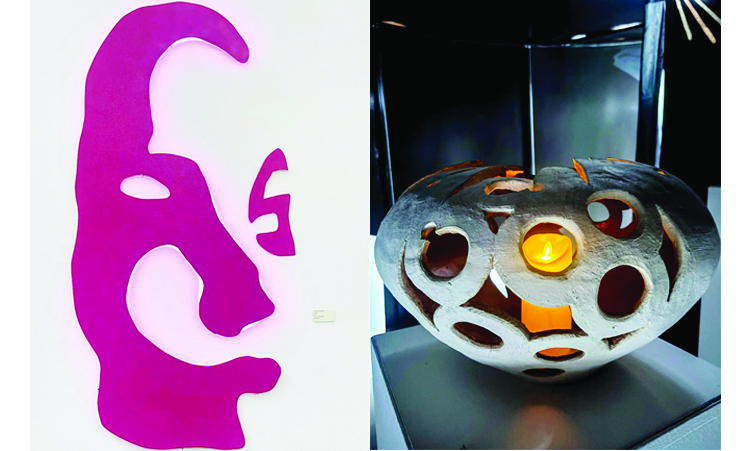
Similarly accessing a point of creative departure from the body and the realm of motherhood is Diergaardt, whose remarkable, large-scale wall hangings illuminate the main gallery.
In ‘Invisible Masks’, Diergaardt reflects on her mother’s struggle with lupus, which is characterised by a butterfly-shaped rash over the nose and cheeks.
Through the reproduction of this rash, Diergaardt highlights ideas of vulnerability, suffering and strength.
“The masks are cut from hardboard sourced from cupboard backing – a domestic material associated with concealment, enclosure and the unseen.
“By using a surface normally hidden, the work reinforces themes of what illness obscures and what it reveals, quietly carried within everyday life,” says Diergaardt in her artist statement.
With varying mask colours echoing her mother’s skin transformation, she additionally employs a light installation to highlight her mother’s heightened visibility as a result of the condition.
“It also represents how undimmed her light is and continues to be,” says Diergaardt.
“Through this combination of symbolism, portrait abstraction and material choice, the body of work offers a distilled visual language that reflects both vulnerability and perseverance.”
The idea of the might of a mother in the face of illness is also present in an installation by Tune.
In a work titled ‘Internal Sunshine’, Tune places 18 candle-lit ceramic vessels into a space of remembrance, connection and reflection.
The space honours her mother as well as the family and friends who supported Tune’s mother as she battled cancer.
“After losing my mother to a six-year battle with cancer, I found myself unable to express the depth of my emotions through words alone. Clay became my voice, a way to process my pain, honour her memory and reconnect with myself,” she says.
“Each vessel holds a small candle, symbolising my mother’s eternal light and her continued presence in our lives. When the candles are lit, the vessels cast soft, shifting shadows – a reminder that love, like light, changes form but never disappears.”
While the exhibition’s reflections on mothers and motherhood are the most eloquent, fully realised and visually compelling, additional work by Xaogus, Vilho, Hangero and Tjiteere is promising.
Large textiles by Xoagus consider the cultural significance of the nara within the lives of the Topnaar community while encouraging respect and safeguarding of indigenous knowledge.
Hangero’s artworks regarding the Herero and Nama genocide of 1904 to 1908 employ Ovaherero and Ovambanderu mythology to suggest a path to healing within the community as bloody clothing and cracked cultural items highlight the unforgettable brutality of the period.
Both using cultural items to revive appreciation of traditional practices, Vilho and Tjiteere make the case for indigenous materials and mythology within contemporary art.
Inspired by the stories, textures and motifs woven into Aawambo baskets, Vilho creates ceramics with the aim of giving “traditional knowledge a new life in a contemporary context”.
Tjiteere’s aim is akin in their paintings made with the red ochre and ash of Ovaherero cultural practice.
Bolstered by intentional methodologies and enlightening artist statements, the University of Namibia Graduate Exhibition is a proficient showing from Unam’s graduate class.
The exhibition will be on display at the National Art Gallery of Namibia until 14 February.
– martha@namibian.com.na; Martha Mukaiwa on Twitter and Instagram; marthamukaiwa.com
In an age of information overload, Sunrise is The Namibian’s morning briefing, delivered at 6h00 from Monday to Friday. It offers a curated rundown of the most important stories from the past 24 hours – occasionally with a light, witty touch. It’s an essential way to stay informed. Subscribe and join our newsletter community.

The Namibian uses AI tools to assist with improved quality, accuracy and efficiency, while maintaining editorial oversight and journalistic integrity.
Stay informed with The Namibian – your source for credible journalism. Get in-depth reporting and opinions for
only N$85 a month. Invest in journalism, invest in democracy –
Subscribe Now!