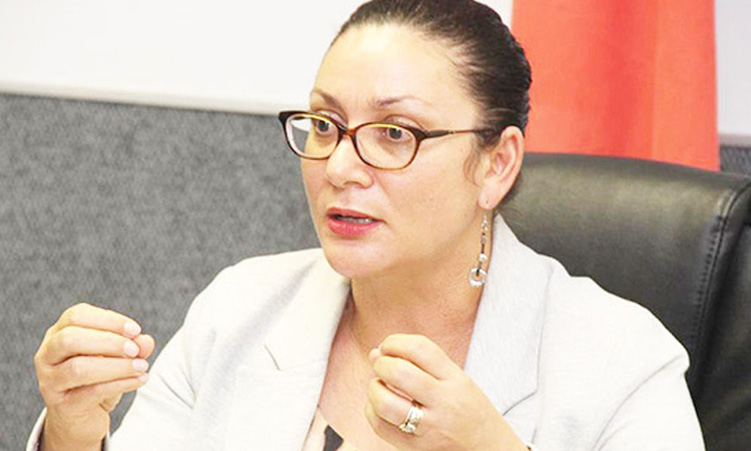
AIR Namibia’s acting managing director, Mandi Samson, says the national carrier’s commitment to gender equality in aviation is a vital step towards creating a more prosperous gender-inclusive Namibia.
She made these remarks in recognition of this year’s International Women’s Day celebrations.
“It is fitting that the theme for International Women’s Day (IWD) 2017 is ‘Be Bold for Change’. The battle for a more gender- inclusive world is the responsibility of every industry. IWD recognises, as we do, that the potential women offer to economies across the world must be nurtured and developed,” Samson added.
Tourism in Namibia is the third-highest contributor to the gross domestic product, and the country is a popular tourist destination, with tens of thousands of jobs directly and indirectly related to the sector.
To fully exploit the economic potential of the tourism industry, the involvement of women is critical, she noted.
“Air Namibia is keen to encourage more women to enter the aviation industry. The potential growth rewards for both their personal careers and the national forecast are impressive, with aviation being an integral part of Namibia’s future economic development.
“Currently, the aviation industry is perceived as predominantly a male domain. This deters women from pursuing careers in a sector which would benefit from equal representation,” stated Samson.
The aviation sector remains an elite profession niche in Namibia. However, it is yet to fully embrace the government’s commitment to gender parity.
Across state-owned enterprises and other sectors such as banking, health, law, and the military, women are already playing pivotal roles, she said, and that for the visibility of women to increase in aviation as they command aircraft and take up other vital positions, a strong message both inside and outside Namibia needs to be delivered.
The board of directors under Gerson Tjihenuna (chairperson), Florette Nakusera (vice-chairperson), Wilhencia K /Uiras, Evelyn Zimba-Naris, Conville R Britz, and Ingrid Cupido (company secretary), Air Namibia encourages young girls to see beyond traditional female roles, and to utilise their own skills to play an important part in their country’s economic development, Samson added.
The representation of women in Namibia’s aviation industry also issues a psychological message to the world that the national carrier is committed to equal representation.
There are several reasons why women are still underrepresented in Namibia’s aviation industry.
The perception that the sector is dominated by men is one important psychological reason for the relatively low number of women pursuing careers in it, but there are others, she said.
For instance, there is an economic barrier to training for many women. Pilot training is an expensive endeavour and, for the purposes of career progression, it requires attendance at a reputable flight school.
“These economic constraints have discouraged women from pursuing a career path in aviation in the past. In addition, the career trajectory naturally takes time, with a significant number of years passing between entry level and flying our largest plane at command level.
“Air Namibia has created an explicit career path for all pilots within our airline. They are first employed as first officers, and then developed into captains. We are committed to mandatory training at all stages of a career path, ensuring that pilots exceed their expected performance and consistently adhere to aviation regulations and requirements, Samson added.
The first female pilot was employed by Air Namibia 20 years ago, in February 1997. Currently, 17% of the airline’s 83 pilots are women.
“We concede that this figure is too low, and are taking steps to increase representation across the airline,” adds Samson.
Training and education are vital components in encouraging female pilots of the future, and the board has already approved the cadet pilot programme, creating a feeder pipeline for the airline, which will begin in 2018.
Air Namibia is also in contact with university students, keen on researching the airline for short internships, or other research purposes. Beyond this, the airline intends to spend time among communities and local trade fairs, demystifying perceptions about the process of becoming a pilot.
“It is increasingly clear that girls in high school are unaware of the entry point for aviation studies, and this information needs to be conveyed at career days in schools and communities.
“We recognise that catching potential pilots young and explaining their career trajectories and which subjects they need to study is the best way of developing young women for a future in the aviation industry,” Samson noted.
In an age of information overload, Sunrise is The Namibian’s morning briefing, delivered at 6h00 from Monday to Friday. It offers a curated rundown of the most important stories from the past 24 hours – occasionally with a light, witty touch. It’s an essential way to stay informed. Subscribe and join our newsletter community.

The Namibian uses AI tools to assist with improved quality, accuracy and efficiency, while maintaining editorial oversight and journalistic integrity.
Stay informed with The Namibian – your source for credible journalism. Get in-depth reporting and opinions for
only N$85 a month. Invest in journalism, invest in democracy –
Subscribe Now!