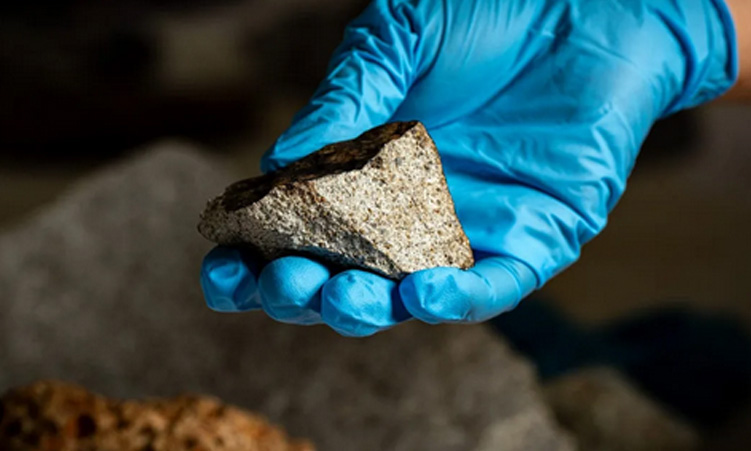
A meteorite that crashed into a home in the United States is older than planet Earth, scientists say.
The object flew through the skies in broad daylight before exploding across the state of Georgia on 26 June.
Researchers at the University of Georgia examined a fragment of the rock and found that, based on the type of meteorite, it is expected to have formed 4.56 billion years ago, making it roughly 20 million years older than Earth.
New signs found of giant gas planet in ‘Earth’s neighbourhood’
Scientists have found evidence of a giant gas planet in the nearest star system to our own.
At four-and-a-half light years away, the lifeless planet would be a close neighbour to Earth in astronomical terms and could have moons that sustain life.
The signs were found in the star system Alpha Centauri by the powerful James Webb Space Telescope.
Scientists are excited about this discovery because of the similarities between the exoplanet’s star and our sun.
The planet would be similar to our solar system’s gas giants, Saturn and Jupiter, and would be enveloped in a thick gas cloud.
That means it could not support life itself, but it could have moons that are habitable.
Russian volcano erupts after 500 years
A volcano in far eastern Russia has erupted for the first time in more than 500 years, which experts say may be linked to a massive earthquake last week.
The Krasheninnikov volcano in Kamchatka threw up an ash plume up to six kilometres high overnight.
Hours later, another large earthquake in Russia led to tsunami warnings in three areas of the peninsula.
– BBC