



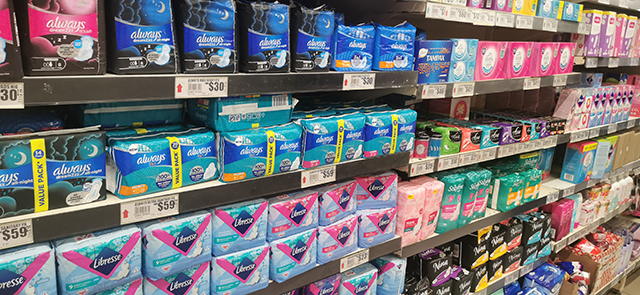
WOMEN and those responsible for raising girls will have to dig deeper in their pockets as the price of sanitary pads and tampons has increased.
Bloomberg in June reported that the average price of a pack of menstrual pads rose by 8,3% this year, and by 9,8% for tampons.
Ndelipewa Mungoba, an activist in the space of menstrual hygiene and sex education who is part of the Namibian Free-Flow campaign, says she noticed the price increase recently when she bought sanitary products for girls in the Erongo region.
“This has indeed affected us negatively as we couldn't reach our target,” she says.
The Free-Flow campaign was launched in April 2018 with the aim of restoring the dignity of vulnerable adolescent and young girls who cannot afford sanitary products.
The campaign has identified disadvantaged girls from the Khomas, Kunene, Erongo, Ohangwena, and Kavango East regions.
Mungoba says although Russia's war in Ukraine is to blame for commodity price increases, as well as fuel increases, sanitary products should not be expensive.
“How do we expect our girls to attend school while on their period if they can't afford a pad?” she asks.
Apart from sanitary pad distribution, Free Flow wants to extend its initiative to supporting adolescents with dignity packs, as well as to educating them on menstrual hygiene.
“With the help of Star of Life, we also try to educate them on menstrual cups and to donate a few as one can use them for at least a year,” she says.
Veronica !Awases runs a children's home at Swakopmund where she accommodates 11 girls.
She normally budgets N$500 for sanitary products, but this is no longer enough.
“The actual prices have risen from N$9 to N$11 for some packs, and others from N$14 to N$16. These price increases have impacted our toiletry budget,” she says.
Last year, the girls were introduced to recyclable pads, which !Awases says they were not comfortable with and prefer to use only during school holidays.
The children are also part of a group of young people at the town who collect sanitary pads for school-going girls at DRC informal settlement.
!Awases says although the children's home does not have a steady income, they are coping through the assistance of the global community.
“I can feel the pinch, because usually I could buy 30 to 60 packs with N$500, but now I am buying less with that money,” she says.
!Awases says while consumers cannot control the price of sanitary pads, those in consumer pricing control should find ways to make them affordable.
Former Swakopmund constituency councillor Ciske Smith-Howard has called on the government to consider subsidising sanitary pads.
“The government needs to seriously consider scrapping taxes on sanitary pads and subsidising them. Women, especially teenage girls, don't have a choice in the matter, and we must do more to help them,” she says.
The Namibia Statistics Agency do not have sanitary pads and tampons as an independent category.
Sanitary products fall under the toilet paper/tissues category.
According to the agency's price statistics manager Aloysius Tsheehama, these products' annual inflation rates were 1,5% in April, 2,0% in May and 2,8% in June 2022.
In an age of information overload, Sunrise is The Namibian’s morning briefing, delivered at 6h00 from Monday to Friday. It offers a curated rundown of the most important stories from the past 24 hours – occasionally with a light, witty touch. It’s an essential way to stay informed. Subscribe and join our newsletter community.

The Namibian uses AI tools to assist with improved quality, accuracy and efficiency, while maintaining editorial oversight and journalistic integrity.
Stay informed with The Namibian – your source for credible journalism. Get in-depth reporting and opinions for
only N$85 a month. Invest in journalism, invest in democracy –
Subscribe Now!



