Since acacias constitute such a large percentage of the woody vegetation in many parts of Namibia, their typical characteristics should be listed.
They have:
-paired thorns that are either straight or hooked
-some species have hooked and straight thorns on the same tree
-twice divided feathery leaves
-either ball-shaped flowers or flowers arranged in spikes
-golden yellow, pale yellow, cream or white flowers
-many-seeded pods of various shapes and sizes
Most mammals can easily be recognised by their outline, but to identify the majority of trees, one needs to look out for a number of characteristic features such as those mentioned above. Once you can identify an acacia, very often you will be able to identify 50% of the vegetation found in large parts of the country.
Some of the 27 acacia species occurring in Namibia grow very wide-spread; others are confined to certain sections of the country. Once you know which species to expect where, they become much easier to identify. In the coming weeks and months individual acacia species will be described as they come into flower or become obvious due to some other aspect.
Black-thorn (Acacia mellifera subsp. detinens) Fabacea:
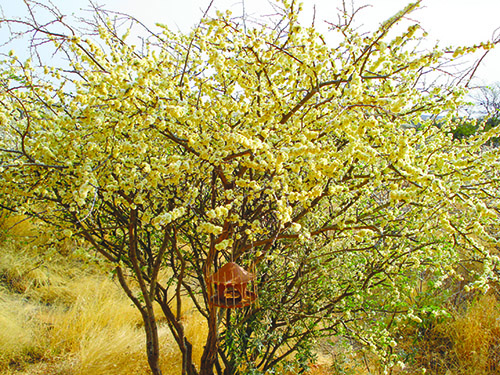
This shrub or medium-sized tree is heavily armed with paired hooked thorns. It is very common all over Namibia and very conspicuous from August to October when covered in a multitude of sweetly scented, white to cream-coloured very short flower spikes, appearing round. These flowers, emerging from dark red buds, are the harbingers of spring and completely obliterate the vicious thorns. When in leaf from November until July, the black-thorn can easily be recognised by its relatively large, rounded leaflets, while all other common acacias in Namibia have small, oblong, narrow leaflets.
Names: G. Hakendornakazie, Hakies; A: Swarthaak, nooibos; H. Omusaona; Nd. okadhilankono; Ky. okadilanghono; N. !noes The botanical name acacia means ‘with thorns’, while mellifera refers to the copious amounts of nectar produced by the flowers.
The strong, very sharp, black, hooked thorns detain anyone careless enough to venture too close to this shrub or tree. Therefore this tree has the subspecies name detinens distinguishing it from the much rarer and unarmed Kunene black-thorn (A. mellifera subssp. mellifera) confined to the far northern edge of Kaokoland.
The black-thorn is one of the most common acacias in Namibia, only absent from the Namib and the Cuvelai and less common in the northwest. The bark is dark grey and smooth with white lenticels or pores.
Numerous thin, papery, straw-coloured pods, pointed at both ends, cover the trees from October onwards, while the shrubs only come into full leaf from November onwards. By producing seeds as soon as possible this tree ensures its survival. The seeds are very numerous but only germinate during the first year.
Due to its highly invasive nature this shrub or tree has a very damaging impact on the carrying capacity of Namibian rangelands. This aspect will be discussed in next week’s article.