


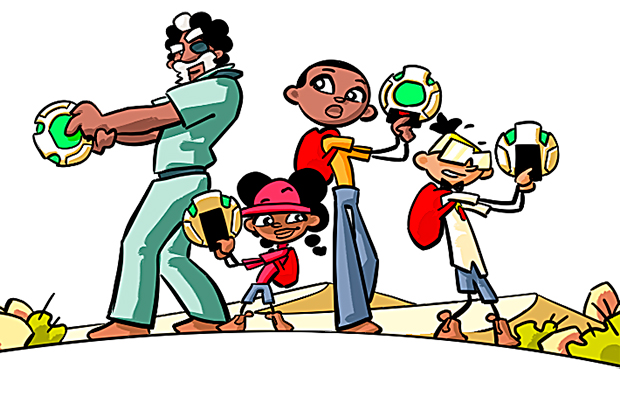
It’;s the year 2100 and Namibians have survived the Great Drought, but new dangers plague the Land of the Brave. Enter the Free Rangers! A fearless team of local heroes ready to protect and save Namibia’;s incredible natural heritage.
Equipped with their trusty Freedom Phones as well as their functional but fashionable Ultravellies, super smart Tuli, eagle-eyed Landu and wisecracking Xodi battle The Sharklion and Mister Nice-Nice under the leadership of wise Captain /Haodago with a little help from technological wiz woman Professor Hâ-Tani.
Co-written and created by Nesindano Namises and Nathan Vyklicky and available free in The Namibian every two weeks, ‘;Free Rangers’; is a vibrant and educational comic book chronicling a futuristic all-Namibian adventure for Namibian families.
“The way the stories are portrayed really creates a space for readers to see our vast environment as the beautiful commodity we ought to care for,” says Namises.
“The content for Namibian children on many platforms does not speak of them and their issues. Namibian children need to be recognised and celebrated more. The content, based on research, helps drive attention to our environmental issues, which is vital in educating Namibians about what role they play as ambassadors of our nature and conservation.”
Filled to the brim with games, trivia, tips on building a reading culture in your home and interviews with local Earth Heroes such as lion ranger Berthus Tjimpombo, the comic book created in partnership with EduVentures cunningly teaches children about local wildlife, conservancies and environmental challenges while providing identifiable reading material peppered with local slang, vernacular and Namibianisms.
“There is a need to inspire Namibian children with stories created for them. Stories that are relatable, adventurous and educational,” says Namises. “There is also a need to recognise that language is different in various spaces and the beauty of it in Namibia is that we are able to communicate with new and integrating styles of language that are or are not linked to indigenous vernacular. Many of the stories we tell include sounds and expressions.”
Paying localising attention to detail, defining slang words for the toppies, encouraging scholastic enviro-clubs, introducing children to unfamiliar animals
as well as endangered species and offering advice on how to live in harmony with wildlife given the realities of human-wildlife conflict, ‘;Free Rangers’; ticks the boxes of education, entertainment and social and environmental responsibility with flair and fun.
“We came up with the idea of these rangers in the future, because we thought it would be a cool way of combining Namibia’;s natural world with advanced technology that’;s becoming more and more a part of our lives,” says Vyklicky who is the comic book artist.
“On the one hand, we wanted them to look like kids anyone in Namibia can relate to, and on the other I designed a bunch of science-fiction elements that hopefully haven’;t really been seen in a Namibian story before: The shuttle they fly in, their high-tech base in a giant tree, and especially their Freedom Phones, which can load anything they can think of from the Free Net to help them on their adventures. It lets us tell stories about finding a balance between nature and new technologies in a way that stays focused on the fun.”
Inspired by his own childhood love of comics including ‘;TinTin’; which showed him the rest of the world, ‘;Calvin & Hobbes’; and even Marvel’;s ‘;Nick Fury’;, Canadian Vyklicky hopes to assist in fostering that same love of comic books in Namibian children, which he believes is a stepping stone to much more.
“If kids fall in love with comics when they’;re small, they fall in love with books for life. They become stronger readers, they do better in every subject at school, they open up new careers. Namibian kids should have the same advantages as children anywhere in the world,” says Vyklicky, who is thrilled that ‘;Free Rangers’;’; partnership with The Namibian will allow the comic book to reach tens of thousands of urban and rural homes, given that children have little to no access to quality recreational and educational reading material in the average Namibian household.
“I just want kids here to be able to have the same experience I did growing up – books they’;re excited to crack open, heroes who look like them and inspire them to dream big. Windows to a world that’;s way bigger and more fascinating to learn about.”
Citing a research team from the University of Namibia (Unam) who surveyed 1 402 Grade 6 students from seven different regions in 2015, Vyklicky shares that only 22% of pupils read outside of school and most of the ones who did came from well-resourced urban schools.
“One of the biggest reasons they found that kids aren’;t reading is simply that they don’;t have anything meant for them to read,” he says.
Chatting to those who are already on the ‘;Free Rangers’; wave, the response is heartening.
“I like that it’;s funny. Like in case three, Xodi was stuck in his phone!” says Aune Dhila, an eight-year-old from Swakopmund’;s School of Excellence whose favourite character is Tuli because she’;s smart.
Happy that she has learnt about poaching and animals, Dhila likes to read ‘;Free Rangers’; and Roald Dahl while 11-year-old Mwinga Mage Mbuche from Mavuluma Primary School at Katima Mulilo enjoys the comic because the young heroes save animals.
“I like Xodi because he’;s a comedian!” says Mbuche who also likes reading the newspaper and is clearly an Earth Hero in waiting. “I’;ve learnt to help animals in need – like when Xodi risks his well-being in Free Net to save the birds.”
Already charming the children, featuring a resourceful boy child, three smart, fearless female characters as well as a strong father figure, ‘;Free Rangers’; is designed for children Grade 4 and up but is actually fun for the whole family and a tool to inspire more children’;s writers.
“I hope ‘;Free Rangers’; inspires more writers and artists to produce children’;s stories here – if you have a story you’;re dying to tell, get in touch with us! Children’;s publishing is a N$140-billion industry worldwide, and why shouldn’;t a creative country like Namibia be a part of that, sharing our stories with other Namibians and the world?” says Vyklicky whose sentiments are echoed by Namises.
“There is and must be more of a platform for these kinds of stories and projects. I hope the project as a collaboration between the two of us as Namibian and Canadian and government and private organisations helps to encourage others to work together on ideas to bring more of these to those who are least able to access them.
“If you love Namibia, chances are you have a Free Ranger waiting to burst from inside you.”
In an age of information overload, Sunrise is The Namibian’s morning briefing, delivered at 6h00 from Monday to Friday. It offers a curated rundown of the most important stories from the past 24 hours – occasionally with a light, witty touch. It’s an essential way to stay informed. Subscribe and join our newsletter community.

The Namibian uses AI tools to assist with improved quality, accuracy and efficiency, while maintaining editorial oversight and journalistic integrity.
Stay informed with The Namibian – your source for credible journalism. Get in-depth reporting and opinions for
only N$85 a month. Invest in journalism, invest in democracy –
Subscribe Now!