



He refuses to be identified or labelled a fashion designer and rightly so. Wearing khaki coloured pants from his last collection paired with a branded Namibian t-shirt and brown boots, it’s clear that Marcellinus Swartbooi does not associate with the general rule of following fashion trends or styles.
A recent graduate from the University of Namibia’s (Unam) art programme, Marcellinus is in a class of his own, with his latest clothing line being a true reflection of his passion for fostering cultural sustainability.
Employed as a private secretary at the Ministry of Education, Arts and Culture in the directorate of arts, Marcellinus has worked for years as a public servant and only recently took up the challenge of going back to school.
“My initial reason for going to study came from my fear of my language dying out,” he tells me during our breakfast meeting at a quaint coffee shop.
Thanks to this fear, along with extra prompting from his colleagues, he enrolled for a bachelors degree in Literature and Fashion and Design to nurture his love for the Khoekhoegowab language and further improve his clothing-making skills which were, up until then, only a hobby.
Somewhat a jack of all trades, Marcellinus is a seasoned choral music composer who has been composing since the age of 10. He has been been the choral director of the Catholic Diocesan Church Choirs (CDCC) Network for six years since its inception. During this time, the need to reform choral music to have a more authentic Namibian sound came alive within him and being the nonconformist that he is, he pursued it with fervour.
“Since secular choirs have been singing the same old songs over and over to much annoyance and irritation of the buying audience and of course, myself, I moved from composing church music to traditional music.”
This passion for all things traditional flowed over into the clothing that he made for the choirs he worked with. “I started by making costumes for choirs, most by hand and very roughly made,” he says of his early years as an amateur clothing designer. Going back to school, although for the purpose of studying Khoekhoegowab, Marcellinus was hit with the realisation that he needed a second major and having just found out that he was a decent designer, he opted for fashion.
“I made my first garment in 2008, purely out of boredom,” he recalls of the first caftan he made in his living room with instructions from his sister who also had limited knowledge of making clothes. “I had this cotton material in my house which belonged to a choir and I decided to myself, today I’m going to make myself a shirt,” he quips.
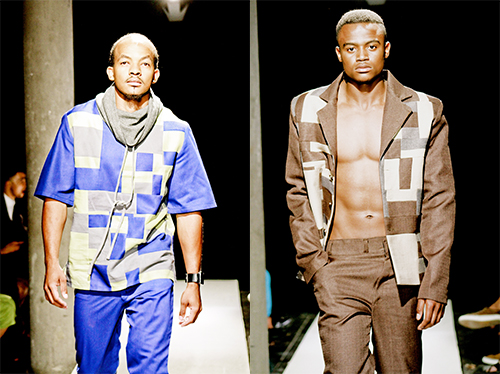
Literature may seem to be the furthest thing from fashion but Marcellinus found a way to link the two. He linked the two majors by bringing the idea of the Nama patchwork into his garments. “I refined the traditional Nama patchwork to fit the modern man without him looking like he’s coming from a cultural festival,” he says.
Throughout his years as a student, he focused on menswear, which he says was not as complicated as most people had warned him it would be. His final year collection, a menswear range characterised by the intricate traditional Nama patchwork that has since become Marcellinus’s trademark, was a showstopping one. The extra hours he put into the creation of this collection paid off when he became one of only two students to graduate with honours from the fashion programme in April.
Marcellinus is proud of the strides that Namibian fashion has made so far and applauds those who have broken into new ground in the area. “I like the direction that the Namibian fashion industry is taking. I love the optimism, but also the aggression with which some designers are pushing the envelope of opportunities,” he notes.
He is furthermore impressed by those who are moving into the African fashion world, while keeping their design identities intact.
“The only concern I feel that needs to be guarded against is stagnancy and to not become hangers-on or followers of foreign design ideas, but keep on creating a collective Namibian identity while still keeping authenticity and individuality intact,” he says.
Another young designer who has found the perfect balance between traditional attire and modern fashion is Mc Bright Kavari. He agrees that keeping ones identity is all about keeping true to yourself. “One thing I always say is that there’s nobody who can stop me from doing what I want to do. There are people who say ‘this is my culture, I’ll not let anyone change it’ but what I tell them is this is my culture too. I’m a proud Herero and if I modernise our dress, I’ll do so in my way.”
Although a promising menswear designer, Marcellinus has no plans of becoming a fully fledged commercial designer, preferring to only cater to a few clients, mostly family and friends. Watch this space though, as he hints that this may change in the near future. “The intention was never to embark on a business-oriented route, but rather self-enrichment in terms of artistic skills. However, there is some pressure building up at the moment from would-be clients, so let’s wait and see what destiny dictates,” he says.
In an age of information overload, Sunrise is The Namibian’s morning briefing, delivered at 6h00 from Monday to Friday. It offers a curated rundown of the most important stories from the past 24 hours – occasionally with a light, witty touch. It’s an essential way to stay informed. Subscribe and join our newsletter community.

The Namibian uses AI tools to assist with improved quality, accuracy and efficiency, while maintaining editorial oversight and journalistic integrity.
Stay informed with The Namibian – your source for credible journalism. Get in-depth reporting and opinions for
only N$85 a month. Invest in journalism, invest in democracy –
Subscribe Now!