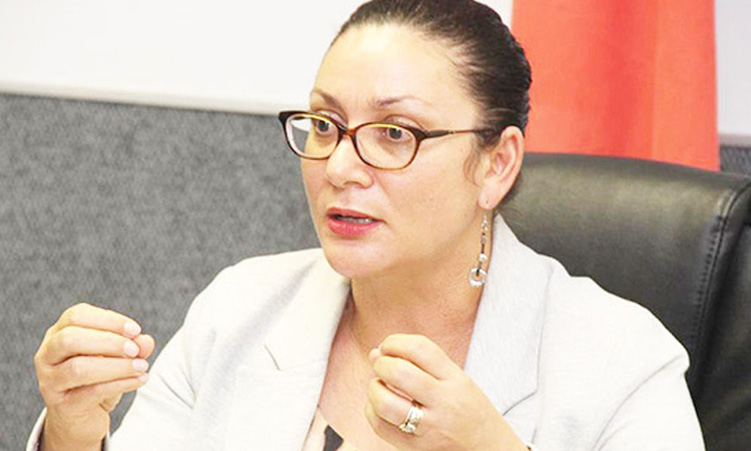
There’s no doubt that engineering is a interesting field, but one that is often male-dominated in most parts of the world. Despite this, 24-year-old Martha Polla decided to pursue this career anyway and is currently excelling in her studies in Budapest, Hungary.
Aside from that, one of her biggest passions is educating and empowering women to pursue science, technology, engineering and mathematics (STEM) careers, hence her application to write an essay for One, an international non-profit organisation where millions of people take action “to end poverty and preventable disease, particularly in Africa”. YouthPaper spoke to Polla about her aims and dreams.
“My beginning dates back to 1993 in a village called Onathinge in the northern part of Namibia,” Polla said. “At the age of three, my mother relocated to Grootfontein for work purposes. I was therefore reared and groomed by my maternal grandparents who are the backbone of who I am.”
In 2000, Polla moved to Grootfontein where she was able to complete both her primary and secondary education. “I was raised in a home with deeply-rooted Christian principles and values which are the centerpiece of my life today. My mother is the epitome of a superwoman, her strength and sacrifices are the vehicle to my success.”
With the determination to do well, Polla discovered she had a passion for town and regional planning, later pursuing a bachelor’s degree, but a project her final year changed her course of action.
“During the final year, I did a project on designing safe roads for walking and cycling. It is this project that made me realise my interest in transportation and thus, I decided to expand on it. I graduated from the Namibia University of Science and Technology as best graduate student from my programme. It is due to these merits that I was awarded an academic scholarship by the government of Hungary to pursue a Master’s degree in transportation engineering at the Budapest University of Science and Technology.”
Although Polla loves what she does, she says the inequality irks her the most. “Transportation engineering is a male-dominated field and one of the greatest challenges for female engineers is the need to prove they are equally as competent as their male counterparts. I believe we live in an era of ‘a can-do mindset’. Therefore, the best way to confront this is to be hardworking, exceptional and committed to what you do and let your work speak for itself.”
But other than her love for the field, Polla said her passion has always been about serving purposes greater than her own. “Being a woman in this field has presented me with an opportunity to make a positive difference. I perceive this as an opportunity to pave way for young girls and women who would like to pursue careers in male-dominated fields.” And according to Polla, Namibia’s greatest resource is its people. “It is imperative to collectively gather inputs from both women and men to foster socio-economic growth and sustainable development. I am always reminded of the inspiring words of Emma Watson: ‘If not me, who and if not now, when?’”
The One Organisation is known to secure over US$37 billion in funding for the Global Fund to Fight Aids, TB and Malaria as well as securing the legislation on the US, Canada and the European Union to fight corruption. One also states that they are funded almost entirely by foundations, philanthropists and corporations around the world. Girls Count is a competition by the One Organisation which is meant to promote girls’ education in Africa. “I came across the opportunity on Namibian Opportunities Facebook page and submitted my idea on empowering young girls to join STEM fields by giving them access to resources, information and mentorship,” Polla said. “There were 4 000 applicants and I made it to the top 10 finalists. I am indeed honoured to represent my country. What I hope to gain from this competition is to create networks that will help me make a greater impact in Namibia and Africa at large.”
“Science, Technology, Engineering and Mathematics (STEM) is a central pillar for industrialisation and technological advancement. From an early age I have pondered on why is there a very low representation of females in these fields compared to the higher ratio of females to males in Africa. In order to accelerate Africa’s development, it is imperative that women take up their rightful responsibility and role in contributing to this advancement through being availed opportunities to join STEM careers.
Through my experience, I have realised that Africa has very few platforms and organisations promoting women in STEM, especially Southern Africa. Most prominent platforms such as Next Einstein Scientific Research Platform target women already pursuing a path in STEM fields. What about the very young generation that is not yet aware of the available career options? The young generation tend to pursue careers that are reflected among the people in their communities and society at large. This is because they believe that those are the only options within their reach. Therefore, my idea on how to make girls count is by reaching out to the less fortunate and help them see that STEM fields are available to them too.
African towns and cities are composed of informal settlements with people that have lost hope on ever achieving the same thing that the kid on other side of town can achieve. Girls from these areas don’t believe they can ever be engineers, scientists or mathematicians because women around them always end up as bartenders, hair dressers or selling at the open markets. There are untapped talents among each and every one of those girls and it is our duty to release that potential. These girls need someone to believe in them and show them that no matter their circumstances, it is possible.”
In an age of information overload, Sunrise is The Namibian’s morning briefing, delivered at 6h00 from Monday to Friday. It offers a curated rundown of the most important stories from the past 24 hours – occasionally with a light, witty touch. It’s an essential way to stay informed. Subscribe and join our newsletter community.

The Namibian uses AI tools to assist with improved quality, accuracy and efficiency, while maintaining editorial oversight and journalistic integrity.
Stay informed with The Namibian – your source for credible journalism. Get in-depth reporting and opinions for
only N$85 a month. Invest in journalism, invest in democracy –
Subscribe Now!