



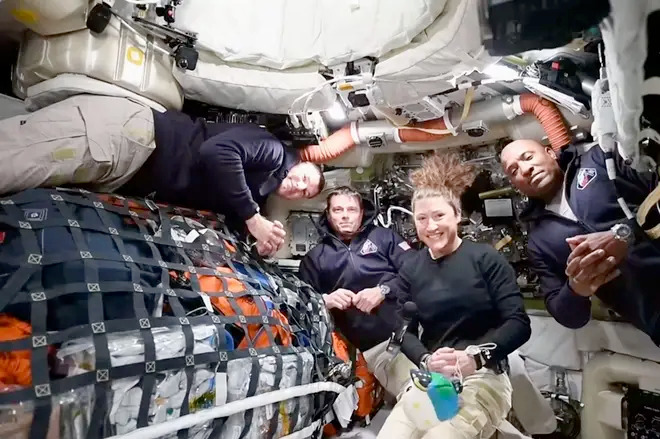
Nasa’s first manned moon mission in more than five decades fired its rockets to break out of Earth’s orbit.
National Aeronautics and Space Administration (Nasa) deputy associate administrator Lori Glaze told a news conference: “Ladies and gentlemen, I am so excited to tell you that for the first time since 1972 during Apollo 17, human beings have left Earth orbit.”
The four astronauts on the Artemis II mission, which launched from Cape Canaveral in Florida, United States, on Wednesday evening, spent the first 25 hours of the flight circling the Earth.
Firing the rockets on the Orion spacecraft – officially called a translunar injection burn – will send them towards the moon, which they will circle before returning to Earth.
Canadian astronaut Jeremy Hansen says the crew, which also includes commander Reid Wiseman, pilot Victor Glover and Christina Koch, had been glued to the windows to see the “phenomenal” view.
He says: “Humanity has once again shown what we are capable of, and it’s your hopes for the future that carry us now on this journey around the moon.”
Nasa says the firing puts the crew “in a free return trajectory,” enabling them to use the moon’s gravity for the return journey.
Nasa administrator Jared Isaacman says on X: “Nominal translunar injection burn complete. The Artemis II crew is officially on the way to the Moon.
“America is back in the business of sending astronauts to the moon. This time, farther than ever before.”
Nasa says preliminary reports indicated the engine firing had gone well and that Orion’s main engine, which was due to burn for five minutes and 49 seconds, provides up to 2 700 kilograms of thrust – enough to accelerate a car from 0 to 97 kilometres per hour in about 2.7 seconds.
There was good news for the astronauts when they were able to fix issues with the toilet, while controllers were also able to raise the cabin temperature.
The Goonhilly Earth Station, near Helston, in Cornwall, is helping to track the flight.
Orion will head around 6 400 kilometres beyond the moon with a lunar flyby on Monday, the next major milestone, which will send the crew some 406 000 kilometres into space before returning to Earth.
The current record for the furthest spaceflight is about 399 111 kilometres, held by members of the Apollo 13 lunar mission in 1970, which was hit by technical problems.
While the astronauts will not touch down on the moon, the Artemis II mission paves the way for a future lunar landing and also lays the foundation to send a crew to Mars.
The mission previously had to be postponed by two months because of hydrogen fuel leaks and clogged helium lines.
Nasa is seeking to return a crew to the lunar surface by 2028, before China does in about 2030.
In an age of information overload, Sunrise is The Namibian’s morning briefing, delivered at 6h00 from Monday to Friday. It offers a curated rundown of the most important stories from the past 24 hours – occasionally with a light, witty touch. It’s an essential way to stay informed. Subscribe and join our newsletter community.

The Namibian uses AI tools to assist with improved quality, accuracy and efficiency, while maintaining editorial oversight and journalistic integrity.
Stay informed with The Namibian – your source for credible journalism. Get in-depth reporting and opinions for
only N$85 a month. Invest in journalism, invest in democracy –
Subscribe Now!