


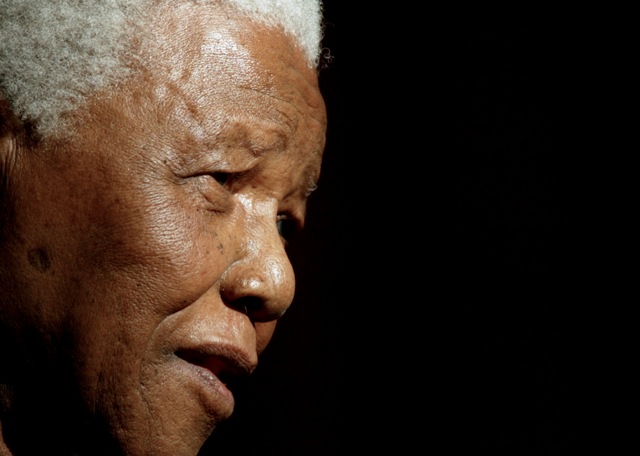
Nelson Mandela's long walk from apartheid prisoner to South African president remade a country and inspired the world.
Mandela died peacefully at home in Johannesburg aged 95 after spending months in critical condition following treatment for a lung infection.
Thirteen years earlier, on 11 February 1990, Nelson Rolihlahla Mandela emerged, greying but unbowed, from 27 years detention for opposing the white-minority apartheid regime.
It was a defining moment of the 20th century.
In freeing the world's most famous political prisoner, President FW de Klerk sent an unequivocal message: after centuries of subjugation, millions of other black South Africans would soon be free too.
Apartheid was over.
"I greet you all in the name of peace, democracy and freedom for all," a 71-year-old Mandela said in his first public speech in 27 years.
"I stand here before you not as a prophet, but as a humble servant of you, the people."
Devoid of self-pity, he reached out the same people who jailed him and who brutalised fellow blacks to preach "true reconciliation" in what was, and remains, a deeply scared country.
"He came out a far greater person than the man who went in," said former archbishop Desmond Tutu.
"He had learned to understand the foibles and weaknesses of human beings and to be more generous in his judgement of others."
Four years after his release – and just a year after he received the Nobel Peace Prize – South Africans would vote in droves to elect Mandela the country's first black president.
As that rarest of politicians, a leader imbued with moral force, Mandela was never likely to lose.
A once-in-a-lifetime leader
But his task in office was immense, nothing less than preventing a civil war.
"We enter into a covenant that we shall build a society in which all South Africans, both black and white, will be able to walk tall, without any fear in their hearts, assured of their inalienable right to human dignity — a Rainbow Nation at peace with itself and the world," he declared on being sworn in.
He succeeded in preventing serious racial violence in part through his easy manner and mastery of symbolism.
Perhaps two of his finest moments as a reconciler came when he had tea with the widow of apartheid architect Hendrik Verwoerd and when he donned the Springbok rugby jersey to congratulate the mainly white team's victory in the 1995 Rugby World Cup.
Mandela remains a unifying symbol in a country still riven by racial tensions and deep inequality.
"His life tells a story that stands in direct opposition to the cynicism and hopelessness that so often afflict our word," US President Barack Obama wrote in the foreword to Mandela's most recent autobiography.
But crime, grinding poverty and corruption scandals have effectively ended the honeymoon enjoyed after Mandela ushered in the "Rainbow Nation".
"Mandela, in a sense, was a once-in-a-hundred-year phenomenon," said Frans Cronje of the Institute for Race Relations.
"Thinking that South Africa would maintain that level or that standard of governance, of attitude, of role in international politics, I think was expecting too much."
Born in the village of Mvezo in one of South Africa's poorest regions, the Transkei, on 18 July 1918, Rolihlahla Dalibhunga Mandela was the great-grandson of a Tembu king.
He was given his English name "Nelson" by a teacher at his school.
An activist since his student days at the University of Fort Hare, Mandela opened the first black law firm in Johannesburg in 1952, along with fellow activist Oliver Tambo.
"An ideal for which I am prepared to die"
After more than a year underground, he was arrested and in 1964 sentenced to life in prison during the Rivonia trial where he delivered a speech that was to become the manifesto of the anti-apartheid movement.
"During my lifetime, I have dedicated myself to this struggle of the African people. I have fought against white domination and I have fought against black domination. I have cherished the ideal of a democratic and free society. … It is an ideal for which I am prepared to die."
In an age of information overload, Sunrise is The Namibian’s morning briefing, delivered at 6h00 from Monday to Friday. It offers a curated rundown of the most important stories from the past 24 hours – occasionally with a light, witty touch. It’s an essential way to stay informed. Subscribe and join our newsletter community.

The Namibian uses AI tools to assist with improved quality, accuracy and efficiency, while maintaining editorial oversight and journalistic integrity.
Stay informed with The Namibian – your source for credible journalism. Get in-depth reporting and opinions for
only N$85 a month. Invest in journalism, invest in democracy –
Subscribe Now!