



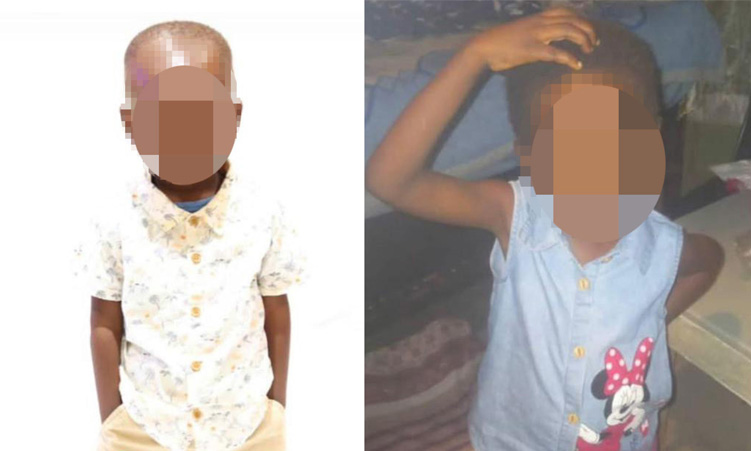
The man charged with strangling his two children on Sunday allegedly attempted to kill their mother last week.
The man (33), who is currently in police custody, handed himself over to the Oshikoto police yesterday.
He is charged with strangling the two toddlers, aged two and four, at Onkani village in the Omuntele constituency on Sunday at around 22h00.
Johanna Ndashiwa – a cousin of Maria Nghulikwa, the children’s mother – who had been close to the couple in Windhoek, says the suspect has attempted to murder his girlfriend of five years twice before.
Ndashiwa says the man tried to strangle Nghulikwa with a rope at their house in the Okahandja Park neighbourhood last Monday.
Nghulikwa, however, survived.
The suspect again attempted to kill the children’s mother on Wednesday night, she says.
This time Nghulikwa lost consciousness.
“Before the first incident, we were at their place at night and I did not notice any signs,” she says.
Ndashiwa says when Nghulikwa freed herself from the rope, she asked the suspect why he tried to kill her.
“He said he just wanted to kill her and himself,” Ndashiwa says.
She says since the first attempt, the suspect had been following Nghulikwa to prevent her from going to the police.
She says Nghulikwa reached out to the man’s sister to tell her about the incident and requested a family meeting.
“The suspect’s sister told her [Nghulikwa] to go to church,” Ndashiwa says.
Nghulikwa last Thursday managed to escape the suspect, went to Katutura Police Station and was referred to Wanaheda Police Station.
The police went to their house when the suspect did not answer his phone.
“When she was at the police station, the suspect took the children and went to the north with them,” Ndashiwa says.
On Thursday, she called Nghulikwa’s number and the suspect answered.
“He picked up and told me he was taking the children to the north. I asked him if they had a fight and he said no. I was just like, they have relationship problems,” Ndashiwa says.
At about 15h00 on Friday, the suspect called Ndashiwa and asked her to speak to his mother to confirm that they arrived at Onkani village.
On Sunday, the suspect sent a message to Ndashiwa, saying he wanted to speak to her.
“He messaged me saying he murdered the children and that we should go get them from the water tank. I did not believe it at first and thought he was just being smart with me,” she says.
She then heard from the suspect’s younger sister who was at the village that the children were found dead at the water tank.
“I also thought the younger sister was shocked and I asked to speak to his mother, and she told me they were dead. I asked if there was blood and she said no, they were waiting for the police to arrive at the scene,” Ndashiwa says.
When she confirmed the news, Ndashiwa went to the police and reported the case.
Ndashiwa then took Nghulikwa to the hospital to see a social worker.
“She is shocked by the death of her children,” she says.
Oshikoto regional crime investigations coordinator Titus Ekandjo says the suspect was found on top of the tank where he strangled his children, claiming he wanted to kill himself.
“It was dark and only the light of his cellphone could be seen. He then vanished,” he says.
The bodies were taken to Omuthiya police mortuary for a postmortem examination.
Ekandjo says the police are investigating the matter.
‘RECYCLED TRAUMA’
Counsellor Joyce Tjizu describes the incident as shocking, saying that such events are painful reminders of the absence of proper mental health services that continue to affect Namibians in devastating ways.
“These are not random acts but symptoms of unresolved trauma, untreated mental illness and a society that has never been given the tools to heal,” she says.
She says the consequences are undeniable with the horrific murders of women, children and the elderly – often at the hands of close relatives shocking the nation with alarming frequency.
“The failure to prioritise mental health with only a handful of psychiatrists in the country and most services based in Windhoek has been Namibia’s greatest gap since independence. Stigma keeps many silent. As a result, trauma is recycled within families and across generations,” she says.
Tjizu calls for training and deploying professionals to every region and investing in community-based support.
“We cannot build a peaceful, safe and prosperous Namibia without confronting the mental health crisis,” she says.
She also proposes a platform where people can express themselves freely and gain autonomy over their feelings and bodies as one of the strongest tools against violence and silence.
“If we choose to invest in mental health, listen to people and teach healing alongside history, we can raise a generation that breaks free from the chains of inherited trauma. The story of Namibia need not be one of endless scars, it can be one of resilience, courage and renewal,” she says.
In an age of information overload, Sunrise is The Namibian’s morning briefing, delivered at 6h00 from Monday to Friday. It offers a curated rundown of the most important stories from the past 24 hours – occasionally with a light, witty touch. It’s an essential way to stay informed. Subscribe and join our newsletter community.

The Namibian uses AI tools to assist with improved quality, accuracy and efficiency, while maintaining editorial oversight and journalistic integrity.
Stay informed with The Namibian – your source for credible journalism. Get in-depth reporting and opinions for
only N$85 a month. Invest in journalism, invest in democracy –
Subscribe Now!