



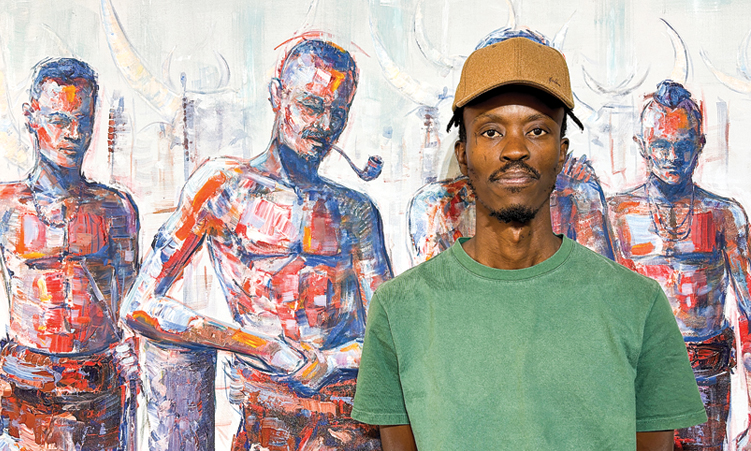
The significance of Namibian clans, their totems and the importance of these encoded archives colour the frames of Nambowa Malua’s ‘Neotypes: Totemic Systems in the Age of the Machine’.
The exhibition is currently on display at the Franco Namibian Cultural Centre in Windhoek.
As Malua paints scenes of power, ritual and survival, totems and totemic systems are signified in anamorphic zebra, venerated lions, cattle horns and luminous spirit animals.
Drawing on the totems and symbols of Aawambo and other Namibian cultures, Malua considers historic structures of kinship, community and classification while reflecting on the emergence of contemporary clans and modern symbolism.
“For ‘Neotypes’, I went down the rabbit hole of totems and totemic systems in Namibian traditions and why we have them. And I found that there is always a story behind them,” says Malua.
“An ancestor survived a crisis with a certain animal. An animal led people to water or to safety. A group survived famine because of a certain plant or an object that was used for survival. These are deep stories. And, over time, people would say: We are the people of that thing.”
The word ‘neotype’ refers to a type specimen that is selected to replace a pre-existing type specimen that has been lost or destroyed.
“Neotype is a highly biological word used in speciation,” says Malua. “I don’t want to say that the old totems are being replaced, but I would say that new ones are forming. I think, to see that properly, it’s important for us to retrospect.”
A painting that speaks most clearly to this core idea is Malua’s ‘City Girl Energy’. The image depicts a fashionable young woman using a traditional method of ploughing as a pair of draft oxen pull the apparatus through the soil.
Seemingly visiting her village from the city, the woman knows the ways of her ancestors and honours this traditional way of work.
“I’ve met a lot of people of my generation, men and women, who live in the city and, over time, they really come to appreciate the value of being connected to nature,” says Malua.
“The city girl is a neotype. You can have that city girl energy, but you can also be connected to your roots. You can learn the language. You can learn the rituals. You can learn the type of work.”
Though men typically engage in this kind of ploughing, Malua depicts a woman steering the equipment to signify evolving gender roles and to speak to women’s power.
In ‘The King’s Daughter’, which portrays artist Tuli Mekondjo as a regal, futurist queen embellished with the horns of her clan, Malua honours one of the women he finds most powerful.
Deeply attuned to the ancestral realm and engaged in the work of reclaiming and repurposing colonial-era photographic archives, Tuli Mekondjo is a modern figure whose purpose, practice and visual language stretch deep into the past and well into the beyond.
“Tuli Mekondjo’s work resonates with me because she’s doing a lot of ancestral work. She is able to tap into something really powerful and I think that deserves to be celebrated and archived,” says Malua.
Archiving is of particular importance to Malua. The artist sees traditional totems as encrypted archives that open into profound wells of oral history that used to organise societies while dictating behaviour, ideology and psychology from birth, through marriage and until death.
“Totems are compressed archives. Instead of saying, we survived the drought, we settled the floodplains, we learned to farm millet, that history is encoded in one symbol. And then the elders would unpack it, if necessary and when needed,” says Malua
“They are also very important for recording survival history. In modern times, they are still significant. If you bring a person home that you intend to marry, your parents will still ask about their clans and totems and if the clans don’t match, they will advise.”
In ‘Neotypes’, Malua considers the role, relevance and nuances of traditional totems in the age of the machine.
“Just as totems were used to organise societies, technology and psychology are now used to organise societies in a physical and metaphysical sense. In ancient times, this organisation might have taken longer but now there is an acceleration to things,” he says.
“It’s really easy for people to come together under a certain cause or symbol in a much more rapid way than before. The totems we have kept from our oral tradition are meeting the pressures of technology and psychology. And this is what we are trying to discuss,” he says.
“Are there new totems, rites and rituals emerging and will the archaic ones be relevant for much longer?”
Join Nambowa Malua for a ‘Neotypes’ art talk at 18h00 on 19 March at the Franco-Namibian Cultural Centre in Windhoek. ‘Neotypes’ will be showing until 27 March.
In an age of information overload, Sunrise is The Namibian’s morning briefing, delivered at 6h00 from Monday to Friday. It offers a curated rundown of the most important stories from the past 24 hours – occasionally with a light, witty touch. It’s an essential way to stay informed. Subscribe and join our newsletter community.

The Namibian uses AI tools to assist with improved quality, accuracy and efficiency, while maintaining editorial oversight and journalistic integrity.
Stay informed with The Namibian – your source for credible journalism. Get in-depth reporting and opinions for
only N$85 a month. Invest in journalism, invest in democracy –
Subscribe Now!