


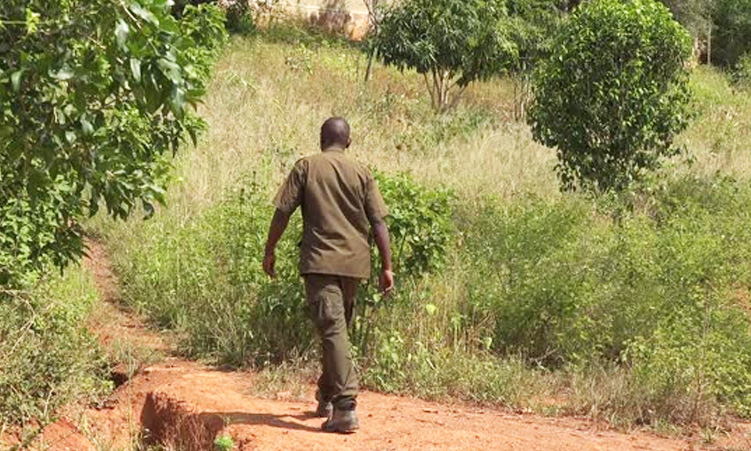
Sesheke village resident Simasiku Libuto says he last week walked for two hours to the nearest clinic to get treated for malaria.
This was despite feeling unwell, he recounts.
Libuto and other residents in the Kongola constituency of the Zambezi region have to walk over 10 kilometres or more to the nearest clinics.
The Zambezi region is among the regions experiencing a spike in malaria cases, with about 2 026 cases and four deaths reported this year.
In the northern and north eastern parts of Namibia, about 8 760 malaria cases and 11 deaths were recorded in January; a 68% increase compared to the same period last year.
Libuto adds that upon arrival and testing at Sesheke Clinic, he tested positive for malaria.
“I started feeling sick on Tuesday but I did not have money for transport.
I got worse on Thursday night, and there was no ambulance to call,” he says. “So I decided to walk the next morning to the clinic to get help.
It was not an easy journey but I am glad that I got myself to the clinic. I am now recovering well.”
Kongola, which is a 5 174 km2 area, has three clinics – Cheto, Choi, and Sesheke.
Kongola-based community activist Glen Shebo says while others dare to walk long distances to the clinics, some are discouraged by the vast stretches.
He adds that as a result, the villagers only seek help when it is too late.
“The reality is that many of these families are living in poverty; as such, transportation money is not readily available.
Hence, they walk over 10 kilometres daily for medical help for malaria and other sicknesses,” Shebo says.
“Community nurses are also there, but people are also unable to call them due to network challenges or lack of airtime.”
He urges the government to provide all the affected communities with mosquito nets before the outbreak gets worse.
“It’s not good enough that the government only provides medicine after the fact or sprays people’s houses.
They must now look into other preventive measures such as mosquito nets for everyone and also provide other mosquito repellents,” Shebo says.
Zambezi regional health director Woita Kapumburu has acknowledged the resurgence of malaria cases in the region, particularly at Choi, Sesheke, Chetto, and Katima Mulilo.
He adds that a malaria outbreak response has been activated, with teams being deployed to the hotspots for focus investigations, malaria testing, and treatment.
“We are continuing to strengthen community engagement, surveillance, early diagnosis, prompt treatment, and vector control measures.
Collaboration with both political and traditional leaders, stakeholders, and communities remains a key pillar for a successful response to the malaria outbreak and, by so doing, prevents further transmission, illness, and deaths,” he says.
Kapumburu adds that the indoor residual spraying (IRS) campaign is effective, however, malaria transmission can still occur due to factors such as population movement, outdoor mosquitoes, and unsprayable or inaccessible structures.
“IRS is most effective when implemented as part of an integrated vector management approach.
This includes the use of long-lasting insecticide-treated mosquito nets, larviciding of active mosquito breeding sites, usage of personal protective measures such as wearing long-sleeved clothing, use of mosquito repellents, covering stagnant water with sand, and maintaining clean surroundings to reduce mosquito breeding,” he says.
Kapumburu says the region received over 12 000 mosquito nets for distribution to affected communities.
Former health minister and malaria elimination ambassador Richard Kamwi on Tuesday warned that Namibia is likely to record more malaria cases and deaths this year.
He said the country’s malaria outbreak is due to the poor execution of established control measures, particularly IRS, despite clear World Health Organisation guidelines and regional commitments to eliminate the disease.
Independent meteorologist Vilho Ndeunyema says while long-term rainfall predictions remain uncertain, the next 30 days are expected to bring significant rain to northern Namibia.
“We should expect a lot of rain to fall over the northern parts of Namibia.
Areas like Oshakati, Ongwediva, Zambezi and the northeast are the usual high-risk malaria zones. Central and southern parts remain low risk,” he says.
In an age of information overload, Sunrise is The Namibian’s morning briefing, delivered at 6h00 from Monday to Friday. It offers a curated rundown of the most important stories from the past 24 hours – occasionally with a light, witty touch. It’s an essential way to stay informed. Subscribe and join our newsletter community.

The Namibian uses AI tools to assist with improved quality, accuracy and efficiency, while maintaining editorial oversight and journalistic integrity.
Stay informed with The Namibian – your source for credible journalism. Get in-depth reporting and opinions for
only N$85 a month. Invest in journalism, invest in democracy –
Subscribe Now!