




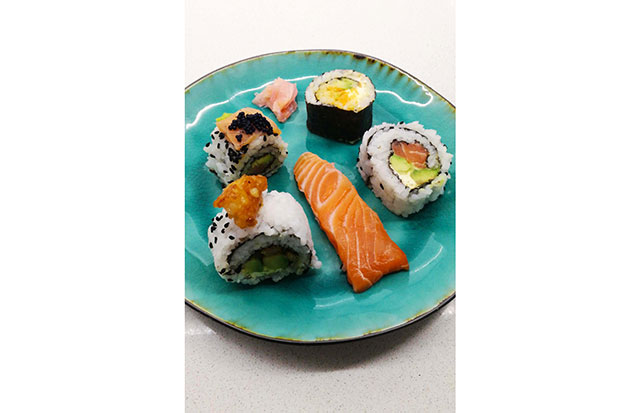
While restaurants, single quarters and street vendors were temporarily prohibited, who among us did not frantically attempt to replicate the tender cuts of meat from their preferred kapana guy, try their hand at baking that cake from their favourite coffee shop or gulp down a travesty of homemade KFC?
Frankly, during lockdown, there were stunts, the most ambitious of which includes sushi.
For those of you who haven’t sampled the Japanese dish at local spots such as Daisho Sushi & Wine Bar, Haiku and Cape Town Fish Market, sushi is vinegared rice served with a variety of fillings and toppings including raw fish, seafood and vegetables.
Attractively rolled and artistically arranged, sushi is beautiful to behold and may seem intimidating to prepare. However, as I came to learn during a particularly intense lockdown craving, making rudimentary yet delicious sushi is pretty easy.
1. To begin, you will need sushi rice, rice vinegar, white sugar, salt, a few sheets of nori (edible seaweed), a bamboo rolling mat, plastic clingwrap to cover your mat and some fillings like avocado and salmon. I got all my ingredients at SuperSpar at Maerua Lifestyle Centre in Windhoek. Tip: get sushi grade raw fish by ordering salmon and/or tuna sashimi at the restaurant inside Spar if there isn’t any on the shelf.
2. Prepare your sushi rice as per instructions on the bag after washing thoroughly to remove excess starch. Sushi rice is a special kind of rice so make sure it says “sushi rice” on the bag. Three cups of rice are enough to make five or six sushi rolls which can then be cut into eight pieces per roll. Add a mixture of a 1⁄4 cup of rice vinegar, two tablespoons of sugar and two teaspoons of salt to a pot, cook and stir it over low heat until the sugar and salt are dissolved. When both the rice vinegar mixture and rice have cooled, mix the mixture into the rice. Wrap your bamboo mat in cling wrap covering both the front and back, place a sheet of nori (rough side facing up, shiny side facing down) on the mat and spread about a handful of rice evenly over the sheet of nori.
3. Once you have spread your rice evenly on the nori, you can either flip it over so the green side is facing upward to make an inside-out roll/California roll (sushi with the rice on the outside) or keep the rice facing upward to make maki (sushi with the seaweed on the outside). Fill the roll with a few lines of toppings of your choice near the edge closest to you. A nice vegetarian option is a line of avocado with a line of grated carrots mixed with spicy mayo as a substitute for spicy tuna. Fillings are up to you but avocado, salmon, tuna, cucumber, prawns, carrots and cream cheese are popular.
4. When you have filled your sushi roll, lift the end of the bamboo mat closest to you and start rolling it away from you to the other end of the mat. Grip the mat firmly, roll slowly and tuck in any filling that may be falling out. The Cling Wrap is there to stop your rice from getting stuck to the bamboo.
5. Once you have rolled your sushi to the end of the mat, you will have one long sushi roll. Add toppings like sesame seeds, salmon, avocado or drizzles of spicy mayo to your large uncut roll. Once you are satisfied with your roll, use your sharpest knife to cut your sushi roll in half, then cut those halves in half. You should then have eight pieces of sushi per roll.
6. Plate and serve your sushi. Sushi can be enjoyed with tiny dollops of wasabi (a potent green paste made primarily of Japanese horseradish), soy sauce and pickled ginger.
This is how I got it right, but if you need someone to walk you through it as you go, YouTube has DIY sushi videos galore. Homemade sushi is a fun activity to do with friends, as the main event of a birthday party or simply when the craving hits. Try this at home and particularly on 18 June which is International Sushi Day.
In an age of information overload, Sunrise is The Namibian’s morning briefing, delivered at 6h00 from Monday to Friday. It offers a curated rundown of the most important stories from the past 24 hours – occasionally with a light, witty touch. It’s an essential way to stay informed. Subscribe and join our newsletter community.

The Namibian uses AI tools to assist with improved quality, accuracy and efficiency, while maintaining editorial oversight and journalistic integrity.
Stay informed with The Namibian – your source for credible journalism. Get in-depth reporting and opinions for
only N$85 a month. Invest in journalism, invest in democracy –
Subscribe Now!