




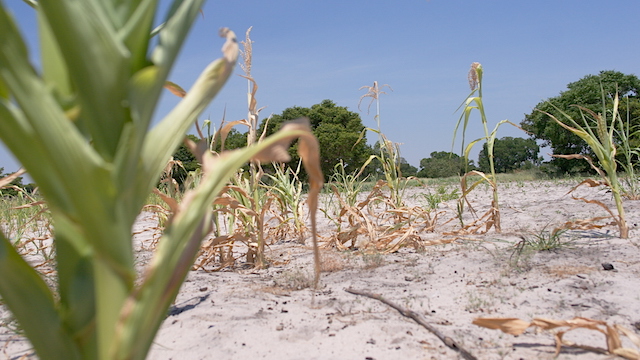
This marks a significant 51.84% drop from the 2023/24 season and threatens the country’s food security.
According to the Namibia Agricultural Union annual report for 2023/24, this sharp decline reflects the ongoing impact of the poor rainfall the country received.
Similarly, local wheat production suffered a dramatic decline, with only 2 984 tonnes produced in 2024/25, a staggering 83.72% decrease from the 2023/24 season where 18 328 tonnes was harvested.
Agronomic Producers Association (APA) chairperson Gerald Engelbrecht attributes this reduction largely to the low Hardap Dam water levels which suspended irrigation supply.
“As a result, wheat imports rose to 126 654 tonnes, covering 97.7% of local demand,” he says in the report.
Engelbrecht says Namibia produced about 98 824 tonnes of maize in the 2022/2023 season and imported 92 205 tonnes of maize, meaning local production surpassed imports by 7.2%, leaving the total demand for white maize at 191 028 tonnes that year.
“Poor rainfall and market dynamics negatively affected the production of white maize for the 2023/2024 season.
“As a result, the recorded figures of white maize for 2023/2024 stood at 67 747 tonnes, which is 31.4% less than what was marketed during the same period in 2022/2023,” he says.
Production in the Karst and Central areas decreased by 52.6% and 29.9%, respectively, while in the south, maize production increased by 20.8%.
The white maize price per tonne was N$7 386.06 in the 2024/25 marketing season, showing an improvement of 28.77% when compared to the 2023/2024 season, the report says.
Meanwhile, Namibia recorded local wheat production of about 18 328 tonnes for 2023/2024, indicating a decrease of 25.8% from the 2022/2023 period, and a further 83.72% drop in the 2024/2025 period when only 2 984 tonnes of wheat was locally produced.
“Wheat imports were estimated to be 126 654 tonnes in the 2024/2025 season, constituting 97.7% of local demand and producers received on average N$7 453.03/tonne, demonstrating an improvement in price of 6.88% from the previous season,” says Engelbrecht.
He says the production of irrigated groundnuts increased, leaving the estimated production for the 2024/2025 season at 4 000 tonnes, and the price at N$17 000 per tonne.
“A good number of producers diversified to groundnut production, hence the estimated production increased significantly by 233.33%,” he says.
Engelbrecht says during the period under review, the APA negotiated with the Namibian Grain Processors’ Association for wheat producers to receive a 3.6% levy (i.e. arrears/arrears of salaries) on the marketing during the 2022 season.
“In value, farmers received about N$292/tonne, worth N$7.1 million as 24 195 tonnes were marketed in 2022,” Engelbrecht says.
– email: matthew@namibian.com.na
In an age of information overload, Sunrise is The Namibian’s morning briefing, delivered at 6h00 from Monday to Friday. It offers a curated rundown of the most important stories from the past 24 hours – occasionally with a light, witty touch. It’s an essential way to stay informed. Subscribe and join our newsletter community.

The Namibian uses AI tools to assist with improved quality, accuracy and efficiency, while maintaining editorial oversight and journalistic integrity.
Stay informed with The Namibian – your source for credible journalism. Get in-depth reporting and opinions for
only N$85 a month. Invest in journalism, invest in democracy –
Subscribe Now!