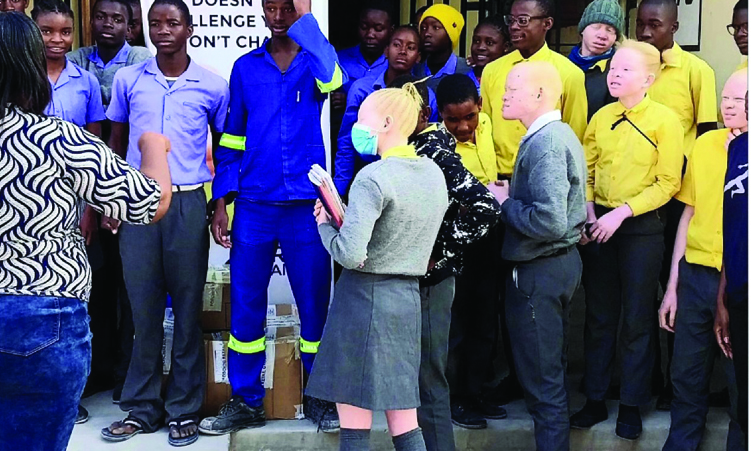
The education ministry is prioritising the integration of pupils with disabilities into mainstream schools to improve accessibility, despite concerns regarding infrastructure and specialist training.
Executive director of education, innovation, youth, sport, arts and culture Erastus Haitengela says this would allow children with disabilities access to education while staying close to their primary support systems.
The ministry’s response follows concerns raised by principals and parents for additional classrooms and at least one special needs school to be built per region.
Critics say many children with special needs remain at home as schools face a major capacity crisis.
The Namibian previously reported that there were only three special schools in the country – Eluwa Special School at Ongwediva, and Môreson Special School and Dagbreek School for the Intellectually Impaired in Windhoek.
Haitengela, however, says Namibia has 12 resource schools.
These include Gabriel Taapopi School at Ongwediva, Haimbili Haufiku Secondary School in the Ohangwena region, and Cosmos High School in Windhoek.
“While such schools remain important, the ministry’s strategic direction is to strengthen inclusive education within mainstream schools.
Construction of new facilities will depend on the disability type, data of pupils not in schools per region, and whether resources are available to cater for them,” he says.
Haitengela says inclusive education will focus on four categories of disabilities – hearing impairment, visual impairment, learning difficulties and intellectual impairment – supported through a combination of resource schools, resource units and inclusive mainstream schools.
Haitengela says feasibility studies and consultations are currently ongoing to determine where additional specialised facilities may need to be prioritised.
At the same time, the ministry recognises the need for additional infrastructure, adding that plans to expand classrooms are integrated into its strategic plan and annual development budget submissions.
Haitengela says the ministry recruits all teachers based on regulations and processes prescribed by the Office of the Prime Minister.
This is in response to whether special training is needed for teachers to teach pupils with disabilities.
“It is not always possible due to a shortage of such teachers . . . Qualified teachers who meet requirements are eligible to teach these pupils with additional in-service training and continuous professional development facilitated by the ministry,” he says.
Haitengela has announced plans to build a 13th resource school at Kamamjab, for which the groundbreaking already took place last April.
IDEA WELCOMED
Autism Association director Petra Dilman says as long as there is special support and the classrooms are not too big, the idea is welcomed.
“Inclusive means everybody is included, but they must get the right support.
We will need class assistants and the curriculum adapted,” she says.
Dilman urges schools to implement policies on bullying, adding that not only those with disabilities are likely to be bullied but those without as well.
Down Syndrome Association chairperson Levien Smit, welcomes the idea, but says schools still need to become physically accessible with smaller classes and assistant teachers.
“That’s what we want. However, the way most schools run at the moment is not suitable for inclusive education. We don’t want to be segregated,” she says.
Smit says challenges often come after Grade 7, urging for stronger collaboration between technical and vocational education institutions and higher education.
“Pupils who do not pursue university studies should have opportunities to enrol at vocational schools where they can acquire practical life skills and improve their employability,” she says.
Smit says one in three pupils may be bullied, urging leadership programmes and campaigns to develop and teach skills to stop bullying.º
In an age of information overload, Sunrise is The Namibian’s morning briefing, delivered at 6h00 from Monday to Friday. It offers a curated rundown of the most important stories from the past 24 hours – occasionally with a light, witty touch. It’s an essential way to stay informed. Subscribe and join our newsletter community.

The Namibian uses AI tools to assist with improved quality, accuracy and efficiency, while maintaining editorial oversight and journalistic integrity.
Stay informed with The Namibian – your source for credible journalism. Get in-depth reporting and opinions for
only N$85 a month. Invest in journalism, invest in democracy –
Subscribe Now!