Local communities in the vicinity of Osino Gold Exploration and Mining’s Twin Hills gold project have been advised to acquire basic skills that would make them marketable when the mine opens in two years.
Osino operational readiness manager Ralf Schommarz during a recent media tour of the mine site, organised by spokesperson Laschandre Coetzee, said the project’s development is on schedule.
In two years’ time, US$900 million (N$17.55 billion) would have been sunk into the project, which is envisaged to employ between 400 and 450 workers, Schommarz said.
The Twin Hills project, named after two identical adjacent hills in the area, was bought by Chinese company Shanjin International Gold Co Ltd from Canadian mine developer Osino Resources for US$450 million (N$8.77 billion).
Schommarz said the company will spend another US$450 million to set up the mining plant and other infrastructure in the next two years.
The mine will coordinate employee recruitment with the Ministry of Justice and Labour Relations.
‘MAXIMUM BENEFIT TO LOCALS’
“We will be using contractors to construct the mine, but whenever we can maximise local benefit we will do so. We have to balance with the requisite skills we need, and these will be from the labour ministry’s data base,” said project support manager Charles Loots.
The site is located about 25km northwest of Karibib in the Erongo region, within Namibia’s prospective Damara Orogenic Belt, in proximity to and along strike of the producing open-pit Navachab and Otjikoto gold mines.
“While the mine has its own skills upgrading programme, this will benefit those already employed.
Before that people must make themselves competitive so they can be hired based on some skills they have,” Schommarz said, adding that people must “help themselves to be helped”.
This was echoed by Liza Gawanas, an employment officer at the labour ministry, who said the ministry will collaborate with the mine to find the right people as per government policy.
She said designated employers of more than 10 people are required to recruit employees through the ministry’s database.
“If the mine wants people with basic welding skills or forklift drivers, for example, and there are none among locals, these can be brought in from other regions of the country,” Gawanas said.
Schommarz said before recruiting, they would have to build the processing plant first.
“We will build a bigger plant than that at B2Gold and Navachab mines to process five million tonnes of ore per year, with an expected output of two to two-and-a-half ounces of gold per tonne,” he said.
The mine is expected to produce about 132 000 ounces of gold a year.
Coetzee said the ground-breaking ceremony is expected around June this year.
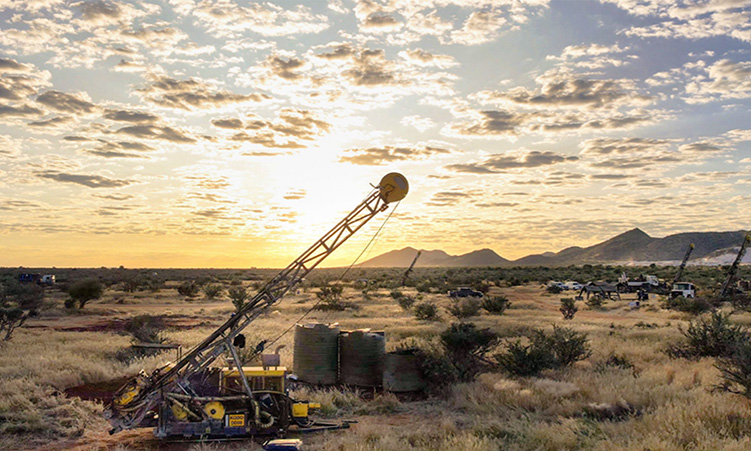
“At the moment we are doing controlled drilling to get more samples, with about 20 people working on the two drill rigs on site,” she said.
The expected life of the open-cast mine has been put at 13 years, but Schommarz said it could go up to 20 years.
He said while the mine will source water from its sources within the licenced area, it has in collaboration with NamWater investigated the feasibility of abstracting water from the Kranzberg Aquifer at Usakos.
“We will also draw water from the Swakoppoort Dam in future,” he said.
On social responsibility, Schommarz said the mine will focus on assisting communities with early childhood development.
“We will be looking at education, because that’s the best place to add value,” he said, adding there will be no housing for workers at the mine, who will be commuting from the nearby towns of Karibib, Usakos and Omaruru.
– email: matthew@namibian.com.na
In an age of information overload, Sunrise is The Namibian’s morning briefing, delivered at 6h00 from Monday to Friday. It offers a curated rundown of the most important stories from the past 24 hours – occasionally with a light, witty touch. It’s an essential way to stay informed. Subscribe and join our newsletter community.

The Namibian uses AI tools to assist with improved quality, accuracy and efficiency, while maintaining editorial oversight and journalistic integrity.
Stay informed with The Namibian – your source for credible journalism. Get in-depth reporting and opinions for
only N$85 a month. Invest in journalism, invest in democracy –
Subscribe Now!