



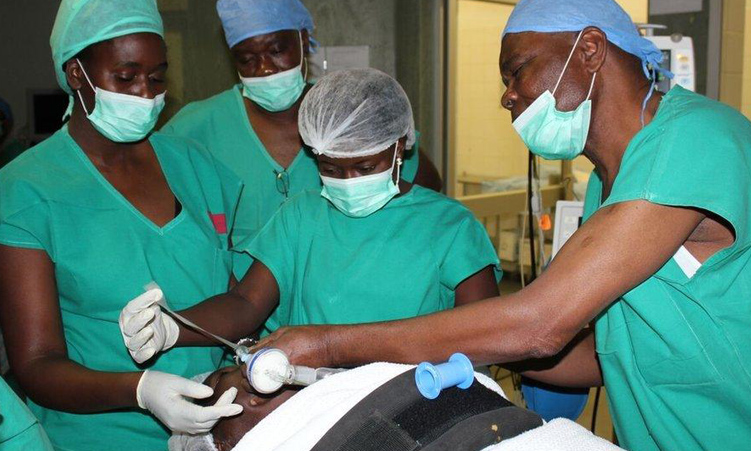
Zambian surgeon Dr Alex Makupe completed his surgical residency at Tygerberg Hospital in South Africa’s Western Cape, because there were no teaching hospitals catering for surgeons in his home country.
At the end of his residency, as he was planning to return to Zambia, one of his colleagues said to him, “You’ll be back in six months!”.
This is typical of the healthcare worker brain drain Africa is faced with – many doctors who leave their home country to complete their training do not come back.
Doctors tend to seek out the professional, lifestyle and income benefits of living in developed economies, but the drain isn’t only from developing to developed nations.
More developed countries in Africa frequently attract doctors and specialists from nearby countries who are behind the curve.
This leaves poorer countries with fewer medical resources – which has a knock-on effect on mortality rates and overall health outcomes.
According to the Lancet Commission on Global Surgery, countries with fewer than 20 specialist surgeons, anaesthetists and obstetricians (SAO) per 100 000 population have worse health outcomes.
To achieve the Sustainable Development Goals’ healthcare targets by 2030, 1.27 million new SAO providers would need to be trained in that timeframe.
“In the same way that doctors prefer to stay in an urban environment rather than a rural one, doctors prefer to go to more developed countries than the less developed ones.
So serious is that matter that the World Health Organisation (WHO) even passed a resolution about it, trying to stem it, to mitigate it,” said South African health minister Aaron Motsoaledi at the World Economic Forum in Durban earlier this year.
The WHO resolution states that no country should actively recruit doctors from their developing counterparts.
Within the Southern African Development Community, there is an additional agreement barring the poaching of medical staff between countries in the region – nonetheless, health professionals who have not actively been recruited may still make the jump because they know their skills are in demand. A teaching hospital is born
That demand is what Dr Makupe’s colleague anticipated would draw him back to South Africa. Instead, Dr Makupe elected to be part of the solution back home.
“If all of us just went back to our countries, it would make a very big difference,” he says.
“I went back to my province where there were only two Zambian surgeons for a population of 2.5 million.”
In 2009, Dr Makupe elected to get involved in starting a surgeon’s teaching hospital in Ndola Province, believing that surgeons trained in Zambia would be more likely to stay in Zambia.
Until this time, the University of Zambia School of Medicine had been the single public medical school in Zambia for over 43 years, and had produced just over 1 200 doctors.
The starting of a second medical university was considered an urgent priority.
Ndola Central Hospital and Arthur Davidson’s Children’s Hospital were selected as the initial location of the administrative offices and the clinical training site, and on 14 November 2011, the training hospital admitted its inaugural class of 72 students – 26 were in the bachelor of dental surgery and 46 in the bachelor of medicine and bachelor of surgery.
Today, Ndola is an 800-bed university teaching hospital under the Copperbelt University.
It serves a wide catchment area and is a tertiary referral hospital for northern Zambia with an estimated population of 2.4 million.
But the teaching hospital doesn’t limit its activities to surgical training.
There is a great focus on primary healthcare, with the intention of heading off medical conditions before they require hospitalisation and surgery.
To this end, the hospital has a one-year training programme for community health assistants.
“These are people at the forefront in our communities, chosen by the chiefs, who send them for acceptance at the school, and after their training, they immediately get back into the community,” says Dr Makupe. “With their help, health promotion and disease prevention are targeted better.”
– BBC Africa
In an age of information overload, Sunrise is The Namibian’s morning briefing, delivered at 6h00 from Monday to Friday. It offers a curated rundown of the most important stories from the past 24 hours – occasionally with a light, witty touch. It’s an essential way to stay informed. Subscribe and join our newsletter community.

The Namibian uses AI tools to assist with improved quality, accuracy and efficiency, while maintaining editorial oversight and journalistic integrity.
Stay informed with The Namibian – your source for credible journalism. Get in-depth reporting and opinions for
only N$85 a month. Invest in journalism, invest in democracy –
Subscribe Now!