



The government is actively consulting with mining industry players to push for 51% ownership in new mining ventures. Currently there is no provision in the law for the government to acquire shares in mineral rights, apart from mineral agreements.
The state owns roughly 3.4%, 7.5% and 10% shares in various mining companies, an issue which has been flagged as concerning.
The only 50/50 shareholding currently exists between the government and De Beers Group in the Namdeb venture. Deputy prime minister and minister of industries, mines and energy Natangue Ithete says the government believes local empowerment is not only a matter of social justice, but also a cornerstone for long-term stability and sustainability in the sector.
“Among all these good developments, there are several licences issued where no activity has commenced. This must change, because mineral rights are granted with the intention of production.
“The ministry, together with the Namibia Investment Promotion and Development Board, is open to constructive dialogue to resolve legitimate challenges.
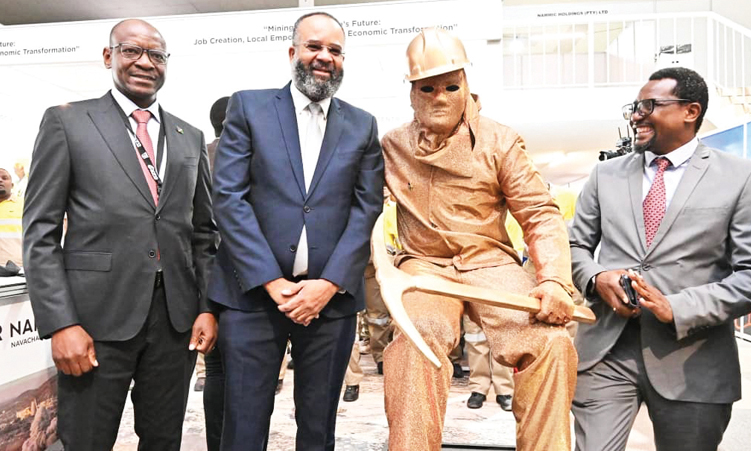
“However, we will not tolerate the hoarding of licences for purposes unrelated to national development. To this end, our ministry has already issued notices to non-compliant mineral rights holders and will soon engage them,” the deputy prime minister says. Ithete was speaking at the 2025 Mining Expo and Conference that kicked off in Windhoek yesterday.
This year’s theme is ‘Mining for Namibia’s Future: Job Creation, Local Empowerment, and Economic Transformation’.
He called for a new era of purpose-driven mining, rooted in transparency, local empowerment, and national development. Ithete urged industry stakeholders to go beyond traditional corporate responsibility and ensure the benefits of Namibia’s mineral wealth reach all corners of society.
“Let us mine not only for profit, but for our people. Our minerals must uplift lives, not just in boardrooms, but in the most remote areas of our country,” he said. Ithete reiterated that the government is currently reviewing the minerals bill and will soon commence stakeholder consultations, especially in key regions where exploration and mining are taking place.
He said the process is essential to ensure Namibian laws are fit for purpose and reflect the ambitions of an equitable and modern mining industry. Ithete further highlighted the sector’s capacity to empower communities and stimulate economic transformation.
Meanwhile, the deputy head of the upstream petroleum unit in the Presidency, Carlo McLeod, who was speaking on behalf of president Netumbo Nandi-Ndaitwah, announced that the country is diversifying its minerals portfolio, anticipating the development of a third gold mine to stimulate economic activity.
Mcleod said these developments open the door to numerous projects across various minerals subsectors, each offering new opportunities for investment, employment, and national development.
He said swift progress is needed to finalise the minerals bill to fully realise this growth trajectory and maintain the country’s competitive edge.
“This critical piece of legislation would modernise Namibia’s mining framework, making it more transparent, predictable, and fit for purpose. It will enhance investment attractiveness by providing clarity on licensing procedures, ownership structures, and regulatory obligations – key decision-making factors for both domestic and foreign investors,” Mcleod said.
He said the bill would align Namibia’s regulatory environment with evolving global expectations around environmental stewardship, social accountability, and responsible resource governance. “Its timely enactment will send a strong signal that Namibia is ready to lead in building a modern and inclusive mining sector,” he said. Chamber of Mines of Namibia president George Botshiwe highlighted the sector’s resilience and alignment with national priorities.
“These achievements reflect the sector’s alignment with our broader national goals, particularly the sixth National Development Plan, which prioritises industrialisation, inclusivity, and sustainable economic growth,” he said. Statistics show that despite significant global headwinds and a contraction of 1.2% in 2024, the mining sector remains the bedrock of the Namibian economy.
The industry generated N$52.3 billion in revenue, contributed 13.3% to the country’s gross domestic product, and created over 2 600 new jobs, bringing total direct employment to 20 843 – a 14.6% increase from the previous year.
In an age of information overload, Sunrise is The Namibian’s morning briefing, delivered at 6h00 from Monday to Friday. It offers a curated rundown of the most important stories from the past 24 hours – occasionally with a light, witty touch. It’s an essential way to stay informed. Subscribe and join our newsletter community.

The Namibian uses AI tools to assist with improved quality, accuracy and efficiency, while maintaining editorial oversight and journalistic integrity.
Stay informed with The Namibian – your source for credible journalism. Get in-depth reporting and opinions for
only N$85 a month. Invest in journalism, invest in democracy –
Subscribe Now!