






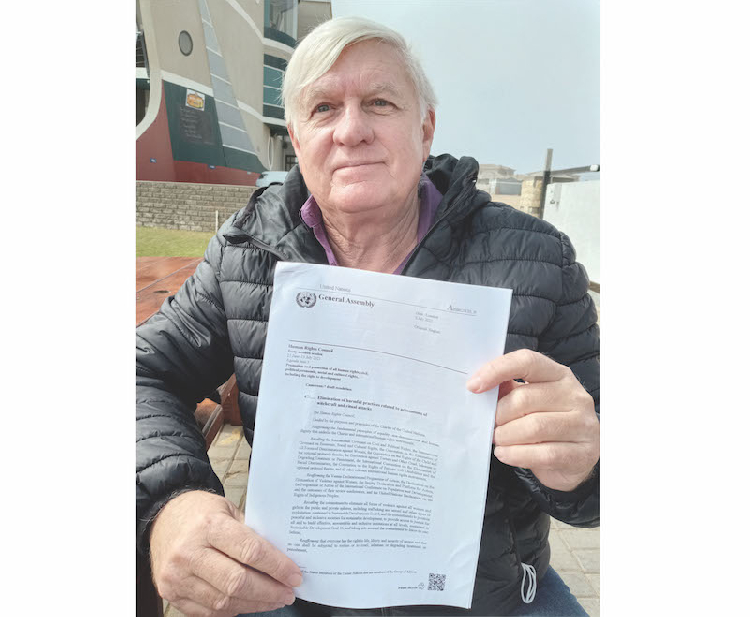
THE United Nations Human Rights Council (UNHRC) last month passed the first ever resolution on the elimination of harmful practices related to accusations of witchcraft and ritual attacks.
Local human rights advocates consider this an ideal opportunity for Namibia to review its 1933 Witchcraft Suppression Proclamation.
The resolution, which was adopted on 13 July, calls on member states (including Namibia) to condemn harmful practices related to accusations of witchcraft and ritual killings that result in human rights violations.
Member states are also urged to take all measures necessary to ensure the elimination of these harmful practices and to ensure accountability and the effective protection of all people – particularly those who are vulnerable.
Namibia’s inherited Witchcraft Suppression Proclamation states that “a person shall be guilty of an offence and liable on conviction to imprisonment with or without hard labour for a period not exceeding five years, or to a fine, or to any two or more of such punishments if he imputes to another the use of non-natural means in causing any disease in any person or property, or in causing injury to any person or property or names, or indicates another as a wizard or witch”.
The drafting of the resolution has come since 2015 and includes the work of various stakeholders.
One of these stakeholders is Alzheimer Dementia Namibia (ADN).
“Without amazing organisations like ADN, this would never have happened,” Gary Foxcroft, the project facilitator of the United Kingdom-based Witchcraft and Human Rights Information Network says.
ADN founder Berrie Holzhausen says the resolution would hopefully bring an end to the scourge of witchcraft-related crimes inflicted on vulnerable Namibians.
“Many people are accused of being witches and wizards, but are in fact people living with dementia.
With this resolution, Namibia’s Witchcraft Suppression law must be redesigned, so that the human rights of people living with dementia, and other elderly people accused of being witches and wizards are respected – not only in the common law, but also in traditional law,” he says.
Holzhausen says such practices have been going on in Namibia for ages under the guise of ‘traditional healing’ or ‘cultural practices’.
“For this reason there is a lack of political will to deal with the issue . . ,” Holzhauzen says.
He says he has approached political leaders, including the minister of justice, on the issue to no avail.
“They speak out against every attack on human rights, but ignore this issue,” he says.
Minister of justice Yvonne Dausab could not be reached for comment.
Ombudsman John Walters says the harmfulness of such practices is denied and they are therefore not brought before the courts.
According to Walters, the Ministry of Justice should submit the UN resolution to the National Assembly (NA), which must hold the executive accountable for the implementation of such resolutions, “but this does not happen”.
“I haven’t heard members of parliament discuss human rights issues in the past 17 years. That is what must happen,” he says.
He says the resolution should be referred to the Law Reform and Development Commission for possible amendment to the existing law, or to create new legislation.
NamRights director Phil ya Nangoloh says the resolution carries weight because Namibia has a witchcraft suppression act, which has never been repealed as a law.
“This resolution is inherent in our Constitution, but the problem is ignorance, which leads to the non-implementation thereof,” he says.
“It needs to be adapted as a matter of urgency, as a great part of our society is being affected by these types of practices.”