



ERONGO governor Cleophas Mutjavikua says regional authorities are looking into addressing the issue of an evicted farmer living on the B2 road corridor.
Ruben Dausab has been living on the B2 road corridor at Farm Wilhelmstal for the past six months after he was evicted by his long-time employer.
Wilhelmstal is situated between Okahandja and Karibib.
Commenting on the issue on Tuesday, Mutjavikua said Dausab has been on the waiting list for a while now and that his issue will be tabled next week at the regional resettlement committee meeting.
“I know of his situation. I also went to where he is staying several times. He is a good farmer but there is only so much that a regional office can do,” he said.
The governor also said the region is experiencing a lot of these cases of late.
“These cases also happen when government buys farms and then goes on to dump the workers onto the corridors. There is a similar issue at Omaruru now. We are experiencing a lot of problems with farm workers who are being dumped onto the corridors. It is a serious problem in the region. The communal areas are too small and there is not enough grazing,” he said.
Although Dausab (54) says he was evicted from Farm Okondura Nord number 5 after falling into a sewer drain and sustaining a back injury last year, farm owner Gerhard Liedtke says they parted ways peacefully.
Dausab worked at Okondura Nord for 35 years since he was 13. He never thought he would end up next to the B2 road trying to keep his livestock from dying of thirst or from being shot by nearby farmers or run over by passing vehicles.
Born and raised on several farms in the Karibib district where his parents and other family members worked, Dausab attended primary school at Otjimbingwe before settling at Okondura Nord after working there during school holidays.
When Liedtke took over the farm after his father’s death, the two worked together harmoniously until 10 years ago when problems started brewing.
Liedtke, who acknowledged Dausab as a hardworking man, said there were many issues that caused them to part ways.
He said Dausab became too comfortable, working at his own pace and disappearing for two months without warning each year for the last two years.
According to him, Dausab had also demanded 1 000 hectares from his private land as payment for years of service.
“I also paid him out [N$18 000]. But now I see he is starting war again. I do not understand it. I did not get rid of him, he resigned.
He knows why he had to go.
“We had a drought and I asked him to reduce his livestock. He did not take care of his livestock well and lost his sheep to wild animals. Now he is crying to everyone,” he said.
Liedtke said Dausab had tried many times to get his own farm but he is blaming everyone else for failing to do so.
In the meantime, Dausab has been living in this corridor, he has put up four shacks and two kraals close by, a sign that he and his family will be at the spot for a long time if nobody gives them a place to go to.
Despite the fact that the Dausab family has been given the boot and are forced to live next to the road, and have to put up with farmers who continuously threaten them, the family has chosen to be positive and to live well despite their circumstances.
Dausab has continued to use his skills which he had picked up over the years and through various training sessions he had been exposed to in his line of work. He had managed to accumulate a lot of livestock from what he was paid and to date he has 60 cattle, 30 chickens and 36 goats. He, however, lost about 20 sheep to wild animals.
He has built a kraal from thorn bushes for his cattle and goats as well as a little chicken coop behind his shack.
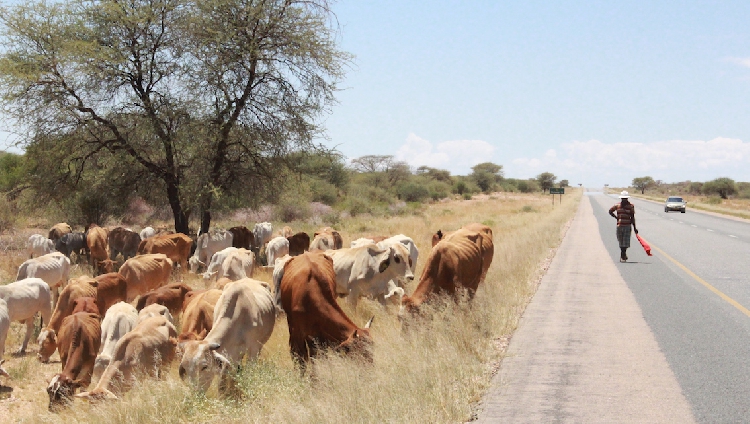
found the family preparing to graze the cattle on the side of the road where the grass grows.
Dausab and his son Danki run across the road to stop the cattle from straying onto the road in case they are hit by speeding motor vehicles.
An exhausted and frustrated Dausab said he had hoped to get a small piece of land from the farm owner as payment for his years of service.
He said he has a family to feed but also has enough livestock to carry on but now, things do not look bright in his world as he has lost hope.
Dausab pleaded with government to look into his plight and give him a piece of land.
“(Some of) my family members and relatives are working on farms, and do not own anything. Where am I supposed to go now with my family and my livestock?” he said.
Dausab also called on the government to look at the plight of workers who look after farms when the owners are away for long periods. He said most are kicked out of farms when the owners feel like it.