



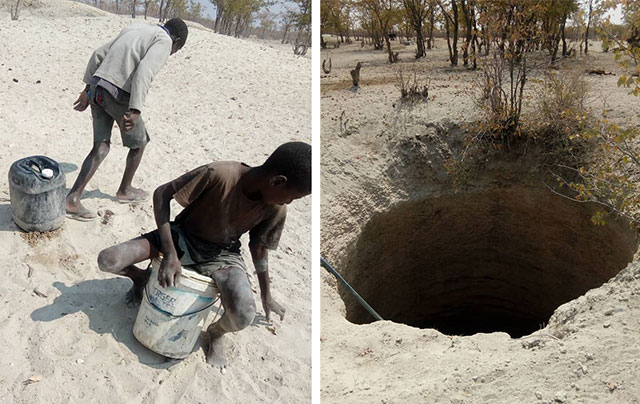
A DIRE shortage of water supply has pushed thousands of Amarika village residents in the Omusati region to the edge, forcing them to consume saline, contaminated water for close to 30 years.
Saline water, more commonly known as salt water, is water that contains a high concentration of dissolved salts.
Despite the obvious health dangers, the residents claim that the water is their most viable source under the circumstances.
The other water sources available to them are underground aquifers and boreholes.
They say such sources are, however, not viable, as their supply is not stable as they depend on erratic rainfall.
Also, setting up the boreholes has proven to be a dangerous undertaking as these are mainly dug by hand.
The local media in June reported on how two men died after being trapped underground for over a day at Okatope in the Oshikoto region.
The men were reportedly digging a well when it caved in and suffocated them in the process. Although reports at the time pointed to the difficulty that residents face due to acute water supply, authorities dismissed such claims.
Residents of Amarika village, however, painted a sad picture of a community hit hard by a water crisis.
Gotlieb Pius, who was born at Amarika village last week, told The Namibian that consuming saline water is the only option left to them as fresh water remains an elusive dream to many there.
“Underground water at Amarika is becoming unsafe to drink because it is highly salty and contaminated. Salt water is a huge problem here, but we drink it anyway since fresh water is scare. We do not have fresh water; this is the only source of water we have here”, he reiterated.
Pius said persistent calls on the government to come to their rescue had seemingly fallen on deaf ears.
“For years now, we have been waiting on the government to supply us with fresh water, but our plight is not being attended to,” he added.
Most farmers in the area have resorted to using water pumps to extract water for their animals.
A nurse at the community clinic, who preferred to remain anonymous, confirmed that a number of patients who frequent the local clinic suffer from diarrhoea and skin diseases – something residents claim emanates from the unhygienic water.
“The situation here is quite depressing. We usually hand out water-purifying sachets to community members, but in most situations, the clinic runs out of stock. Due to its remoteness, the villagers also go for days without water purification mechanisms”, the nurse narrated.
Agriculture, water and forestry deputy minister Anna Shiweda said during president Hage Geingob’s visit and townhall meeting at Outapi on Tuesday that they acknowledge the state of affairs at Amarika village.
“Due to insufficient rainfall experienced this year, the underground water at Amarika could not be replenished, and it has become very saline. Even if we try to drill more boreholes, the water is very salty, unfortunately. We have to see how far we can come with our pipelines. We have made strides, and we still have to continue working hard,” she noted.
Shiweda said the ministry will look at ways of how to supply the community of Amarika with fresh potable water in the near future.
The water tanker, which was supplied by the agriculture ministry to supply the residents with fresh water, broke down in 2018.
The N$200 million desalination plant donated by Germany is still out of order, and the agriculture ministry is experiencing difficulties to fix the machine, Shiweda said.
Omusati has 4,6% of the population living under the poverty line, according to the SDGs, while 8,6% of the region’s people depend on borehole water, according to the country’s sustainable development goals’ baseline report.
Namibia reached upper middle-income country status in 2014. Despite this, 25% of the rural population is considered poor, while 15,9% are severely poor.
The SDG report also indicates that 580 000 Namibians are affected by the drought, with 7,5% of the country dependent on borehole water, with 15,7% of the rural population dependent on borehole sources.
In an age of information overload, Sunrise is The Namibian’s morning briefing, delivered at 6h00 from Monday to Friday. It offers a curated rundown of the most important stories from the past 24 hours – occasionally with a light, witty touch. It’s an essential way to stay informed. Subscribe and join our newsletter community.

The Namibian uses AI tools to assist with improved quality, accuracy and efficiency, while maintaining editorial oversight and journalistic integrity.
Stay informed with The Namibian – your source for credible journalism. Get in-depth reporting and opinions for
only N$85 a month. Invest in journalism, invest in democracy –
Subscribe Now!