



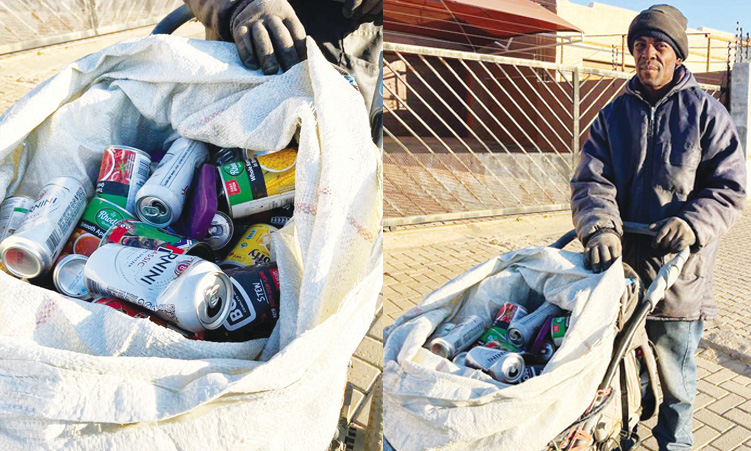
Every morning, Tate Jacobes Garoeb rolls through the streets of Windhoek with his companion – a trolley made from an old beaten up baby stroller with mismatched wheels.
The streets are quiet. The air is chilly. The only sound that can be heard is the old man gently rolling the stroller down the road as he whistles to himself.
He is dressed in blue jeans and a navy blue jacket and gloves.
The gloves are more for protection than the cold.
He stops at a bin, opens it and reaches deep into its belly.
He doesn’t even scrunch his face.
When his hand comes back up, it is strapped around a can of beer with a piece of paper stuck to it.
He scans the paper, throws it back into the bin, and rolls the stroller down to the next bin.
While rummaging, trash falls onto the ground. Garoeb does not bend down to pick it up, leaving a sign that someone had been through this one. He does not open every bin.
Garoeb rolls past a bin with a broken leg, as well as a straight one.
Not all bins are equal.
He finally stops at a house on the corner.
With this bin, he takes his time. His focus is simple: cans, glass bottles, and pieces of metal.
He retrieves something soft, a piece of clothing, pants.
Garoeb puts them along his torso, gauging whether they would fit him, and throws them in the stroller.
“I began this almost 20 years ago,” he says.
“You get used to the stench. Some people see dirt and rubbish, but I see opportunity.”
To the untrained eye, the world of bins is just that, but to Garoeb it’s almost a science. He knows what he’s looking for.
After his morning rounds, when all the bins have been cleared, his next stop is the City of Windhoek’s Buy-Back Centre, where he sells tin cans and bottles.
A kilogram of glass bottles and tins can earn him up to N$145.
What can’t be sold there, the batteries, wires, and heavier scrap, he takes to a scrapyard in the Northern Industrial Area.
Prices vary, but every kilogram counts.
“The money I make goes to food and toiletries,” he says.
Garoeb says he can make over N$1 000 during the festive season when people throw away a lot of cans and bottles.
But for the rest of the year it’s a hustle.
Garoeb says he got into informal recycling after years of struggling to find stable employment.
“I only went as far as Grade 8. But without papers, it doesn’t matter how skilled you are.”
Despite having welding and boilermaking experience, he says a limited education has always blocked him from securing long-term employment.
“I may not have a job, but I wake up early and I earn something without stealing from anyone,” he says.
For those like Garoeb, rubbish is evidence that we were all here.
That we all leave something behind.
In an age of information overload, Sunrise is The Namibian’s morning briefing, delivered at 6h00 from Monday to Friday. It offers a curated rundown of the most important stories from the past 24 hours – occasionally with a light, witty touch. It’s an essential way to stay informed. Subscribe and join our newsletter community.

The Namibian uses AI tools to assist with improved quality, accuracy and efficiency, while maintaining editorial oversight and journalistic integrity.
Stay informed with The Namibian – your source for credible journalism. Get in-depth reporting and opinions for
only N$85 a month. Invest in journalism, invest in democracy –
Subscribe Now!