



Namibia’s livestock sector saw a slow start to 2025, recording a sharp drop in market-ready animals due to widespread herd rebuilding efforts following good rains early in the first quarter of the year.
According to the Livestock Producers Association, the favourable weather has encouraged farmers to retain their animals, leading to reduced supply across key marketing channels.
“This has consequently led to contractions across all sectors, except for the pig sector, which grew during the first quarter of 2025. Livestock prices, on the other hand, improved as limited supply of animals drove up shortages,” trade and strategic marketing statistician Fransina Angula said recently.
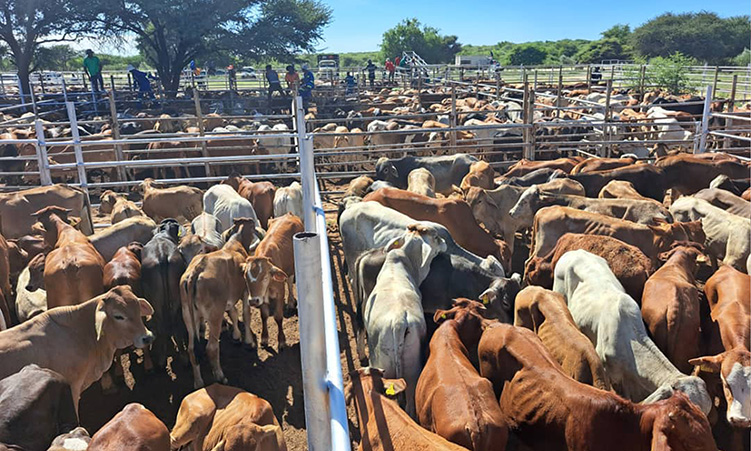
Market-ready cattle totaled 37 577 animals, representing a decrease of 58% compared to the 89 507 animals marketed in the same period of 2024.
Angula said the 2024 drought posed immense challenges for farmers, necessitating increased cattle marketing as a response to the harsh environmental conditions.
“Consequently, farmers experienced significant herd reductions, leaving them with minimal market-ready livestock during the current year,” Angula said.
Live exports, the largest segment, experienced a steep decline of 79.8%.
Similarly, export-approved abattoirs recorded a decrease, with throughput dropping by 24.2%.
“While slaughtering at domestic abattoirs has been affected by the overall industry contraction, the impact has been less severe than that on live exports. Export-approved abattoirs declined by 22% during the quarter under review,” Angula said.
Live cattle and beef prices remained higher than the level recorded during the first quarter of 2024. South of the veterinary cordon fence (redline), B2-grade averaged N$69.89/kg during the quarter, N$9.02/kg higher than the level recorded during the same period last year.
Meanwhile, the outbreak of lumpy skin disease led to restrictions on animal movement south of the redline.
These restrictions placed upward pressure on prices due to the reduced supply of animals at auctions. As a result, weaner prices averaged N$29.13/kg, 17.7% higher than the N$24.75/kg level recorded during the first quarter of 2024.
Beef exports totaled 1 425 615kg during the period under review, a significant decrease compared to the 2 936 183kg exported during the same period in 2024.
These exports were mostly directed to the European Union with a market share of 84.2%, Norway with 10.2%, the United Kingdom (UK) with 3.4%, China with 1.7% and South Africa with 0.8% market share.
Furthermore, sheep slaughter activities saw a significant reduction at both export-approved and local abattoirs and recorded contractions of 53.9% and 21.6%, respectively, while live exports dropped by 44.2%.
“Mutton exports during the period under review dropped due to significant reductions in throughput at export-approved abattoirs and declined by 63.3%,” Angula said.
As a result, only 82 707kg of lamb and mutton were exported to South Africa, Botswana and Norway, lower than the 2024 exports of 225 411kg.
Additionally, the goat sector recorded a decline of 15.1%. A total of 20 758 goats were marketed compared to 24 442 goats marketed during the same period in 2024.
“The contraction is owed to a drop in the availability of marketable animals across all marketing channels. Additionally, lamb auction prices averaged N$39.57/kg,” Angula said.
Angula noted that the marketing of pigs at abattoirs approved by the association totalled 12 324 pigs, relative to the 12 255 pigs marketed during the same period in 2024.
Pork imports totalled 1 957 886kg, 74.1% higher than during imports in the same period in 2024.
“Pork Market Share Promotion Scheme administered by the association continues to assist local producers in maintaining significant market share,” Angula said.
In the poultry sector, year to date, a total of 4 418 322 chickens were slaughtered for domestic consumption while 23 634 209 table eggs were produced locally during the same period.
The sector imported 135 597 day-old chicks and 1 799 layers for breeding purposes. In terms of trade, a total of 3 048 643kg of processed chicken products were exported to South Africa, Botswana, Zimbabwe, Zambia and the Democratic Republic of Congo.
In an age of information overload, Sunrise is The Namibian’s morning briefing, delivered at 6h00 from Monday to Friday. It offers a curated rundown of the most important stories from the past 24 hours – occasionally with a light, witty touch. It’s an essential way to stay informed. Subscribe and join our newsletter community.

The Namibian uses AI tools to assist with improved quality, accuracy and efficiency, while maintaining editorial oversight and journalistic integrity.
Stay informed with The Namibian – your source for credible journalism. Get in-depth reporting and opinions for
only N$85 a month. Invest in journalism, invest in democracy –
Subscribe Now!