



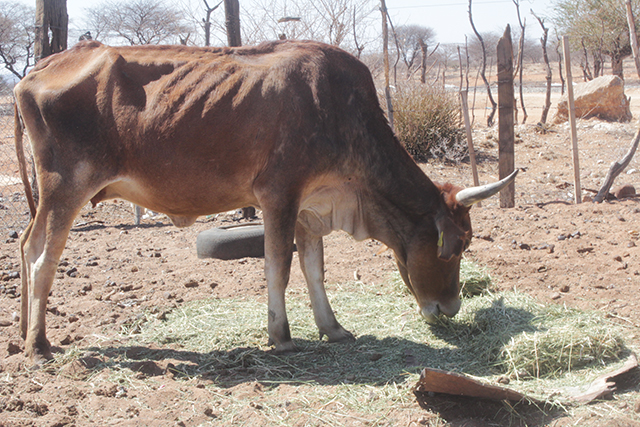
IN times of drought and depleted grazing, farmers can turn to an under-utilised and often overlooked resource – bush vegetation – to provide fodder that would help their livestock survive.
Animal Needs
Providing roughage in a drought situation is a given and extremely necessary for the survival of ruminants due to their four-stomach- digestive system. A ruminant will always need roughage as part of their daily nutritional source so that the microbe populations in the rumen can remain healthy and vibrant to effectively help convert the feed to volatile fatty acids and useful proteins.
The biggest source of protein utilized by the animal is, in fact, the micro-organisms in the rumen that flush from the rumen and are digested by the animal. In normal years, the grass is the largest source of energy and protein for the microbe populations along with the strategic supplementation of nutrients in licks to supplement the deficiencies in pastures.
Animals, being predominantly grazers, however, in droughts, there is no longer enough field grass available. Alternative roughage sources have been investigated and this is where bush feeds can be considered to help provide daily roughage needs.
Bush feed (material such as leaves and young branches) may be relatively high in proteïen (depending on growth period and season) and is therefore, a great possibility that parts of the plant material derived from the bush feed can be included as a crude fiber source in balanced ruminant feeds to be used as primarily survival feeds.
The ideal would be to limit the roughage around 60% because animal production at higher levels may be affected.
There is however formulations in use, depending on the strategy that is followed, that includes processed bush between 50 – 75% of the bush feed mixture.
Redefine farming goals
The making of bush feed redirected farmers into a total new feeding concept at farm level, be it temporary or on a more permanent basis. In disaster droughts, the focus is on surviving with the core herd to be able to restock the farm over time again. bush feed can be seen as a short-term objective for the survival of animals but also as a long-term objective as part of a diversification option at farm level. Feeding animals with bush feed requires careful planning in the harvesting and processing of bush, the specific bush feed formulation used (survival, maintenance or production), the mixing process of the various feed components and the storage and future use of the product.
Droughts, according to the National Rangeland Policy document (June 2012), is not a result of poor rangeland and animal management but a period of below-average rainfall. However, the effect of poor rangeland management in the past will have a more detrimental impact on the veld compared to farms implementing revitalising rangeland management practices. Besides careful planning of a future drought strategy for the farm, it is also very important to have a strategy in place how to utilise the rangeland in the season following the drought.
Roughage shortages during droughts
The lack of roughage for animals during drought years is a common situation. The drought in Namibia redirects the thinking and action towards alternative natural feed sources of which, besides others, bush feed came very much to the forefront. Roughage (grass, dwarf shrub- and shrub leaves, pods) form part of the total roughage ruminants such as cattle, sheep, goats and various game species, need for survival and production. The kind of bush to be used in making bush feed depends on the farming area. Bush feed has various advantages when invader bush species such as Blackthorn (Senegalia melifera) and others are utilized.
Thinning out these bushes will reverse the negative environmental effect on the water availability for the natural grasses and fodder bushes, hence increasing carrying capacity with sound practices. In addition, the larger diameter bush branches and stems (diameter larger than 10mm) are suitable for a mulch product for gardens and charcoal production.
What you need to know about Bush Feed
Due to the high moisture content, the milled bush can rot quickly and therefore should be dried before storage. Moldy bush feed might contain microbial toxins and must not be fed to animals.
Use Bush Improver Concentrate when the bush is green.
*Bush Improver Concentrate contains tannin inhibitors. When using Bush Improver Concentrate at 10% of the final mixture the correct level of 6g/day tannin inhibitor will be consumed daily.
Consider including a tannin inhibitor when using Dryveld Concentrate or HPK 30 as recommended.
Intakes should not exceed 1.5 to 2.5% of body mass A mineral lick supplement such as Futterfos and salt should be available on an ad lib basis to sustain long term production and fertility attributes. Roughage should not be too fine to allow for proper rumination.
Refrain from cutting branches which are too thick as the lignin (indigestible portion) levels will increase significantly in thicker branches.
– Article contributed by Feedmaster