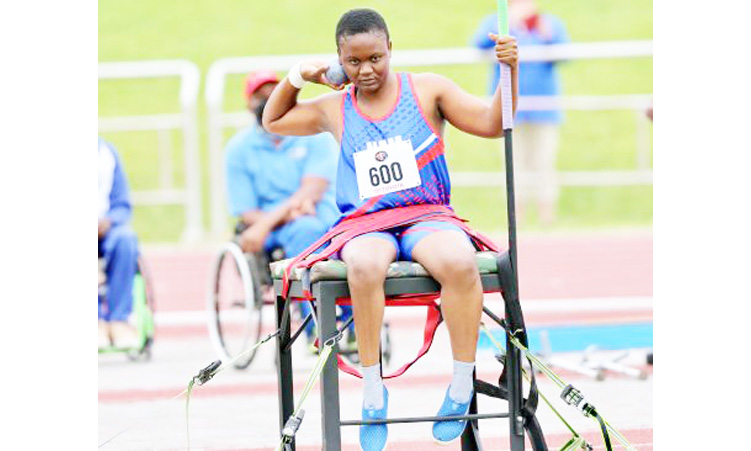
Polio survivor transforms adversity into resilience, hope and advocacy
In the quieter corners of north-western Windhoek, where the streets stretch out beneath the harsh Namibian sun and children’s laughter echoes between modest homes, life moves with quiet determination.
It is here that the story of Johanna Amukoto begins, not with triumph or headlines, but with the ordinary rhythms of childhood, family and hope.
Raised between Golgota, Greenwell Matongo, and eventually Okuryangava, Amukoto’s upbringing reflects the experience of many Namibian families with constant movement in search of opportunity, stability, and a better tomorrow.
Her schoolyears unfolded at Namutoni Primary School, Olof Palme Primary School, and later Concordia College, places that shaped both her character and dreams.
But in May 2006, those dreams were suddenly interrupted.
On the evening of 22 May 2006, Amukoto began feeling unusually weak. By dawn, her right leg had become numb and unresponsive. When she arrived at school in the morning, she could no longer stand. Within hours, her world transformed from classrooms and teenage routines to hospital corridors filled with uncertainty and fear.
She was first admitted to Robert Mugabe Clinic before being transferred to Katutura State Hospital, where doctors struggled to identify the illness.
Visitors were restricted. Rumours circulated. Anxiety spread through the ward like wildfire. Months later, her diagnosis was confirmed – Amukoto had contracted polio.
For many, survival would have felt like victory. But for Amukoto, survival marked the beginning of an entirely new battle.
“The greatest challenge was waking up and realising I could no longer do what I once could,” she recalls.
Once energetic and independent, she now had to relearn basic tasks. Around her, other patients with similar symptoms did not survive. Death lingered heavily in the ward, leaving emotional scars that no medicine could erase.
Yet somewhere within that darkness, resilience quietly began to grow.
Encouragement first came from a teacher, Elia Kim, who refused to let Johanna surrender to despair.
Later, inspiration arrived through the achievements of Namibian Paralympic champion Ananias Shikongo.
‘WHY NOT ME?’
“If he could rise, why not me?” she says with a smile.
That single thought would become the foundation of her recovery.
Meanwhile, hundreds of kilometres away at Walvis Bay, another Namibian was navigating a different but equally difficult reality.
Tsire ‘Twalaboy’ Tsauseb grew up during the apartheid era, a time when disability inclusion in schools was rare and public understanding even rarer.
As a pupil at Kuisebmond Inboorling Skool, now Immanuel Ruiters, during the 1970s and 1980s, he often faced rejection instead of support.
“At one point, I was told I was wasting my time because the system had not even properly registered me due to my disability,” he remembers.
His experience reflects the harsh reality many disabled Namibians once endured: exclusion from education, limited opportunities, and widespread misunderstanding.
“There was a time when children went to bed healthy and woke up unable to walk. Polio was real, unpredictable, and devastating. And it still exists.”
‘VACCINATION SAVES LIVES’
His message is simple but urgent: Vaccination and awareness save lives.
According to paediatrician Dr Steffen Bau, a member of Namibia’s expert polio committee, polio remains one of the most infectious viral diseases known to medicine.
The virus enters the body through the mouth, multiplies in the intestines, and in severe cases attacks the nervous system, permanently damaging nerve cells.
Historically, the disease affected mainly children under the age of 15. However, Namibia’s 2006 outbreak proved that adults are not immune.
Although Namibia was declared polio-free years ago, health authorities in November 2025 detected a vaccine-derived type two polio virus in sewage samples collected at Rundu.
Dr Nguundja Uumburu, Namibia’s polio incident manager and public health practitioner, says the detection of the virus demanded immediate action.
“We intend to ensure we protect the Namibian people so we can prevent anyone from getting paralytic polio,” she explains.
In efforts to deal with the outbreak, the Ministry of Health and Social Services rolled out three consecutive rounds of a nationwide polio vaccination campaign between January and April this year, targeting all children aged 10 and under to halt potential transmission.
Health officials also continue urging parents to vaccinate their children and maintain proper hygiene practices, including hand washing, sanitation, and access to clean water.
Despite the discrimination he experienced, Tsauseb refused to allow disability to define his future. He later became one of the first disabled recruits in the South African Police Force, where his athletic talent flourished.
From sprinting and power lifting to shot put and javelin, he discovered a new identity through sport.
“These challenges did not stop me. Instead, they pushed me towards advocacy and inclusion.”
His advocacy would later inspire many others, including Amukoto.
For her, sport became more than competition; it became healing.
She began participating in seated shot put, rediscovering confidence through every throw.
“Although my legs could no longer carry me, my arms could still propel something forward. With every throw, I reclaimed a part of myself.”
TRANSFORMATION
Travelling to South Africa alongside Paralympians such as Johanna Benson and Ananias Shikongo transformed her outlook entirely.
“I realised disability is not truly disability,” Amukoto says.
What she witnessed was not limitation, but adaptation, athletes competing, thriving, and living boldly despite physical challenges.
Today, Amukoto’s life extends far beyond her diagnosis.
She is the mother of two boys, whom she calls her greatest blessings. She is also a trained counsellor, having earned both a certificate and diploma while working exhausting night shifts as a security guard.
Her work in a hospital’s Centres for Disease Control and Prevention department deepened her understanding of human suffering and resilience.
Now based at Ondangwa, Amukoto continues giving back to the community by supporting orphanages caring for children with disabilities.
“I see a reflection of my younger self in those children,” she says.
Amukoto continues to live with scoliosis and ongoing physical pain.
Polio, she explains, is irreversible and requires lifelong management. Yet she refuses to let the condition define her future.
Instead, she lives by a philosophy forged through suffering, survival, and courage: “Life is a journey, you do not end it because it has changed.” – Nampa