


The first sign that something was wrong was the sound of the dogs barking.
It was 02h30 and dark outside. When Husam Abdelgawi, a 31-year-old accountant in the eastern Libyan city of Derna, got up and went sleepily downstairs to check on them, he felt water under his feet.
Husam opened the front door of the house he shared with his younger brother, Ibrahim. More water flooded in, pulling the door off of its hinges.
The brothers ran to the back door, where they were met by a “ghastly, unimaginable scene, worse than death itself to witness”, Abdelgawi said, in a phone interview from the city of Al-Qubbah.
“The bodies of women and children were floating past us. Cars and entire houses were caught up in the current. Some of the bodies were swept by the water into our house.”
The water swept Husam and Ibrahim up too, carrying them farther and faster than they imagined possible. Within seconds, they were 150m apart.
Ibrahim (28) managed to grab on to floating power cables still tethered to their poles and grapple himself back towards where Husam was stuck. The brothers used the cables like ropes to pull themselves towards a nearby building and through a third-floor window, and from there they made it to a fifth-floor rooftop where they could wait out the flood.
“The area where we were was a higher part of the city,” Husam said. “In the lower parts, I don’t think anyone on the fifth or sixth floors has survived. I think they are all dead. May God have mercy on their souls.”
Estimates of the number of dead vary. Libya’s ambassador to the UN said about 6 000 people are confirmed to have died with thousands more missing. A Red Crescent official in Libya said about 10 000 people were believed killed. Derna’s mayor has warned that 20 000 people may have lost their lives.
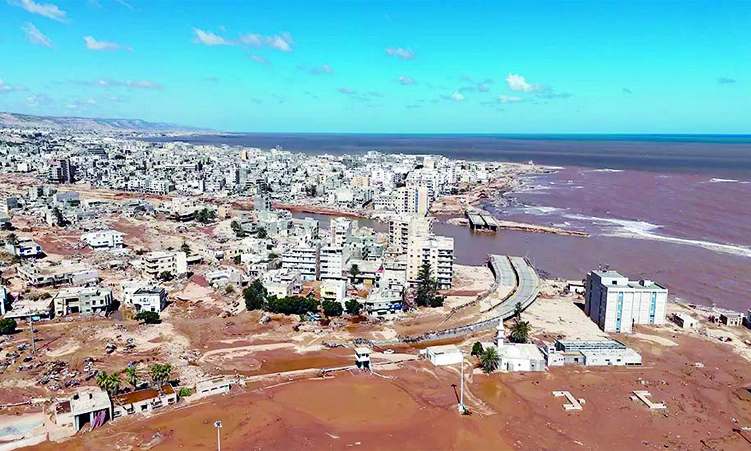
The flood was triggered by the failure of two dams outside Derna, unleashing a torrent of water through the city’s centre.
“Derna was divided in two halves by the water and everything in between is gone,” said Rahma Ben Khayal, an 18-year-old student who made it to safety on a rooftop in the city. “The people in between are all dead,” she said.
The torrent that washed away entire streets had begun a day earlier, as light rain.
It was not frightening at first, said Amna Al Ameen Absais, a 23-year-old medical student born and raised in Derna, who is guardian to her three younger siblings following the death of both parents from illness.
As the raindrops drummed outside, the four siblings sat in their first floor apartment in the Beach Towers, a seven-story building next to the waterfront, playing games and scrolling on their phones. They dressed her younger brother in a life vest and laughed.
But as Sunday night wore on, the rain got heavier. Sirens sounded. The siblings couldn’t sleep.
“It really began about 02h30,” Absais said, in a phone interview from the nearby city of Tobruk. “The noise was getting much louder. My brother said he could see water covering the street.”
As the water rose, the neighbours began to migrate upstairs. Absais grabbed the cat and four passports and they went up from their first floor apartment to a third floor apartment.
“People were looking outside into the dark, praying,” she said. Then the water reached the third floor. “Everyone started screaming. We moved up again, to the fifth floor and finally up to the seventh floor.”
Panic had set in. “I lost the cat,” Absais said. “I lost my little brother for a minute but then I found him. I realised we could not even stay on the seventh floor, we had to go to the rooftop.”
From there, they could see neighbours on the roof of a three-storey building opposite, including a family with whom they were friends. The neighbours were waving their phone torches. Moments later, their entire building collapsed into the water in the dark.
“It felt like an earthquake,” Amna said. “That family still hasn’t been found. Their son is looking for them. We told him that we saw their building collapse in front of our eyes.”
Some of Absais’ own family are missing, too. Her uncle, his wife and their three sons lived in a nearby building that collapsed. “Our last call was about 21h00, he was calling to make sure we were OK,” she said. “We haven’t heard from him since.”
Eventually, Absais was able to escape the building with all three siblings, after the floodwaters lowered. Her street had disappeared completely. “It was like the earth had split open,” she said. “Only a cavity left where the street used to be.”
A neighbour she knew slipped and disappeared into the water in front of them, her husband and son unable to save her, Absais said.
She heard that her best friend, Aisha, had not made it.
Absais and her siblings walked for hours to higher ground, passing bodies on the way.
The death toll from the catastrophe looks set to rise significantly. Abdelgawi said he had already counted at least 30 friends among the dead, and more than 200 acquaintances. “It is a miracle that I survived,” he said.
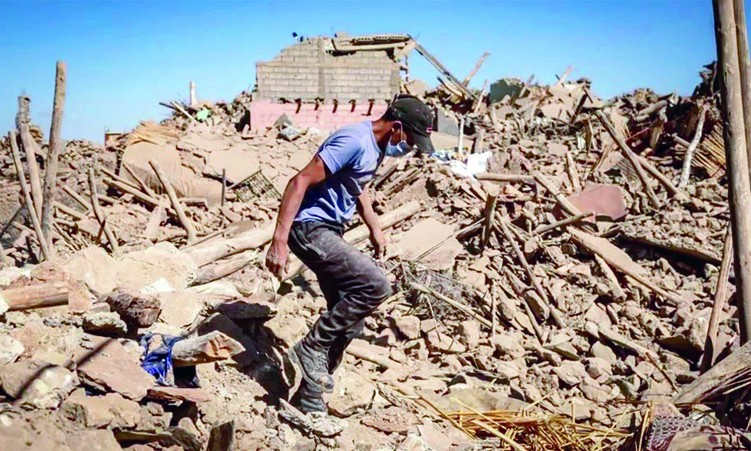
The damage to Derna itself is catastrophic. Entire neighbourhoods have been destroyed.
Mohamed al-Menfi from Libya’s internationally-recognised government in the western city of Tripoli said he had asked the country’s attorney general to investigate and that anyone whose actions or failure to act were responsible for the dams’ collapse should be held accountable.
The World Meteorological Organisation (WMO) said most loss of life could have been prevented if Libya had a functioning weather agency.
“They could have issued warnings. The emergency management authorities would have been able to carry out evacuation of the people. And we could have avoided most of the human casualties,” said WMO head Petteri Taalashe.
Many survivors are waiting desperately for news of loved ones. Others are mourning, for the dead and for Derna.
“I don’t think I can ever go back,” Absais said. “Those streets were my whole life. We knew every corner of the city. Now it’s gone.”
- Riam Dalati contributed to this report.
– BBC
In an age of information overload, Sunrise is The Namibian’s morning briefing, delivered at 6h00 from Monday to Friday. It offers a curated rundown of the most important stories from the past 24 hours – occasionally with a light, witty touch. It’s an essential way to stay informed. Subscribe and join our newsletter community.

The Namibian uses AI tools to assist with improved quality, accuracy and efficiency, while maintaining editorial oversight and journalistic integrity.
Stay informed with The Namibian – your source for credible journalism. Get in-depth reporting and opinions for
only N$85 a month. Invest in journalism, invest in democracy –
Subscribe Now!