




Let’s say you have around N$1,5 million to spend on a new two-door sports car, but you aren’t a fan of the rear-biased engineering of the Porsche 911, arguably one of the best sports cars you can buy right now.
You could opt for a tried-and-tested front-engine, rear-drive platform, which means there are really only two choices for you – the BMW M4 and the Mercedes-Benz C63 S. There’s a third choice, though, that has recently joined the ring to punch it out for your hard-earned bucks, which comes from the land of the rising sun.
Enter The Wildcard
For 2019, Lexus has said ‘F-it’, and have thrown the five-litre we know and love into the RC to create the RC F. With 351kW and 530Nm on tap and an eight-speed automatic gearbox as well as several driving modes that enable you to slip-n-slide when you want a thrill, it’s actually quite a compelling package.
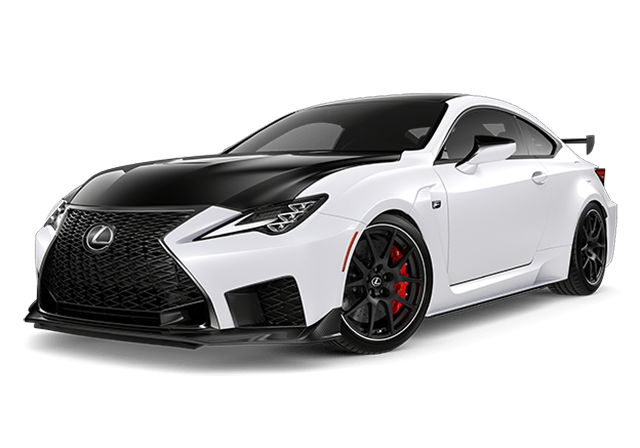
From a styling perspective, the front of the RC F is Lexus-wild, thanks to that massive spindle grille design and kinks and creases in more places than necessary. It’s not as sleek-looking as an M4 or C63 S, but it can’t be denied that it oozes character.
In profile, you get a wonderful long hood, with squat roofline and snappy trunk, the genuine silhouette that a sporty coupe should prove, but more rakish-looking, like something out of Japanese manga.
Sublime As Standard
Lexus is notorious for giving you everything that you might need in a luxury car as standard, which sort of justifies the fact that their cars are slightly more expensive than their German competitors. In the RC F, the brand’s product team have ticked almost all the boxes – giving you everything from heated and cooled seats to active radar-guided cruise control with steering assist, as well as one of the most banging audio systems you’ll find in a vehicle, courtesy of Mark Levinson.
During the test, I did not feel the car lacking in any shape or form when it comes to cocooning the driver and passengers in the lap of luxury, all while there’s this beastly engine purring away under the hood. In fact, if you stick the RC F in ‘normal’ mode, and just potter around town, you would be forgiven for thinking you were in an IS 350.
The seats are heavily bolstered and comfortable, with electric adjustment and memory function to ensure you are as comfortable as possible, while the steering wheel can also be electrically adjusted for rake and reach.
The car also comes with a widescreen multimedia system with built-in navigation, but to be honest, this is the one area where the RC F let me down, mostly due to the finicky nature of operating the on-board systems. Instead of a rotary wheel or direct-access buttons (or touchscreen tech), Lexus has fitted a haptic-feedback touchpad between the front seats to allow you to interact with the various functions. Like the mousepad/trackpad on your laptop, you use this to navigate and then click lightly to make your selection. The challenge comes in when you’re driving and trying to find a radio station or select a playlist and the trackpad selector moves ever so slightly because you hit a bump in the road. The sensitivity can be adjusted, but in general, the system in the RC F is not as polished as iDrive or Comand.
Multiple Personalities
I kept the RC F in sport+ mode for most of the test period, as it provided the most thrills, but there are eco, normal and sport modes to opt for too. Eco puts you into the least aggressive set-up, dialling back throttle sensitivity and gearing up earlier than expected.
Normal works well, but it’s similar to eco. In normal, you get a ‘normal’ rev-counter on the central digital cluster, while in eco you get this weird vortex loop that’s supposed to represent your use of the throttle.
Sport gives you a bit more throttle sensitivity but keeps the traction systems in full-alert mode just to ensure you don’t go farming. Sport+ gives you the sharpest of input calibrations, a little more slip from the rear before traction control intervenes and it will hang onto the lower gears for longer.
You also get this wonderful induction sound when accelerating in all the modes, most prominent and gruff-sounding when you dial sport+. The key thing with these modes is that you really have access to a variety of cars in one package. In eco and normal, you won’t be tempted to go too fast, while the sportier modes are there to let you play a bit. Because the car comes as standard with 19-inch wheel and tyres, it doesn’t crash and bang as much when you hit an imperfection in the tarmac, compared to other cars riding on larger-profile alloys.
The adaptive suspension also helps to give suppleness on one end and firmness on the other, without becoming too ‘hard’ or jarring.
– IOL Motoring