




These days the link between food and budget is most obvious. Many households do not have access to cash to spend on luxury items, including luxury food items. Generally, the budget conscious have a few strategies to stretch the value of their hard-earned dollars.
First, they eliminate unnecessary expenses, and as a result, many have already cut most, or all, costs associated with eating or dining out. No more takeaways and no more restaurants. This is not a bad strategy, as it allows you to take greater control over ingredients and food costs.
Dinner parties at home do not have to be costly – everyone can bring something – and can be great fun. This is not good news for our restaurants, especially not for those at the lower end of the price scale. Those doing fine-dining or supplying upmarket food experiences have more financially resilient customers who will always be able to dine out. Those catering for the lower end are the first to see their customers disappear when the going gets tough.
A second coping strategy is to change shopping behaviour. There are a few ways this can be done. First, people start to change what they buy. They buy cheaper brands and products, and they concentrate on fewer, must-have staples. Consumers may avoid luxuries altogether or they buy smaller quantities thereof. Second, they start chasing any offer of anything on ‘special’. If fact, some will travel across town to save a few cents, often on some arbitrary delicacy such as canned peaches or guavas. A few may even start buying in bulk to get cheaper unit prices.
A third coping strategy is to change the way we cook and eat. More expensive food items such as prime cuts of meat may be changed for cheaper, tougher cuts. Or cheaper ingredients may replace their more expensive counterparts. Margarine replaces butter, vegetable oil takes the place of olive oil, and we start cooking stews instead of grilling steak. We add larger portions of cheap starches to our plates to make up for the cutbacks on expensive proteins and vegetables.
Fourthly, hard times force us to cut back on wastage. Those carrot tops that went into the bin? These days they get washed and go into the salad. Or maybe we could turn them into a pesto of sorts. Anything goes, but they do not go into the bin no more. We lose a lot by peeling vegetables that should not be peeled, and by dumping bits and pieces and trimmings that are perfectly edible. Moreover, we have paid good money for this, there is no need to put it in the bin. Find ways to use these, and you’ll get a lot more value for your money.
I am sure there are many more ways to save on food costs, and that there are very creative people out there who have developed their coping strategies into a fine art. We should admire these folks and learn from them.
Making do with less often presents opportunities to reconsider our standards and actions, and to change them. Making it to the end of the month requires a simple mathematical formula: income must surpass expenses or more money has to come into our household than what goes out. Food is but one expense among many, and there is more that needs to be done than just tinkering with food costs. But food is not a fixed cost, thus it is something that is under our control so you should be able to make a meaningful change by reorganising your approach to sourcing and cooking food.
Not all the strategies I listed above are always successful and there are many reasons for that. Foods sold as ‘specials’ are often inferior quality produce close to expiry date. Rather than running the risk of letting the produce go bad on their shelves, vendors try to transfer the risk onto you by giving it to you at a reduced price. If it now goes bad, it is your loss, not theirs. These less than prime products must be used immediately or it becomes an expensive loss. Remember fresh produce lasts longer than produce that it about to expire. The real value is in buying a little less and using it at its prime than at lower cost for lower quality. The same goes for buying in bulk. Having too much on your shelves at home might also not be the best financial strategy. Not only is there greater risk for spoilage, but people also seem to waste more if they work with larger quantities. Goods on the shelf still puts you out of pocket, even if you get the item at a reduced unit cost.
I know of no better strategy to saving food costs than to be creative. If you can’t cook, now is the right time to learn. Learn fast and learn furious, because never before in our history as humans have we had as many resources for learning at our disposal. We must just use them. Learn to bake a cake with only three ingredients, or how to make a dessert pizza with a dough that requires only two.
Hardship often gives birth to new ideas and radical solutions. All that is required is commitment to the cause, creative thinking and experimentation, and discipline. Using fewer ingredients does not mean you have to compromise on flavour or sustenance. Be cleaver, be curious, be brave and try new things. Know one thing: If it is convenient, it is probably more expensive.
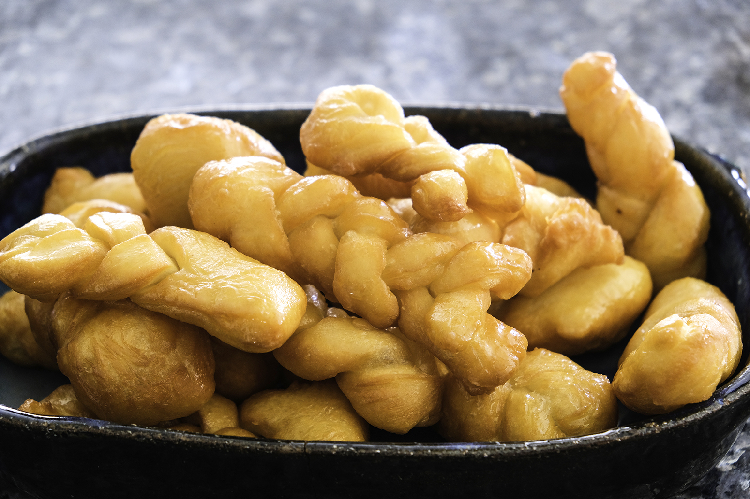
Easier said than done, but rest assured all cultures in the world have treasure troves of recipes for delicious food on a tight budget. Just search the names ‘Blou Hermaans’ or ‘Bankrot poeding’ and you’ll see what I mean. Where there is a will with food, there is a way. Two ingredient dough recipes are all the craze right now, so I thought I’d give you a recipe that may take you in many different directions: Flat bread and pizza, koeksisters and doughnuts, bagels and buns – this dough is cheap, easy to make and very versatile. All you need is some plain yogurt and self-rising flour and you are in business. There is thus no need any more to go without your regular (now) cheap, sweet thrills.
Happy savings!
Easy Koeksisters
The syrup:
• 500 grams sugar
• 400 millilitres water
• 2 tablespoons lemon juice
• 2×2 cm pieces fresh ginger
• 1⁄4 teaspoon cream of tartar
The koeksister dough:
• 3 cups self-raising flour
• 11⁄2 cups plain yoghurt
• 2 litres vegetable oil
(for deep frying)
Remember, the key to making good koeksisters is to keep the syrup as cold as possible. It is, therefore, best to make syrup a day ahead and keep it in the refrigerator right up until it is needed. Always dunk your warm, just fried koeksister into ice-cold syrup. Use more than one batch of syrup if you can, that way you always have a cold batch on standby.
To make the koeksisters, sift the flour and gently fold in the yoghurt with a spatula until the mixture forms a dough. Once a dough has formed, move the dough to a floured surface, and knead the dough by hand for five to eight minutes. If the dough is too sticky, add more flour, a little at a time, and knead until smooth. You can also do this with a stand mixer and a dough hook.
Roll out the dough to 5mm in thickness. Cut the dough into strips 6cm long by 1cm wide. Lay three strips over each other at one end and press together, then plait, pinching together at the other end to seal.
Heat the oil to 180°C, then deep-fry the koeksisters, a few at a time, turning often, until golden and cooked through. Once cooked, remove the koeksisters from the oil with a slotted spoon and dunk into the cold syrup. Use a potato masher to keep the koeksisters submerged if needed. Then remove them and place them on a cooling rack over a sheet pan to cool down further.
In an age of information overload, Sunrise is The Namibian’s morning briefing, delivered at 6h00 from Monday to Friday. It offers a curated rundown of the most important stories from the past 24 hours – occasionally with a light, witty touch. It’s an essential way to stay informed. Subscribe and join our newsletter community.

The Namibian uses AI tools to assist with improved quality, accuracy and efficiency, while maintaining editorial oversight and journalistic integrity.
Stay informed with The Namibian – your source for credible journalism. Get in-depth reporting and opinions for
only N$85 a month. Invest in journalism, invest in democracy –
Subscribe Now!