



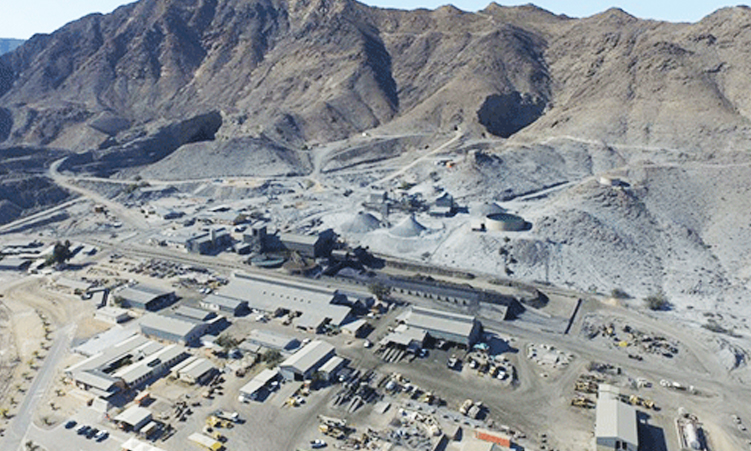
Exposure to lead at Rosh Pinah in the ||Kharas region remains a constant risk for the residents of the town and the employees of the local zinc mine.
This was confirmed by Jonathan Guia, the general manager of Rosh Pinah’s Sidadi clinic.
In 2023, former minister of mines and energy Tom Alweendo confirmed that test results found lead in the blood of 18 of 30 children living near the zinc mine at the town.
Guia says lead exposure is not caused by mining activity only, but also the environment itself, which is lead-rich.
He says the risk to exposure is increased due to mining.
“There are cases of lead exposure all the time. When the public comes to get tested at the clinic, we pick up these cases.
All those statistics being part of the Communicable Diseases Act of Namibia we are reporting on a weekly basis to the Ministry of Health and Social Services – irrespective of the level,” Guia says.
He says the clinic reports its results to the health ministry every Monday.
Efforts to obtain the ministry’s current statistics this week proved futile as the director of health for the ||Kharas region, Sandra Owoses, promised to share a report but had not done so at the time of going to print.
Two years ago, then deputy health minister Ester Muinjangue confirmed that cases of chronic lead exposure were reported among children and infants at Rosh Pinah.
The Namibian at the time reported that Muinjangue said Rosh Pinah recorded 10 cases of chronic lead exposure among children ranging from one to 12 years old in July in 2023.
This was after more than 200 tests were conducted by Dr Kurt Dausab at Sidadi clinic, with 22 children found with unacceptably high lead levels.
In one instance, a one-year-old baby exhibited a lead concentr ation of 25 micrograms per decilitre, while a two-year-old child had a concentration of 22.
The blood-lead reference value for children should not exceed 5 micrograms per decilitre.
Guia says after 2023, the situation has improved, but it is difficult to determine whether lead exposure is higher in children or the elderly because the whole community is exposed to lead pollution.
‘HYGIENE IS KEY’
“There is definitely an improvement, but the risk of exposure in Rosh Pinah remains constant.
Lead exposure is in many ways still misunderstood, as authorities have not been able to determine the precise avenues of how the lead gets ingested as there are different ways,” Guia says.
He says basic hygiene is a key component in reducing the risk of ingesting or inhaling lead and encourages employees in mines to wear proper protective gear, not take their overalls home, and to keep dusting and sterilising at home to limit their exposure.
Lead is distributed throughout the body, including the brain, liver, kidneys, and bones.
It accumulates over time in the teeth and bones, and during pregnancy, lead in bone can be released into the blood, thereby becoming a source of exposure for the developing foetus, he says.
Rosh Pinah Zinc Corporation is now owned by Appian Capital Advisory, which mines lead and other precious metals at the town.
Vedanta Skorpion Zinc, located about 30km outside Rosh Pinah, was a zinc mine and has been placed under care and maintenance since 2020.
Rosh Pinah resident Geraldine Isaacks says mineworkers and their families are the most exposed and affected by lead.
Isaacks says she has two children she has to watch most of the time as they play in and sometimes eat sand and inhale dust particles.
“One of my children tested positive for lead exposure.
Her levels were, however, not that high. But I wondered how she got it because she is two years old and mostly stays indoors,” she says.
The toddler was placed on treatment and her lead levels have reduced to less than 5mg.
A report by Viceroy Research group indicates that Rosh Pinah, which previously housed Skorpion Zinc employees, has documented lead contamination linked to local mining activity, including the Skorpion and the Rosh Pinah mines.
The report states that sheens of toxic lead dust were visible under doors every morning at Rosh Pinah and that workers described Rosh Pinah as among the worst living conditions they had experienced, with many citing health hazards as the reason for a high turnover rate at the mine.
“The township has not undergone any rehabilitation.
Instead, ownership was transferred to the state under the pretext of addressing a ‘housing shortage’, despite Rosh Pinah’s isolation, lack of employment opportunities and proximity to contaminated mining areas,” the report says.
UNREHABILITATED SITES
Namibia’s mining sector’s legacy is marked by the scars of more than 250 abandoned and unrehabilitated mining sites that pose environmental and public health threats.
Rosh Pinah Zinc Corporation’s new owners, Appian Capital Advisory, say when they took over two years ago they launched an investigation into lead exposure among children.
The company says protecting local communities, “our employees, and the environment is our greatest priority”.
It says it only became aware of lead exposure risks following completion of its acquisition of Rosh Pinah in June 2023.
“We regard environmental, social and governance standards as crucial elements within all investment opportunities and are committed to ensuring that all of its portfolio companies adhere to leading international standards,” the company says.
It says the mine has carried out a lead awareness campaign at local schools and distributed lead awareness pamphlets to the community, while the identified area responsible for lead inducement was fenced off.
“Over a hundred families from the Beth-El township that were most affected were also moved from their houses so we could rehabilitate the area, and we have moved them back recently after obtaining clearance from the health ministry,” the statement says.
Appian says it is a signatory to the United Nation’s Principles for Responsible Investment, the International Council on Mining and Metals Sustainable Development Framework, and the ESG Data Convergence Initiative, and says it supports the responsible sourcing initiative and is a partner of the World Bank’s International Finance Corporation.
In an age of information overload, Sunrise is The Namibian’s morning briefing, delivered at 6h00 from Monday to Friday. It offers a curated rundown of the most important stories from the past 24 hours – occasionally with a light, witty touch. It’s an essential way to stay informed. Subscribe and join our newsletter community.

The Namibian uses AI tools to assist with improved quality, accuracy and efficiency, while maintaining editorial oversight and journalistic integrity.
Stay informed with The Namibian – your source for credible journalism. Get in-depth reporting and opinions for
only N$85 a month. Invest in journalism, invest in democracy –
Subscribe Now!