



THE trucks start arriving at the site as early as 05h00 carrying men and women who are rehabilitating the Kranzberg-Tsumeb railway line between Otjiwarongo and Otavi.
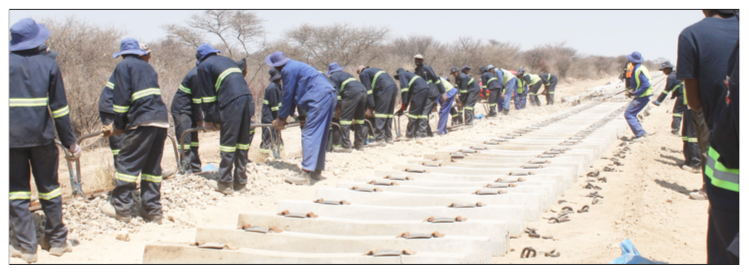
Once on site, the workers employed by D&M Rail Construction prepare for the day’s work. They are removing steel railway sleepers and replacing them with concrete ones.
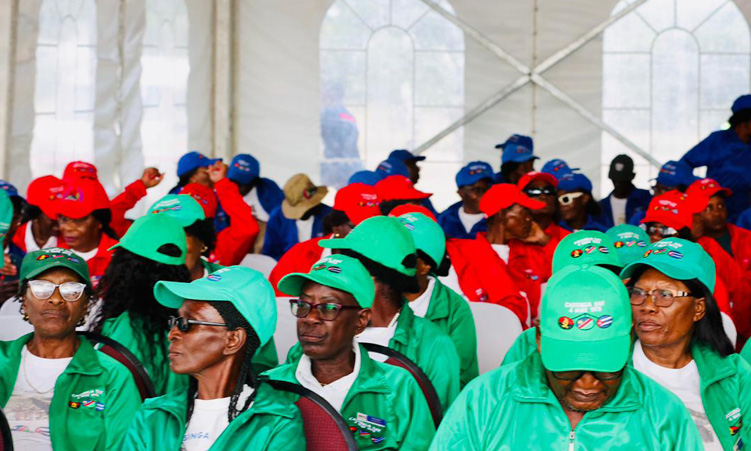
D&M Rail Construction is rehabilitating the Kranzberg-Tsumeb railway, which is 392 kilometres long. The company employs 400 people, of whom 70 are women.
TransNamib’s acting chief executive officer Hippy Tjivikua, who was also at the site on Friday last week, said the workers were upgrading the railway line and putting new ballast on selected sections of the track.
“Without new ballast, the track loosens but with new ballast, the rail is firm,” Tjivikua said.
The workers upgrade the 200 metre rail section by removing the rails and placing them on the side of the railway line. Then the old steel sleepers are manually removed and when that portion of that rail is cleared, a grader is used to remove the old ballast and clean the line.
Concrete sleepers are then placed on the line and aligned with a rope, and the rails are taken from the side and placed on the concrete sleepers and fastened.
An AY wagon, which looks like a tractor on rails, offloads the ballast onto the rail before a regulator machine boxes in the ballast. In the final process a tamper machine pushes the ballast under sleepers and correctly lines the rails.
Since there are more than 400 people here who should lift rails at the same time, one of them – a man – takes up the role of ‘choirmaster’.
All he does is direct the others on whether they should lift, move sideways or place the heavy steel rails on the ground. The others chorus after him when he says: To the north; to the south or even, we are lifting.
One of the workers said this was their signal to help them move in unison in which ever direction when placing the rails.
As they lift or remove the sleepers, dust swirls around them. They sing after the choirmaster. They move in the direction he asks them to, sweating in the heat of the early morning sun.
Such hard work requires food. Not far from where the others are busy with the sleepers, Kariuka Muhenje is attending to a big three-legged pot on an open fire. He is preparing soft porridge for those working on the railway line. Around 08h00, the workers take a break. They wander to where Muhenje is to get their ration. This is a simple soft porridge flavoured with fat and salt.
Muhenje said he has been working for D&M Rail Construction for a few years now as a cook and also on the rail. He said the meal was for those who would not have brought food from home.
“When we have our breaks between work, we eat this pap. It only has fat and salt so most of us bring soup or whatever we can to supplement the porridge,” said Muhenje.
Another worker, Joseph Elias (38) has also been working on the rail since 2011 while living in Otjiwarongo’s informal settlement of Ombili. He said his job helps him to support his family of four children even though his salary of N$3 000 is not enough.
Leonardo Niipepepa (32) started work at the same time.
“I am happy to support my family, even though the money is not enough,” he said.
Olivia Johannes (45), one of the women working on the railway line, said she lives in Ombili and is raising five children. Although the work is hard, Johannes said she is not discouraged.
“This work is better than struggling,” she said.
At Otjiwarongo train station, some workers from Moka Engineering were doing some welding on the rails.
Moka Engineering is a welding company owned by Morris Ndjaba, who was trained by D&M Rail Construction.
“Welding makes the rail smooth to ride on as opposed to when you have joints on the rail and it becomes a bumpy ride,” Ndjaba said, adding that D&M Rail sent him for training in South Africa.
At a third site, which is about 60 kilometres outside Otjiwarongo, some D&M Rail Construction workers were removing old wood sleepers.
Dawie Moller, the D&M Rail Construction managing director, said the kind of work being done on the rail is labour intensive and very costly.
“We do several kilometres a day sometimes. The amount of money spent on just a kilometre of railway can even be N$10 million,” he said.
Founded in 1994 as D&M Tracks to service the private sector, it is the only Namibian privately owned company to undertake major local railway projects.
D&M Rail Construction shareholder is made up of James Hatuikulipi (60%) John Walenga (30%) while D&M Tracks owns the remaining 10%.
The company has been able to provide services for companies such as Dundee Mining, NamPort, Rossing Uranium, Namib Mills, Ohorongo Cement and the Chinese firm Chico, among others.
In an age of information overload, Sunrise is The Namibian’s morning briefing, delivered at 6h00 from Monday to Friday. It offers a curated rundown of the most important stories from the past 24 hours – occasionally with a light, witty touch. It’s an essential way to stay informed. Subscribe and join our newsletter community.

The Namibian uses AI tools to assist with improved quality, accuracy and efficiency, while maintaining editorial oversight and journalistic integrity.
Stay informed with The Namibian – your source for credible journalism. Get in-depth reporting and opinions for
only N$85 a month. Invest in journalism, invest in democracy –
Subscribe Now!