


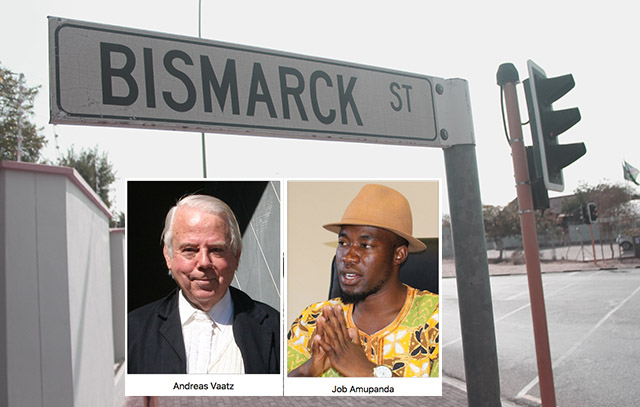
SOCIAL activist Job Amupanda has accused veteran lawyer Andreas Vaatz of racism after he placed a newspaper insert condemning the renaming of Bismarck Street in Windhoek to Simeon Lineekela Shixungileni Street.
Vaatz, who referred to himself as a representative of the Namibian German community, published a four-page insert in The Namibian yesterday, where he explained why the City of Windhoek should not rename Bismark Street. He argued that the proposed name is too long, difficult to pronounce, and hard to remember.
Bismarck Street is a main street in Windhoek, between David Meroro Street and Hosea Kutako Drive in a south-to-north direction. Bismarck Street is named after Otto von Bismarck, the chancellor of Germany when Namibia was made a German colony in 1884.
Shixungileni, who died in 2014, was a member of the People’s Liberation Army of Namibia, and was one of the fighters involved in a clash with the South African security forces at Omugulugwombashe on 26 August 1966. This battle officially marked the start of the armed liberation struggle for Namibia. He later served a term of imprisonment on Robben Island near Cape Town, South Africa.
Vaatz accused the City of Windhoek of attempting to erase all memories of German historical figures from the streets of Windhoek by replacing their street names with those of black Namibians.
Reacting to the insert yesterday, Affirmative Repositioning movement leader Amupanda, who proposed the name change, told The Namibian that in the next three years, he plans on removing all colonial history in the country, starting with the Curt von François statue in Windhoek, and replacing it with a statue of Anna Kakurukaze Mungunda.
Mungunda was the only woman among the casualties of the Old Location uprising in Windhoek on 10 December 1959.
The activist stated that Vaatz’s complaints are ridiculous, as the late Shixungileni is a Namibian hero who should be honoured with a street name.
He added that the late Shixungileni was someone who defeated colonialism, while Bismarck brought it to the country.
“I will remove them through the law or out of the law, and you can quote me on that,” he said.
“I am coming for all the colonial representatives,” he continued.
Amupanda said he submitted the application for the street renaming in 2014, and hoped that it would have been completed before Shixungileni’s death.
Vaatz’s complaint was because the street name would be “disturbing white privilege”, he stressed, adding that the amount he spent on the advertisement could have been donated to companies to change their letter-heads.
“He [Vaatz] is just nostalgic about colonialism,” the activist continued.
A lecturer at the Namibia University of Science and Technology, Peter Gallert, said the late Shixungileni is a national hero of Namibia.
“Considering that Germans today form a 4% minority in Namibia, I think it is fair to say that the hero Bismarck is of far less relevance to Namibia than the hero Shixungileni,” he said in a letter in response to Vaatz’s comments.
Gallert further stated that a fair number of Namibians will find pronouncing “Shixungileni” no more difficult than pronouncing “Bismarck”.
“It is all a matter of perspective, Mr Vaatz,” he observed.
In his newspaper insert, Vaatz had said the new choice of name is insensitive and unreasonable to businesses and residents in Bismark Street.
“Bismarck Street should now be changed […] into a long and most unwieldy name, difficult to pronounce and even more difficult to remember,” he stated.
He further said the renaming will have very expensive consequences, as making changes could easily amount to N$30 000 or more per office.
“The choice of such a name by the city councillors and the city management is insensitive, unfair and unreasonable to the property owners and tenants having offices in that street,” he lamented.
“The question here is, why must the admired leader [Bismarck] of one of the ethnic groups presently calling Namibia their home country be removed and substituted by a hero of one of the other ethnic groups?” he asked.
This is not the first time that the lawyer objected to the street renaming of Bismark Street.
reported last year that he wrote an objection letter to the proposed street renaming, stating that the name change would affect his business as his clients will not be able to find him under this lengthy and challenging name.
“It is thus not understood why this street must now be renamed to Simeon Lineekela Shixungileni, a name I have never heard of in my life,” he stated.
He previously opposed the renaming of that street, but his efforts failed twice in court.
According to the City of Windhoek’s street and place naming/renaming committee, the naming and renaming of streets and places after persons who made an impact on the development of the city is a way of etching the country’s history, both pleasant and not so pleasant, in the memories of the people.
“Council has the final approval for all naming and renaming of streets,” says the committee. The City of Windhoek’s mayor, Muesee Kazapua, did not respond to questions sent to him on the issue yesterday.
In an age of information overload, Sunrise is The Namibian’s morning briefing, delivered at 6h00 from Monday to Friday. It offers a curated rundown of the most important stories from the past 24 hours – occasionally with a light, witty touch. It’s an essential way to stay informed. Subscribe and join our newsletter community.

The Namibian uses AI tools to assist with improved quality, accuracy and efficiency, while maintaining editorial oversight and journalistic integrity.
Stay informed with The Namibian – your source for credible journalism. Get in-depth reporting and opinions for
only N$85 a month. Invest in journalism, invest in democracy –
Subscribe Now!