





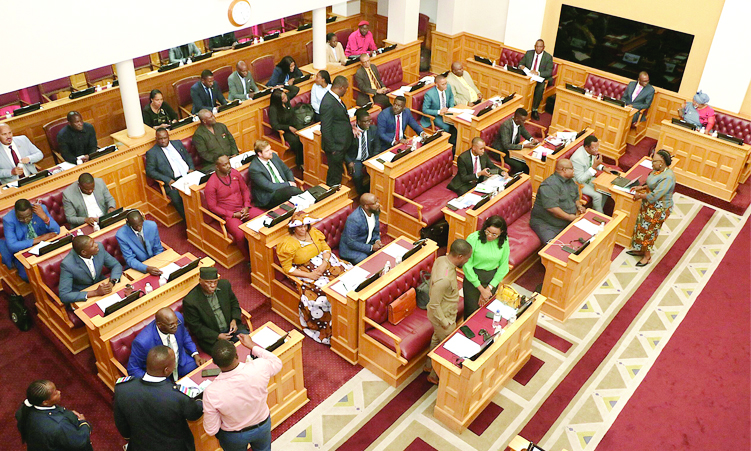
The National Assembly faces growing criticism over its legislative effectiveness as the annual national budget remains the only bill to make any significant progress.
Major legislation, including the land bill and the regional councils bill, failed to pass during the seventh National Assembly in 2024.
Although both were reintroduced last year, they remain under discussion.
Political analysts, former lawmakers and current members of parliament say the slow pace of lawmaking reflects a combination of institutional, procedural and political challenges.
Former National Assembly member Elifas Dingara says the prominence of the appropriation bill should not automatically be viewed as a sign of parliamentary failure.
He says the budget process is constitutionally mandatory and must be processed within strict timelines to ensure government operations continue uninterrupted.
“The budget will always receive priority because the government cannot function without the lawful allocation of public funds,” Dingara says.
He says the sluggish movement of other bills, however, points to wider challenges, including poorly prepared draft legislation from the executive, extensive public consultations, legal scrutiny by parliamentary committees, limited sitting days, and capacity constraints within ministries sponsoring legislation.
Dingara says citizens are justified in expecting greater legislative output beyond the annual budget process.
“Parliamentary effectiveness should be measured not only by the number of laws passed, but also by the quality of scrutiny, oversight and public participation,” he says.
Public policy analyst Marius Kudumo says the parliament has become distracted from its primary role of law making.
“Every day seems focused on interpreting rules and procedures instead of dealing with substantive parliamentary business,” he says.
Kudumo believes many procedural matters should have been settled during induction programmes and warns that prolonged delays risk undermining public confidence in the institution.
Elvis Lizazi attributes the slow progress to both structural and political factors.
He says the absence of a genuine separation of powers weakens the legislative process, as many bills are extensively discussed within executive and ruling party structures before reaching the parliament.
“When opposition lawmakers see a bill for the first time on the floor, they must first determine whether it genuinely serves the interests of ordinary Namibians before supporting it,” Lizazi says.
Former parliamentarian Josef Kauandenge believes the problem is rooted in decades of one-party dominance.
He says Swapo’s parliamentary majority has created a culture in which opposition parties are rarely consulted on key legislation before it is tabled.
“The executive often introduces bills at the 11th hour without sufficient consultation,” he says.
Kauandenge says opposition parties often respond by using parliamentary procedures to delay legislation, while lawmakers from both sides sometimes make lengthy contributions that do little to advance debate.
Despite differing views on the causes, there is broad agreement that both the executive and the parliament share responsibility for ensuring legislation is processed efficiently without compromising scrutiny, accountability and public participation.