





The end of the year is typically a good time to review legislative developments – but this year there is virtually nothing to say.
As many have already highlighted, the new parliament that took its seats on 21 March has shockingly passed not one single law other than Appropriations Acts (laws allocating funds for expenditures from the state budget).
Three other laws were passed in 2025, but these were approved prior to the March changeover.
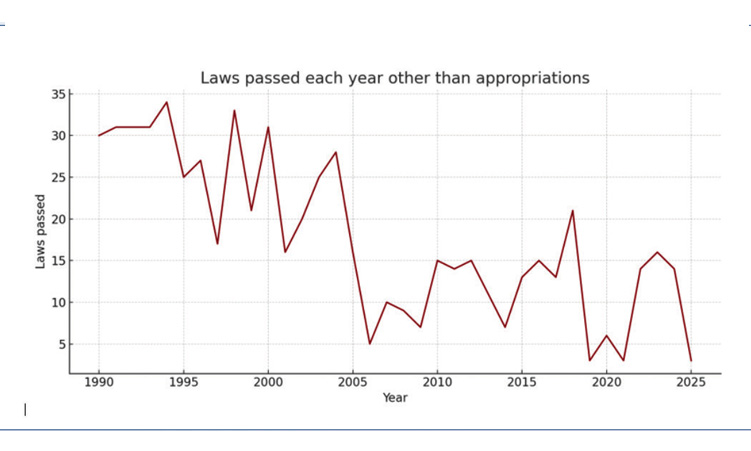
Legislative activity has been declining in recent years. Law reform was moving forward at a rapid rate during the first few years after Independence, with more than 30 laws being enacted each year during Namibia’s first five years.
It is not surprising that there was a sense of urgency about redrawing the legal landscape during the first flush of freedom.
The pace of legal change continued to move forward steadily for the first 29 years after independence, with 19 or 20 laws passed each year on average during that entire period.
A PARLIAMENT LOSING PACE
However, the last seven years have been legal doldrums.
One Appropriation Act is always enacted during each financial year, with one or two additional Appropriations Acts often being approved as the financial year proceeds; these laws must be passed to keep the government running.
Not counting Appropriation Acts, 2019 saw the passage of only three laws, followed by six in 2020 and three in 2021.
Things picked up again during 2022-2024, with 14-16 laws other than Appropriations Acts being passed each year .
However, this period of legislative activity was nudged forward by the 13 laws passed in short order in 2023 in an effort to stave off the grey-listing of Namibia by the Financial Action Task Force that monitors the risks of money laundering and terrorist financing.
Counting laws has its shortcomings, of course. A single law might be short and simple or long and extremely complex.
Some proposed bills are straightforward, while others are more controversial or require more intense scrutiny.
But, despite these caveats, the momentum of law reform in Namibia certainly seems to be sputtering.
STILL LINGERING IN THE WINGS
In addition, not all laws that are enacted are brought into force.
A law passed by parliament will often include a provision allowing the relevant minister to bring it into force at a later date.
This is a useful mechanism because it allows time for regulations to be drafted setting out the details necessary for the law’s implementation.
It also allows time for new government officials or bodies to be put into place so that the law can be administered from the very first day that it is given legal force.
But Namibia often leaves laws languishing on the statute books for years without bringing them into action.
Currently, 19 laws passed by parliament have not yet been brought into force.
The clear winner in this dubious sweepstakes is the Namibia Film Commission Act – passed 25 years ago but never activated.
The National Arts Fund of Namibia Act and the Accreditation Board of Namibia Act have both been waiting in the wings for 20 years, making it seem doubtful that they will ever be actioned.
The Namibia Investment Promotion Act passed in 2016 is set to be replaced in the near future by a new law on the same topic, without ever having been brought into force.
And the Whistleblower Protection Act passed in 2017 is also still sitting dormant, which is disappointing in an administration that repeatedly cites its commitment to combating corruption.
MARRIAGE, BIRTH DIVORCE, DEATH
Almost half of the laws passed in 2024 are not yet in force, including important new laws on marriage, divorce, birth, and death registration that will affect many Namibians.
One year is not an unreasonable time period to prepare for implementation, but the waiting period should not keep stretching out into the future.
Is Namibia’s law reform activity slowing down because there is less of a need for new laws now?
That seems unlikely. Namibia has no laws in place on important issues such as child pornography, cybersecurity and data protection, to name just a few.
Our law books also still have some race-based laws and regulations in place that are long overdue for replacement, such as the notorious ‘Native Administration Proclamation’ that still governs some aspects of marriage and inheritance for black Namibians.
Furthermore, even the new post-independence laws are almost always in need of amendment over time, to refine them in light of lessons learned over the years or to keep pace with national and international developments.
SERVING THE PUBLIC
Of course, parliament does not work alone to enact legislation.
Law reform also involves line ministries, legal drafters and the Law Reform and Development Commission.
Extensive public consultation can also be a factor that slows down the progress of bills through the system, but can (if done well) help to ensure that new laws will serve the needs of the public adequately.
The worry is that all of these players will lose their energy.
Namibia needs to be vigilant and proactive to keep its legal house in order, and to make sure Namibia has the laws it needs for equality, sustainable development and orderly progress.
- – Dianne Hubbard is a legal consultant with many years of experience in public interest law and a passion for trying to make legal issues clear and accessible.
In an age of information overload, Sunrise is The Namibian’s morning briefing, delivered at 6h00 from Monday to Friday. It offers a curated rundown of the most important stories from the past 24 hours – occasionally with a light, witty touch. It’s an essential way to stay informed. Subscribe and join our newsletter community.

The Namibian uses AI tools to assist with improved quality, accuracy and efficiency, while maintaining editorial oversight and journalistic integrity.
Stay informed with The Namibian – your source for credible journalism. Get in-depth reporting and opinions for
only N$85 a month. Invest in journalism, invest in democracy –
Subscribe Now!