



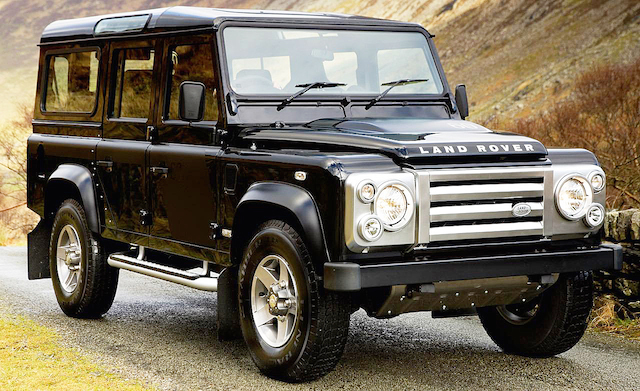
Much more than just a pavement crawler, the Land Rover Defender has been the staple off-road enthusiasts for many years. First introduced in 1948, the Defender was designed, from the ground up, to go wherever you want it to.
Land Rover doesn’t mess too much with the Defender for fear of buyer backlash. Looking at our test model, a magnificent 110, this is quite evident.
Apart from the new alloys, the basic shape has remained largely unchanged over the years. Sure, the door handles have changed, so have the head light positions and other small variations, but it’s still a bulking behemoth of a brick. That being said, its presence demands respect on the road.
A good chunk larger than a Hilux/Ranger/what-have-you means that the Defender looks the bully out on the tarmac; the aggressive styling sure doesn’t do it any favours for cuteness. Pop rivets, visible weld seams and sheet metal all add to its rugged persona. Still, you’d be hard pressed to differentiate between the newest model and its 65-year-old sibling.
Like the exterior, the cabin is a no-frills affair. The tall seats are comfortable, supportive and suitable for long days in the saddle. The rear pew is a three-seater with good head and shoulder room with adequate leg room. It folds to create a larger cargo area.
Behind the back seat is a typical wagon layout with a squared-off wheel well along either side that would double up as seats for extended families. As comfortable as the new interior is, Samir Gamieldien the hobbit won’t be all too happy, though. The Defender is seriously tall and makes for some interesting enter and exit strategies when you’re the size of a dwarf.
The 2.2-litre turbo-diesel engine is a delightful engine that easily copes with the size and weight of the 110 Defender. It’s no V8 Range Rover off the mark, but for use around town you can just about leave it in third gear which hits the torque sweet spot.
On the open road, the Defender 110 cruises easily at 100 to 110 km/h with the engine sitting on around `
2 000 rpm in sixth gear. And it pulls away easily in sixth gear from slowing down to 60 km/h. Drop it back to fourth and it pulls up steep hills without stress.
Land Rover last year replaced the 2.4-litre turbo diesel with this new 2.2-litre powerplant. The new engine matches the older, larger engine in torque, power and fuel consumption. The new engine produces 360 Nm of torque at 2 000 rpm and 90 kW of power at 3 500 rpm. In order to reduce excessive engine noise, Land Rover installed a new acoustic engine cover.
They’ve done a great job of making the Defender 110 as refined as possible for running on the black top. The ride is good given the vehicle’s real purpose. Over rough tarmac and gravel outback roads, the Defender effortlessly absorbed corrugations and pot holes without the tail becoming unhinged. We took the Land Rover Defender on some serious 4WD tracks, deeply rutted mogul-style mud tracks. Defender, in low range, simply crawled up and down with no traction loss. Steering was the only necessary driver input.
Afterwards, the Defender was taken to the Tuffstuff get-together at SKW (more on that in another article) where it completed each obstacle with ease. With Defender’s ground clearance and entry, departure and ramp-over angles makes this vehicle one of the best off-roaders in the market.
This is a vehicle that you will either love or hate. There is no middle ground. It is built for a purpose and that is to provide transport to places not normally accessible to people in any soft-roader or even some of the genuine 4WDs. Compromise is not part of the Defender’s DNA.
A practical, tough box on wheels that puts function ahead of form, Land Rover Defender is built for work, whether that be towing, serious off-roading, grey-nomading or farm duties. There is no other vehicle on the market that does what it’s built to do quite as well as the Defender. I’ll have mine in gun metal, please.
In an age of information overload, Sunrise is The Namibian’s morning briefing, delivered at 6h00 from Monday to Friday. It offers a curated rundown of the most important stories from the past 24 hours – occasionally with a light, witty touch. It’s an essential way to stay informed. Subscribe and join our newsletter community.

The Namibian uses AI tools to assist with improved quality, accuracy and efficiency, while maintaining editorial oversight and journalistic integrity.
Stay informed with The Namibian – your source for credible journalism. Get in-depth reporting and opinions for
only N$85 a month. Invest in journalism, invest in democracy –
Subscribe Now!