


CANADIAN company Koryx Copper, which is developing the Haib Copper Project in southern Namibia, has reported positive drill results at the site.
According to a statement issued by Koryx president and chief executive Heye Daun, test results from 13 drill holes (at 4 960m) has been received as part of the phase 2 and 3 infill and expansion drill programme.
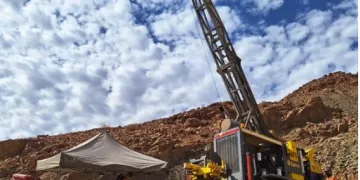
Daun says there are 12 additional track-mounted rigs for faster drilling and movement between the holes to accelerate the programme.
The drill programme has been designed to achieve a comprehensive conversion of all mineral resources to qualify for the pre-feasibility study update in the second half of 2026, he says.
“This entire drill programme comprises 55 000m to be completed by the end of July 2026 to allow time for the assaying and updated resource modelling in the third quarter of 2026,” he says.
Haib is an advanced, large-scale open-pit copper, molybdenum and gold project that is envisaged to produce at an average of 88 000 tonnes per year of copper in concentrate over a 24-year mine life via a simple, scalable, open-pit crushing, milling, or flotation process.
The company’s preliminary economic assessment of 4 September 2025 shows that the project is technically and economically feasible, with attractive economics and a simple, scalable, long-life and low-cost development strategy undergoing rapid advancement.
“These latest assay results once again demonstrate and confirm the size, grade and robust copper mineralisation of the Haib deposit with some excellent, wide and very consistent intercepts across multiple areas of the envisaged open pit.
“These results demonstrate the ongoing success of our drill programme as we progress the technical work towards the highly anticipated pre-feasibility study to be published in late 2026,” he says.
Daun says 13 drill holes are spread across the main mineralised zone at Haib.
“Four of these holes are classified as in-fill drill holes, designed to reduce sample spacing within known mineralisation, while the remaining nine are peripheral step-out holes, intended to test the lateral extent of copper mineralisation,” he says.
Daun says the results from the in-fill holes are better than anticipated, with both intersection widths and copper grades exceeding expectations.
“The two holes drilled in the northern part of Target 3 and the two in the southeastern part of Target 2 tested conceptual grade extensions. Although grades were low, the implications for the mineral resource are considered negligible.
“The remaining step-out holes returned results ranging from slightly positive to highly encouraging,” he says.
He says all drill core was logged, photographed, and cut in half with a diamond saw.
Half of the core was sent to ALS Laboratories in Johannesburg, South Africa, for analysis and ActLabs in Canada.
The other half was quartered, with one quarter archived and stored on site for verification and reference purposes while the other quarter will be used for metallurgical test work.
– email:
matthew@namibian.com.na
In an age of information overload, Sunrise is The Namibian’s morning briefing, delivered at 6h00 from Monday to Friday. It offers a curated rundown of the most important stories from the past 24 hours – occasionally with a light, witty touch. It’s an essential way to stay informed. Subscribe and join our newsletter community.

The Namibian uses AI tools to assist with improved quality, accuracy and efficiency, while maintaining editorial oversight and journalistic integrity.
Stay informed with The Namibian – your source for credible journalism. Get in-depth reporting and opinions for
only N$85 a month. Invest in journalism, invest in democracy –
Subscribe Now!