



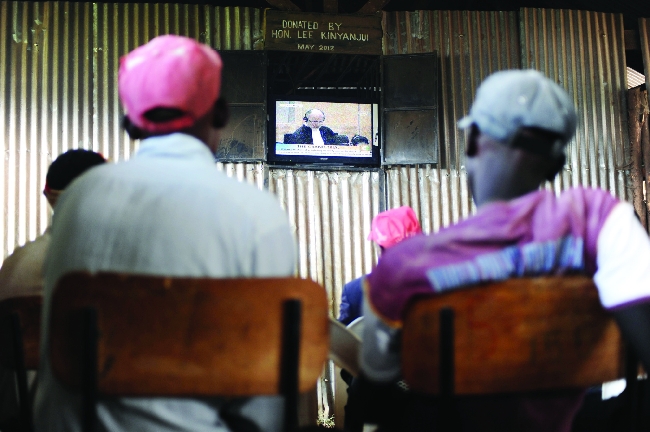
Kenya is canvassing support for a possible walk-out by African states from the International Criminal Court, whose prosecution of elected Kenyan leaders has revived accusations on the continent that the court unfairly targets Africans.
The start last week of the trial for crimes against humanity of Kenyan Deputy President William Ruto, with President Uhuru Kenyatta’s trial due in November, has stirred a growing backlash against the Hague-based court from some African governments, which see it as a biased tool of Western powers.
ICC prosecutors accuse Ruto and Kenyatta of fomenting ethnic bloodletting that killed about 1 200 people after a disputed election in December 2007. They both deny this.
Opinions Divided
Kenya’s parliament voted on September 5 to quit the ICC’s jurisdiction, and Nairobi is discussing with its neighbours and other governments a broad rejection by Africa of the ICC. This taps into African anger that the ICC has so far only prosecuted African accused – warlords, politicians and leaders – while ignoring alleged war crimes by global powers.
Yet a lack of local alternatives, for which there is a shortage of both political will and financing, makes the ICC the only hope for many African victims seeking justice.
Some of Kenya’s east African neighbours are already backing calls by Ruto’s lawyers for him to be excused from attending all ICC hearings. Officials say suggestions are being made in the African Union for a pullout from the Hague court by the 34 African signatories to the Rome Statute that created it.
“There is a proposal in the African Union, which will likely come in January, for all AU member countries to withdraw from the ICC because the court is seen to be targeting only African leaders,” Tanzania’s government spokesman Assah Mwambene said.
The walk-out proposal could come even sooner, possibly at an extraordinary AU summit before the year end, following expected criticism of the ICC at the UN General Assembly this month.
Uganda’s junior foreign affairs minister Asuman Kiyingi told Reuters his country was unhappy about the way the ICC was :used by big powers to pursue certain selfish interests against African leaders”. He said Uganda could consider withdrawing.
But such a move might not be unanimous. Officials from Ivory Coast, Democratic Republic of Congo, Nigeria and South Africa, four of the Africa Union’s biggest member states, told Reuters their governments had no plans so far to leave the ICC.
“It is clear the ICC needs to explore ways and means to fix its relationship with Africa, its biggest block of membership, otherwise many African states may follow the Kenyan move,” AU Political Commissioner Aisha Abdullahi told Reuters by e-mail.
No Alternative
ICC spokesman Fadi El-Abdallah said such pullouts would be a mistake. “Withdrawals would not serve justice nor the interests of victims,” he said in a statement to Reuters. He was confident African states would remain signatories to the Rome Statute.
When asked if he felt Kenya was garnering much support, a Western diplomat in Nairobi said: “A bit, but I am not convinced that we will see a mass walk-out that they are talking about.”
Kenyatta and Ruto’s political alliance won Kenya’s March election, averting a repeat of the bloodshed six years ago. Some Kenyans fear the ICC process against their leaders could reignite violence and destabilise East Africa’s biggest economy.
But even if an African walk-out does occur, the world’s least developed continent is far from having its own criminal court alternative to replace the ICC. Ratification by AU members for existing continental judicial structures has proceeded at a snail’s pace and there is a big question, too, over funding.
“We don’t have a credible, regional alternative,” said Nicole Fritz, director of the Southern Africa Litigation Centre, a non-profit group which seeks to support human rights in Africa through court processes. “The political will is not there.”
The ICC Kenya cases brought against democratically elected leaders are a key test of the credibility of the decade-old court; its conviction record and methods are under fire.
Based on ideas developed at the Nuremberg and Tokyo trials after World War Two, moves to establish the ICC accelerated in the 1990s, when atrocities in Yugoslavia and Rwanda saw ad hoc tribunals set up at The Hague and Arusha, Tanzania respectively.
In 1998, over 100 governments adopted the United Nations’ Rome Statute. The ICC gained legal powers on ratification of the Statute in 2002 and judges were elected the following year.
Experts say the criticism caricaturing the ICC as delivering ‘white man’s justice’ for Africa rings hollow, as the Rome Statute broadly requires the acquiescence of signatory parties to the prosecutions. Kenya, for example, had itself referred the case of its 2007-2008 post-election violence to the court.
“In Kenya, it was in the absence of the domestic initiative where the ICC stepped in,” said Fritz.
However, when the UN Security Council requested the ICC to investigate the late Libyan leader Muammar Gaddafi’s crackdown against opponents in 2011, this was viewed suspiciously by some African leaders who saw it as Western powers misusing the court.
Double Standards?
ICC Chief Prosecutor Fatou Bensouda rejects the accusations of anti-African bias, saying cases are prosecuted on merit and that the court is a big deterrent. Bensouda herself is from Gambia and five of the 21 serving judges, including the first vice president, are also Africans. Nine of them are Europeans.
Fritz said however the Hague court had not “done itself any favours by filling its dockets exclusively with African cases”.
In an age of information overload, Sunrise is The Namibian’s morning briefing, delivered at 6h00 from Monday to Friday. It offers a curated rundown of the most important stories from the past 24 hours – occasionally with a light, witty touch. It’s an essential way to stay informed. Subscribe and join our newsletter community.

The Namibian uses AI tools to assist with improved quality, accuracy and efficiency, while maintaining editorial oversight and journalistic integrity.
Stay informed with The Namibian – your source for credible journalism. Get in-depth reporting and opinions for
only N$85 a month. Invest in journalism, invest in democracy –
Subscribe Now!