




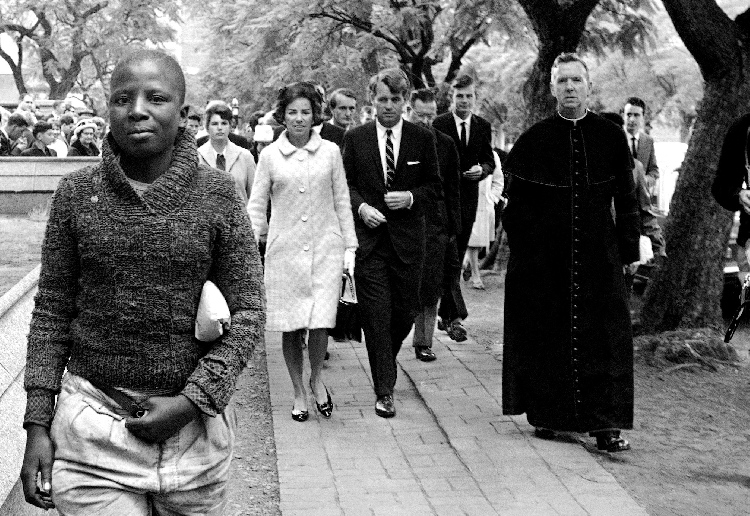
In 1966, someone tossed a garland around Robert F Kennedy’s neck after he arrived at the Johannesburg airport at the height of white minority rule in South Africa.
The American senator and civil rights advocate removed it and gestured at a ‘Yankee Go Home’ sign, saying he was delighted that people were expressing different points of view.
“Many times in my own country of the United States, I see much worse signs,” Kennedy said with a smile. The crowd cheered.
Kennedy’s visit 50 years ago was exhilarating for many opponents of apartheid, a relief from a system of racial oppression that had recently sentenced Nelson Mandela to life in prison.
Apartheid would grind on for nearly three more decades after Kennedy’s tour of the country in conflict, whose anniversary is being marked this week with events in several South African cities.
Kennedy’s daughter, Kerry, heads a human rights group and is among twodozen members of the Kennedy family, as well as some US congressmen, who are in democratic South Africa to remember the trip by a man whose speeches in South Africa about freedom, equality and the rule of law were informed by the civil rights struggle roiling the United States at the time.
The group includes her three daughters, 23 nieces and nephews, and seven members of the US Congress.
Congressman John Lewis – the famous Freedom Rider – and Chris Coons, who worked to renew the African Growth and Opportunity Act, are among the congressmen.
“It gave people a feeling that someone important in the outside world was on our side, opposed to apartheid and would maybe do something about it,” Larry Shore, the South Africaborn producer and codirector of a documentary, ‘RFK in the Land of Apartheid: A Ripple of Hope’, said of the 1966 visit.
The documentary includes footage from Kennedy’s arrival in South Africa as well as a photograph of him with Albert Luthuli, the head of the antiapartheid African National Congress and a Nobel laureate living under travel and other restrictions in a rural area.
Kennedy met students from the white Afrikaner minority that oversaw racist rule, and toured Soweto, the Johannesburg area where blacks were required to live under South Africa’s system of racial segregation.
Kennedy recognised that access to housing, education and health care were key to democratic change, Kerry Kennedy said on Monday in Johannesburg.
Echoing that concern, some South Africans are frustrated at a continuing lack of economic opportunities, more than two decades after apartheid ended with the first allrace elections in their country in 1994.
Kennedy died on 6 June 1968 after being shot by an assassin in California, two years to the day after he spoke at the University of Cape Town.
An excerpt from that speech in South Africa, in which Kennedy talked about a “ripple of hope” from every small act against injustice, is inscribed at his grave in Arlington National Cemetery.
