




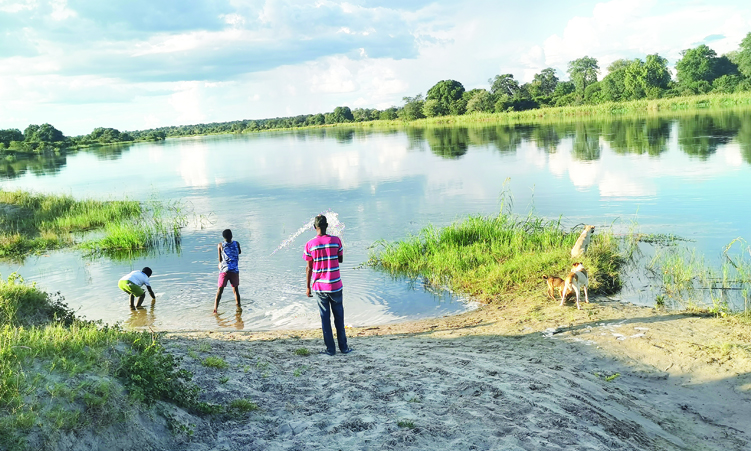
A Scientific report assessing water from the Cubango-Kavango River (CKR) system has revealed that its overall water quality is suitable for drinking.
The assessment was based on a water quality index (WQI) analysis.
The report, however, warns that some indicators exceed guideline levels and that regular monitoring is needed.
The study was released in January, titled ‘Suitability Assessment of Water for Human Consumption Using Water Quality Index Along the Cubango-Kavango River in Angola and Namibia’, and was drafted by Maurício Clemente, Hilma Amwele, Nicola Fohrer, Edward Smit, Francois Jacobs, Alfredo Muacahila and Oluibukun Ajayi.
Samples used to test water were taken at 12 locations along about 447km of the river, including areas affected by urban activity and irrigation farming.
These include the Katwitwi, Nkurenkuru, Cuangar, Musese, Rundu, Calai, Divundu, Ndonga Linena and Mahango areas.
“River water quality is a critical issue as it directly affects both human health and biodiversity,” the report reads.
According to the report, man-made and agricultural activities have increased, exerting significant pressure on the river.
To measure suitability for human consumption, a total of 88 water samples were collected throughout the river in two phases: the dry season (August) and the wet season (March).
In the dry season, the report says the WQI values ranged from good water of 32.13 at Calai, to 39.12 at Ndonga Linena.
In the wet season, the WQI value indicated good water quality of 31.86 at Rundu and 42.60 at Nkurenkuru.
According to the report, poor water quality involves a WQI score of above 50, and severely poor quality would involve a score of 100.
The researchers calculated a WQI using multiple parameters, including nutrients and chemical indicators such as nitrite, ammonia, dissolved oxygen and chlorophyll-a (Chl-a).
However, the report flags overshoots against health and national benchmarks.
“The result obtained showed that the levels of certain elements exceed the World Health Organisation 2022 guidelines,” the report reads.
It further reveals that the levels of certain elements exceeded the 2013 Namibian Water Quality Guidelines.
Despite this, the authors conclude that the index points to generally acceptable water quality overall.
“The WQI values indicate that the overall water quality is suitable for drinking, however, continuous monitoring is needed to further assess the impact of human activities within the CKR,” the report reads.
The authors say the WQI approach can support decision-making and the design of monitoring programmes, particularly in a region facing development pressure along the river corridor.
In an age of information overload, Sunrise is The Namibian’s morning briefing, delivered at 6h00 from Monday to Friday. It offers a curated rundown of the most important stories from the past 24 hours – occasionally with a light, witty touch. It’s an essential way to stay informed. Subscribe and join our newsletter community.

The Namibian uses AI tools to assist with improved quality, accuracy and efficiency, while maintaining editorial oversight and journalistic integrity.
Stay informed with The Namibian – your source for credible journalism. Get in-depth reporting and opinions for
only N$85 a month. Invest in journalism, invest in democracy –
Subscribe Now!