



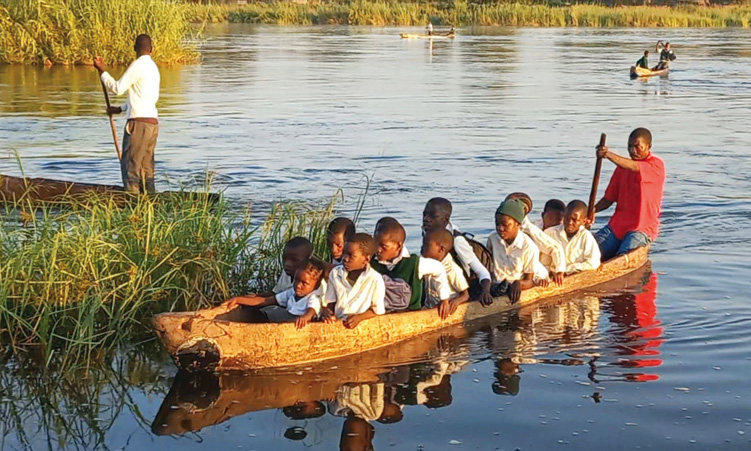
On Monday morning at around 06h40, five children climb off a canoe with their schoolbags, relieved they did not come across any crocodiles.
Ndhagho Marungu (48), who helps some of the children cross the Kavango River in a canoe every morning, says the daily trips are stressful.
A parent himself, he makes at least three trips daily to pick up some of the children, while others have learnt to paddle the canoes themselves.
Over 152 pupils of Kavango East region’s Mukwe and Kangongo circuits cross the river daily to attend classes on the other side of the shore.
Some are from the Mushangara, Ngongo, Tjova, Kambamba, and Ditemwange villages in Angola.
Some of the affected schools include the Kake, Thipanana, Shadipwera, Thikanduko, and Robert Mushongo primary schools.
Between home and school is a river where crocodiles and the possibility of drowning is a daily reality.
FACE TO FACE WITH A HIPPO
Kake Primary School principal Lyndex Shangara says 11 pupils from his school encountered a hippopotamus while crossing the river on their way to school on 15 May last year.
He says it is fortunate that none of them were injured.
“What is alarming is that even pre-primary pupils are involved. These are very young children paddling canoes without supervision or training,” Shangara says.
He says the group of eight boys and three girls panicked after being followed by the animal and jumped out of the canoe, running to a nearby small island to save themselves.
“We were extremely lucky that no life was lost,” he says.
Shangara says the matter was immediately reported to the circuit education inspector, and parents were summoned for an urgent meeting to find solutions.
He says although parents initially agreed that their children would stay with relatives on the school’s side of the river, the arrangement failed due to family conflicts and social challenges.
Cornelia Dinyando (15), a Grade 7 pupil at Kake Primary School, says they fear crocodiles, hippos, and drowning every day.
“We love school. There’s no option, that is why we cross the river every day, and wish to stay on this side of the river in Namibia,” she says.
She says she only carries one book, because she fears all her books might be soaked after the canoe trips.
“We study at school because we get home late, and we wake up early in the morning,” Dinyando says.
NOT ENOUGH CANOES
Marungu says parents have invested in making the canoes themselves or paying for them with cash or cattle.
“We are Namibians, not Angolans, living in the Mukwe constituency. Government officials visit our areas only during election time.
Not even our councillor or governor have crossed to our areas,” he says. He says the lack of schools, clinics and other essential services has contributed to them having to cross the river.
“The government only drilled a borehole recently and we still need more development, including even a junior primary school and clinics,” Marungu says.
Community members on the other side of the river say since there is a shortage of canoes to transport the children to school, they sometimes have to pay canoe owners N$5 per child per trip.
In an age of information overload, Sunrise is The Namibian’s morning briefing, delivered at 6h00 from Monday to Friday. It offers a curated rundown of the most important stories from the past 24 hours – occasionally with a light, witty touch. It’s an essential way to stay informed. Subscribe and join our newsletter community.

The Namibian uses AI tools to assist with improved quality, accuracy and efficiency, while maintaining editorial oversight and journalistic integrity.
Stay informed with The Namibian – your source for credible journalism. Get in-depth reporting and opinions for
only N$85 a month. Invest in journalism, invest in democracy –
Subscribe Now!