




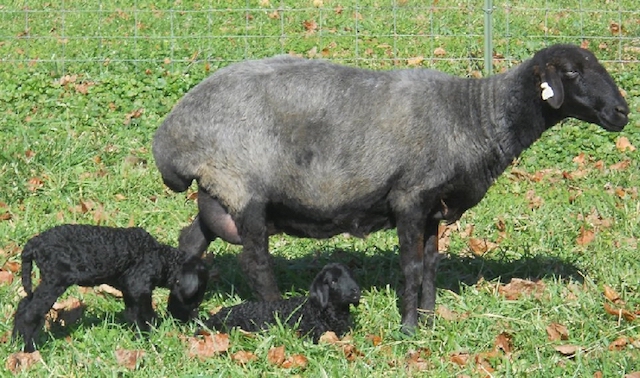
THE karakul sheep is believed to be one of the oldest breeds of domesticated sheep in the world. Originally from the steppes of Turkistan, this broad-tailed sheep gradually spread to other regions of Central Asia. This breed is named after the village Qorako’l, which lies in present-day Uzbekistan.
On 24 September 1907, the first 12 sheep, 2 rams and 10 ewes, arrived onboard a freight ship at Swakopmund, in Namibia, which at that time still had a harbour. These sheep were imported to Namibia by the German government.
About 750 Karakuls were imported to Namibia from Asia at the beginning of the previous century. From there the breed also spread to the Northern Cape and surrounding areas.
The numbers of Karakul increased rapidly until it reached its peak of more than five million animals for Namibia and South Africa in 1979.
DESCRIPTION
The grown sheep are medium-sized; their wool is a mixture of coarse and fine fibres, varying in colour from black to shades of tan and grey. Karakul sheep have a wide, fat tail that stores fat. The head is long and narrow, slightly indented between the eyes and often exhibiting a Roman type nose.
Most rams have horns, and the females are polled.
The Karakul is distinguished by its coloured fleece, which is due to a dominant black gene. Most lambs are born coal black with lustrous wavy curls, with the face, ears and legs usually showing smooth, sleek hair.
As the lambs grow, the curls open and lose their pattern and the colour generally begins to turn brownish or bluish-grey, getting greyer with age. Many adults have a double coat, a fine down undercoat, covered by a coat of guard hair. Grey, white and brown coloured sheep are also found.
In southern Africa Karakul breeders moved away from the long curly type of hair shown by the Asian Karakul. Our Karakul has high quality, short and strong hair with a sought after character. The ‘character’ refers to the wavy pattern of the hair and the spacing of the waves.
Because of the significant differences between the pelts of Asian Karakul lambs and those of southern African lambs, the local Karakul industry embarked on an exercise to rename and re-brand the Karakul breed.
Since the first half of the 20th century, Karakul pelts from South Africa and Namibia have been marketed as Swakara (derived from South West Africa karakul).
In April 2013, Namibian authorities granted permission for the Karakul breed name to change to Swakara. Similar authorisation from South Africa is still pending. The name change is necessary as pelt buyers associate Karakul with heavier-haired pelts.
PRODUCTION NORMS
Karakuls breed out of season, making it possible for three lamb crops every two years. Single lambs are the rule, although twins are not uncommon. The Swakara ram can weigh 80-100 kg, while the ewes range from 45-70 kg.
The meat of the Swakara is very lean and the breed’s abundant milk supply is used for butter and cheese in some countries.
The wool of adult sheep is used in making carpets and other heavy fabrics.
The Swakara produces a lightweight, high volume, strong fibre fleece, that at its best is long and lustrous, usually with no crimp. It is easily spun, with little preparation.
It produces a superior carpet yarn, is often used for rugs and saddle blankets, outer garments and wall-hangings, and has an excellent felting ability. It is the wool from which the art of felting evolved.
The best pelts are obtained from unborn lambs and those up to three days old.
Namibia produces approximately 140 000 Swakara pelts per annum. These are sold under the name Swakara at Kopenhagen Fur in Denmark twice a year.
South Africa produces 20% of the total percentage of pelts that are exported.
There are about 200 000 Swakara sheep found mainly in the Keetmanshoop area of Namibia. About 40 000 Swakara sheep are found in South Africa, mainly in the Northern Cape.
References This info-pack was compiled from various sources of information. The text may contain extracts from the following: www.ansi.okstate.edu/breeds/sheep/karakul
In an age of information overload, Sunrise is The Namibian’s morning briefing, delivered at 6h00 from Monday to Friday. It offers a curated rundown of the most important stories from the past 24 hours – occasionally with a light, witty touch. It’s an essential way to stay informed. Subscribe and join our newsletter community.

The Namibian uses AI tools to assist with improved quality, accuracy and efficiency, while maintaining editorial oversight and journalistic integrity.
Stay informed with The Namibian – your source for credible journalism. Get in-depth reporting and opinions for
only N$85 a month. Invest in journalism, invest in democracy –
Subscribe Now!