



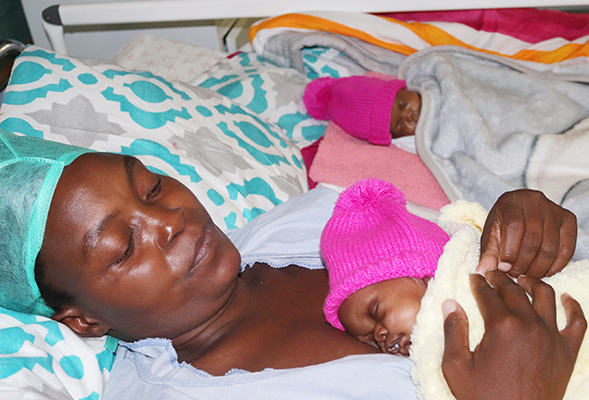
THE transition from the womb to the world is a huge adjustment for any baby, especially a premature one, and a mother’s skin is like a magic touch for that baby to grow fast.
Magdalena Jeremia (35) gave birth to twins when she was only six months pregnant, and they weighed only 1,2 kg at birth. They are admitted in the kangaroo mother care unit at the Oshakati State Hospital, where they have been for close to six weeks.
Jeremia was being assisted by nurse Willemine Ekandjo to wrap one of her babies tightly against her chest. The baby, wrapped in a yellow blanket, meanwhile fumbles around for its mother’s breast.
According to the United Nations Children’s Fund (Unicef)’s communications specialist, Judy Matjila, it is vital how the baby is received and treated in the first few days of its life.
She said studies have shown that the benefits of kangaroo mother care (KMC) include skin-to-skin contact, which stabilises heart and respiratory rates, improves oxygen saturation rates, better regulates an infant’s body temperature, and conserves its calories. Neonatal deaths are one of the major contributors to under-5 (years) mortality in Namibia, with 36,4% of the mortality in 2013.
“The every newborn action plan is currently being implemented at a model scale at the Oshakati State Hospital, and kangaroo mother care is one of the approaches adopted at this referral hospital to provide a continuum of care for the newborn and the mother. It is important that the neonate and the mother are thoroughly checked and given cost-effective interventions during this period,” said Matjila.
She added that the kangaroo mother care model is one of the high-impact, low-cost interventions which were adopted for prioritisation at the Oshakati hospital as part of quick wins during the modelling of the every newborn action plan, which is being supported by Unicef since 2017. Paediatrician Lona Mwenda said there are many factors that make women deliver babies prematurely.
Some of these causes is booking late, while antenatal care plays an important role in preventing premature births.
“Other reasons are maternal under-nutrition and the mother’s lifestyle, while unplanned pregnancies can also lead to pre-term births, as well as multiple pregnancies, infections, and chronic conditions, just to name a few,” she said.
Mwenda added that the introduction of the kangaroo mother care model has enabled infants to survive and grow, and most importantly, it has increased the rates of exclusive breastfeeding.
Suama Ipinge said she had lost a baby before this one, and it was a pre-term birth.
“I am not sure if it was because I did not know how to handle my baby well, but she died. She was very small. After a few months, I fell pregnant again. The baby came after 28 weeks, and I was introduced to KMC. Now, my baby is growing fast and our bond is very strong,” Ipinge beamed. Matjila added that by adopting KMC, the length of hospital stay has been reduced significantly from two or more months to between four and seven weeks, and babies are gaining weight faster with KMC than before the process was strengthened.
In 2012, Namibia was among the first countries which pledged to support A Promise Renewed: Child Survival Call to Action to reduce child mortality to 20 or fewer deaths per 1 000 live births by 2035.
When mother and baby are together, hormones that regulate lactation balance out, helping the mother to produce more milk.
Just 10 minutes of skin-to-skin contact reduces the babies’ levels of the stress hormone cortisol, and increases levels of the “cuddle hormone” oxytocin, which stimulates the parasympathetic nervous system to make babies feel calm and safe.
It Helps The Baby Sleep
Less stress equals better sleep. Premature babies who were cradled skin-to-skin sleep more deeply and wake up less often than those who slept in incubators, reported the journal Paediatrics.
“From their time in the womb, babies recognise their fathers’ voice,” said researcher Gene Cranston Anderson, , professor emeritus of nursing at Case Western Reserve University in Cleveland. “Babies find skin-to-skin contact with dad calming, and it helps them bond.”
“Thermal regulation is a very common problem with infants, especially pre-term babies.
After all, when your baby was in the womb, it did not need to regulate its own temperature. Since your skin is the same temperature as the womb, baby will find it easier to adapt to its post-birth environment.
Premature babies who received kangaroo care had better brain functioning at 15 years, compared to that of adolescents born at full term, than those who had been placed in incubators, said a Canadian study.
When babies are warm, they do not need to use their energy to regulate their body temperature,” executive director of the US institute for kangaroo care, Susan Ludington said.
“They can use that energy to grow instead.” In addition, kangarooed babies enjoy increased breastfeeding rates, which cannot hurt healthy weight gain.
In an age of information overload, Sunrise is The Namibian’s morning briefing, delivered at 6h00 from Monday to Friday. It offers a curated rundown of the most important stories from the past 24 hours – occasionally with a light, witty touch. It’s an essential way to stay informed. Subscribe and join our newsletter community.

The Namibian uses AI tools to assist with improved quality, accuracy and efficiency, while maintaining editorial oversight and journalistic integrity.
Stay informed with The Namibian – your source for credible journalism. Get in-depth reporting and opinions for
only N$85 a month. Invest in journalism, invest in democracy –
Subscribe Now!