




AS FROM Tuesday this week, all the commercial state-owned businesses are reporting to the public enterprises ministry, government announced yesterday.
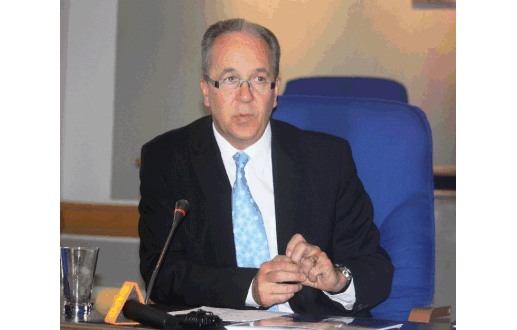
The new changes were announced by public enterprises minister Leon Jooste, who made this remark as part of a media briefing held in Windhoek.
Jooste as minister of public enterprises will now be responsible for supervising at least 18 strategic profit-driven state-owned businesses which are involved in the electricity, road construction, petroleum, information technology, telecommunications and transport industries.
He will now be responsible for, among others, board appointments of key state-owned entities, review their business plans, approve their annual budgets, determine how much boards and management will be paid, direct special investigations when necessary as well as deal with the restructuring of state entities.
Until now, state-owned entities reported to a minister whose portfolio matched their core business or activities.
Cabinet approved the new system, which Jooste calls a “hybrid governance model”, as opposed to the outgoing one dubbed “dual governance”.
The new hybrid governance model groups parastatals into three categories, namely commercial, non-commercial and financial institutions. Namibia has over 90 state-owned businesses.
A commercial public entity is described as “wholly or partly-owned or controlled by the state, guided by market principles, to provide a product or render a service in the best interest of the public, and have the potential to generate sustainable profit”.
Commercial state-owned entities which will report to the ministry of public enterprises include Air Namibia, Epangelo Mining, Henties Bay Waterfront, Lüderitz Waterfront, Meat Corporation of Namibia, Namibia Airports Company, Namibia Institute of Pathology and Namibia Ports Authority, Namibia Post and Telecommunication Holdings, Namibia Power Corporation, Namibia Wildlife Resorts, National Fishing Corporation, National Petroleum Corporation of Namibia and the Namibia Industrial Development Agency.
Other commercial parastals which will report to the public enterprises ministry are the Roads Authority, Roads Contractor Company, TransNamib Holdings and the Zambezi Waterfront.
“As to the commercial public enterprises, the Ministry of Public Enterprises will henceforth execute the full shareholder rights,” Jooste stated.
Performance management, key performance targets and remuneration incentives will be an integral part of how government-owned businesses are governed, he continued.
Ministers have over the years been seen as powerful and dominant, depending on what state-owned entities they controlled. Jooste has thus just been elevated, amid reports that several of his Cabinet colleagues have fought him hard to hold onto the businesses.
The latest development means ministers will focus more on forming policies, laws and the regulation of their respective sectors.
Jooste said the new governance model addresses the current problem where ministries become the “coach, referee and a player” since they are lawmakers, policymakers, regulators, implementers and controllers.
Non-commercial government entities are regulatory, developmental, research, advocacy, educational, media and service providers such as the Namibia Statistics Agency, the Namibia Press Agency and the University of Namibia.
Non-commercial state-owned entities that will remain under their respective line ministries include the Namibia Broadcasting Corporation, Namibia Agronomic Board, Meat Board, Karakul Board, Fisheries Observer Agency, Electricity Control Board, Diamond Board of Namibia, the Communications Regulatory Authority of Namibia and the Accreditation Board of Namibia.
Jooste said while accountable to the portfolio ministry, this category will still adhere to his ministry’s rules for good governance, salaries and reporting.
There is also the financial institutions’ category such as the Road Fund Administration and the Motor-Vehicle Accident Fund, which he said will be under the finance ministry. The minister said the government will not achieve all its plans if the Ministry of Public Enterprises remains a mere compliance and oversight body.
The latest model will be implemented during the course of the year, and the reforms will be done without escalating costs. Jooste listed the benefits of the new system as centralised monitoring, cost-effectiveness, consistent oversight, better communication, the removal of conflict of interest, reducing reporting layers and improving accountability.
“The Ministry of Public Enterprises has now consolidated its mandate, and this is a game changer. Changes will be made,” Jooste stressed.
In an age of information overload, Sunrise is The Namibian’s morning briefing, delivered at 6h00 from Monday to Friday. It offers a curated rundown of the most important stories from the past 24 hours – occasionally with a light, witty touch. It’s an essential way to stay informed. Subscribe and join our newsletter community.

The Namibian uses AI tools to assist with improved quality, accuracy and efficiency, while maintaining editorial oversight and journalistic integrity.
Stay informed with The Namibian – your source for credible journalism. Get in-depth reporting and opinions for
only N$85 a month. Invest in journalism, invest in democracy –
Subscribe Now!